
Last updated: October 8, 2026
Two ways to be covered
Korea's National Health Insurance Service (국민건강보험공단, NHIS) covers foreigners in one of three ways.
| Type | Who it is for | Who pays |
|---|---|---|
| Employee subscriber (직장가입자) | You work for a company in Korea | You and your employer split the premium 50/50 |
| Local subscriber (지역가입자) | Freelancers, students, spouses, people without a Korean employer | You pay the full bill yourself |
| Dependent (피부양자) | Family of an employee subscriber who meets the rules | No separate premium |
If you have a job with a Korean employer, the company usually handles enrollment. The rest of this guide matters most if you are a local subscriber.
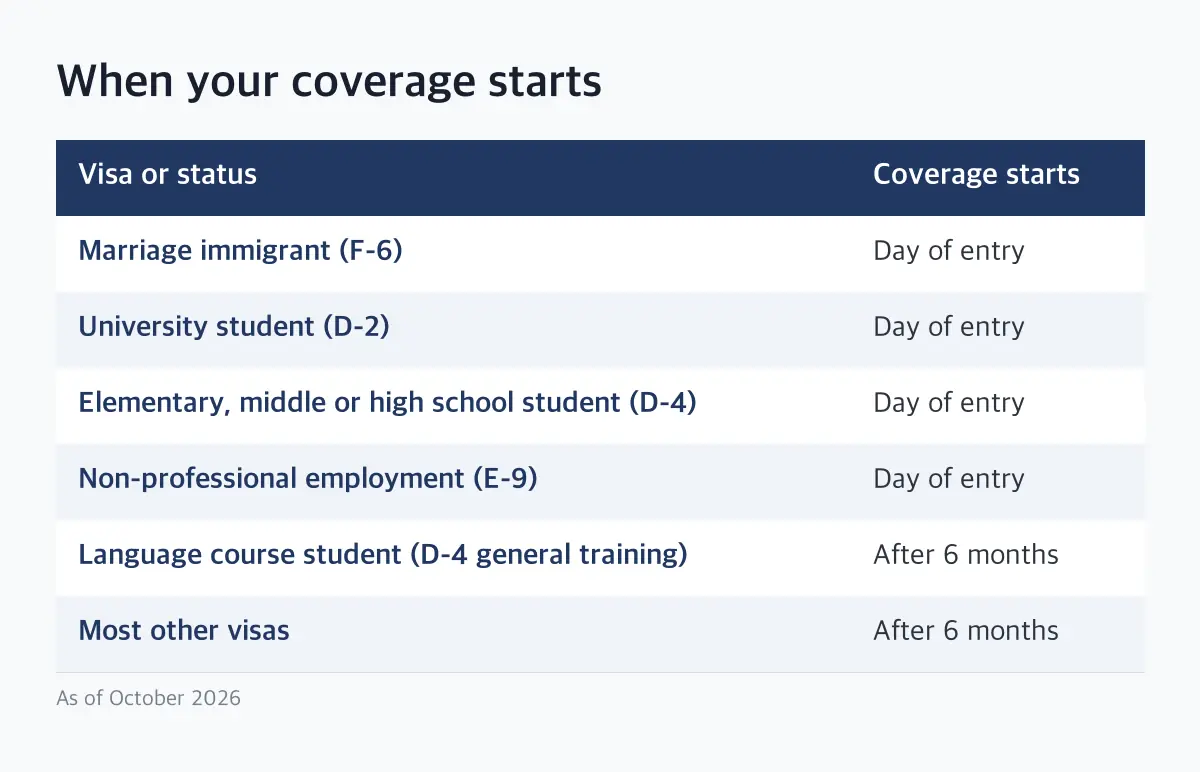
When your coverage starts
The general rule: you become a local subscriber on the day after you have lived in Korea for 6 months. Short trips abroad do not reset the clock. Up to 30 days abroad in total during those 6 months still counts as time in Korea.
Some visa types are covered from the day you enter Korea instead:
| Visa or status | Coverage starts |
|---|---|
| Marriage immigrant (F-6) | Day of entry |
| University student (D-2) | Day of entry |
| Elementary, middle or high school student (D-4) | Day of entry |
| Non-professional employment (E-9) | Day of entry |
| Language course student (D-4 general training) | After 6 months |
| Most other visas | After 6 months |
You do not need to apply. NHIS sends the bill once you qualify. Your coverage ends the day after your permitted stay ends, or when you leave Korea for a month or more.
How much you pay in 2026
Local subscribers
NHIS first calculates your premium the same way it does for Koreans, based on income and property. In 2026 the formula is:
- Income × 7.19%
- plus property points × ₩211.5 per point
- plus long-term care insurance on top
Then comes the rule that surprises most foreigners: if the result is lower than the average premium, you pay the average premium. For 2026, that floor is ₩158,630 a month:
| Part | 2026 amount |
|---|---|
| Health insurance | ₩140,210 |
| Long-term care insurance | ₩18,420 |
| Total minimum | ₩158,630 |
That is 3.80% more than in 2025. This floor does not apply to households whose head holds permanent residence (F-5) or marriage immigrant (F-6) status. Those households pay the normal calculated amount, even if it is lower.
Students
International students pay a reduced premium. For 2026, NHIS set the monthly student premium at ₩79,320. This applies to D-2 students and D-4 school students from the day of entry. Language course students on D-4 general training join after 6 months.
Employees
If you work for a Korean company, the 2026 health insurance rate is 7.19% of your monthly salary. You pay half and your employer pays half. For example, on a salary of ₩3,000,000, the total health premium is ₩215,700 and your share is ₩107,850. Long-term care insurance is added on top of that.
When and how to pay
- Due date: Foreign local subscribers pay in advance. The premium for a month is due by the 25th of the previous month. For example, your November premium is due by October 25.
- Payment methods: automatic bank transfer, virtual account, bank counter, ATM, or convenience store.
- If you miss it: If you still have not paid by the 25th of the following month, NHIS stops covering your medical bills from the month after that. You pay full price at the hospital until you catch up.
The easiest fix is to set up automatic payment so you never miss the 25th.
Show this: 건강보험료 자동이체 신청하러 왔어요. (I'm here to set up automatic payment for my health insurance.)
Unpaid premiums can shorten your visa extension
Korea's immigration service checks unpaid taxes and health insurance premiums when you apply to extend your stay. The Ministry of Justice describes the rule like this:
| Your situation | Visa extension |
|---|---|
| You pay all unpaid premiums | Normal extension, usually 2 to 5 years depending on status |
| You do not pay | Limited extension, in principle 6 months or less |
This check runs at 38 immigration offices nationwide. If you have unpaid premiums, pay them before your immigration appointment.
What the insurance covers
Once enrolled, you get the same benefits as Korean citizens. You pay part of the bill yourself at the hospital or pharmacy, and NHIS pays the rest. As a rough guide from NHIS information for students, insurance covers about 40 to 70% of outpatient costs and about 80% of inpatient costs. Some treatments, like many cosmetic procedures, are not covered.
FAQ
Does health insurance cover tourists in Korea? No. Short-term visitors are not enrolled in national health insurance. Buy travel insurance before your trip.
Can I stay on my private insurance instead? In general, no. Once you qualify, enrollment in NHIS is automatic for local subscribers. Students should ask their school, because some schools share separate guidance.
What number do I call? The NHIS call center is 1577-1000.
Sources
- NHIS notice: 2026 premium rates and the foreign local subscriber average premium (Korean)
- NHIS: Health insurance rules for long-term resident foreigners and overseas Koreans (Korean)
- Ministry of Justice: Checking unpaid taxes and health insurance before visa extension (Korean)
- Sungshin Women's University: 2026 NHIS premium for international students (citing NHIS)
This guide is general information, not legal advice. Rules change, so confirm with HiKorea or the 1345 Immigration Contact Center before you apply.
Related guides
 How to Get ARC in Korea (Residence Card): Book Within 90 Days, Pay ₩35,000Staying in Korea longer than 90 days? You need a Residence Card, still called an ARC. Here are the documents, the…