
Last updated: October 8, 2026
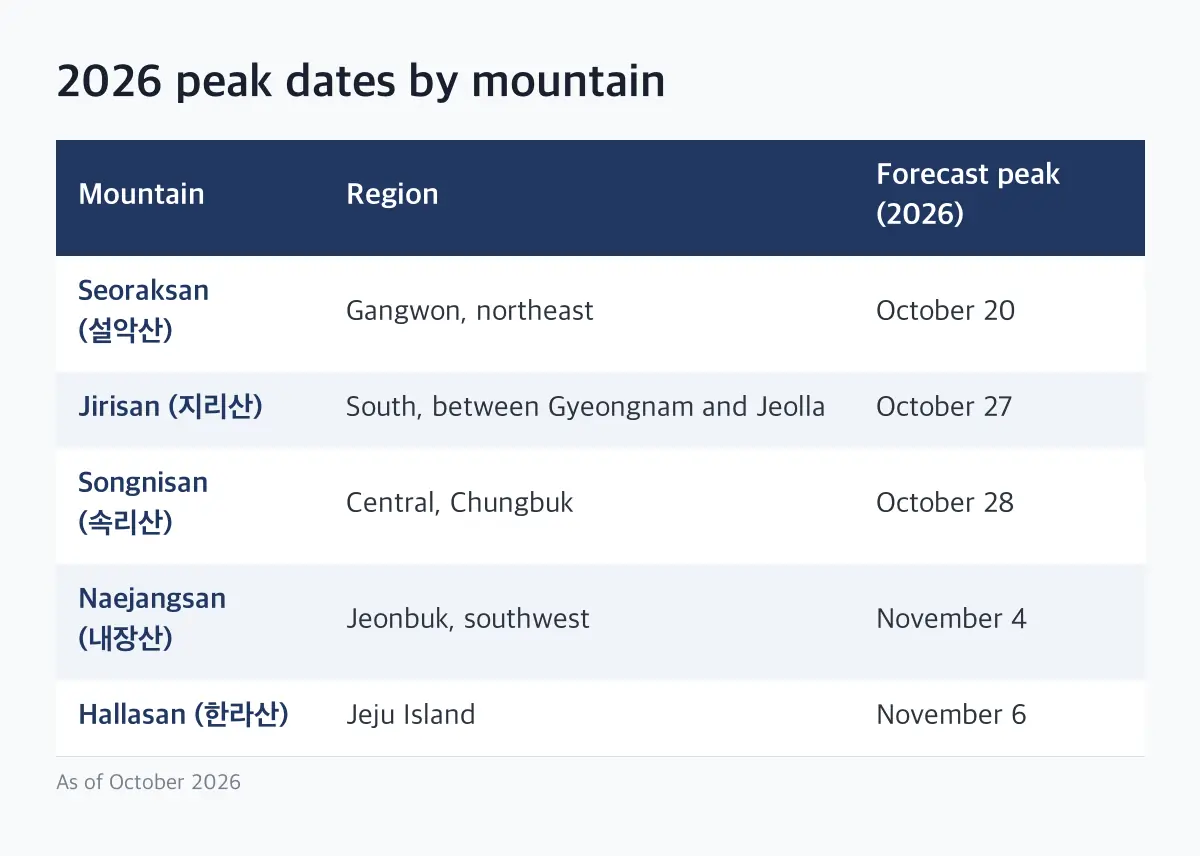
2026 peak dates by mountain
The Korea Forest Service (산림청) published its 2026 foliage peak prediction map on September 22. The color starts in the mountains of northern Gangwon in early October and moves south.
| Mountain | Region | Forecast peak (2026) |
|---|---|---|
| Seoraksan (설악산) | Gangwon, northeast | October 20 |
| Jirisan (지리산) | South, between Gyeongnam and Jeolla | October 27 |
| Songnisan (속리산) | Central, Chungbuk | October 28 |
| Naejangsan (내장산) | Jeonbuk, southwest | November 4 |
| Hallasan (한라산) | Jeju Island | November 6 |
The forecast also gives dates by tree type, which is more useful if you are staying in a city:
| Tree type | Where you see it | Forecast peak (2026) |
|---|---|---|
| Ginkgo (은행나무) | City streets, palaces, campuses | October 30 |
| Maple (단풍나무) | Mountain valleys, temples | October 31 |
| Oak (참나무) | Mountain slopes | October 31 |
The Forest Service says this year's peak is about 0.8 days later than the average of the last five years. In other words, 2026 is a normal year. Weather can still move the real dates by a few days in either direction.
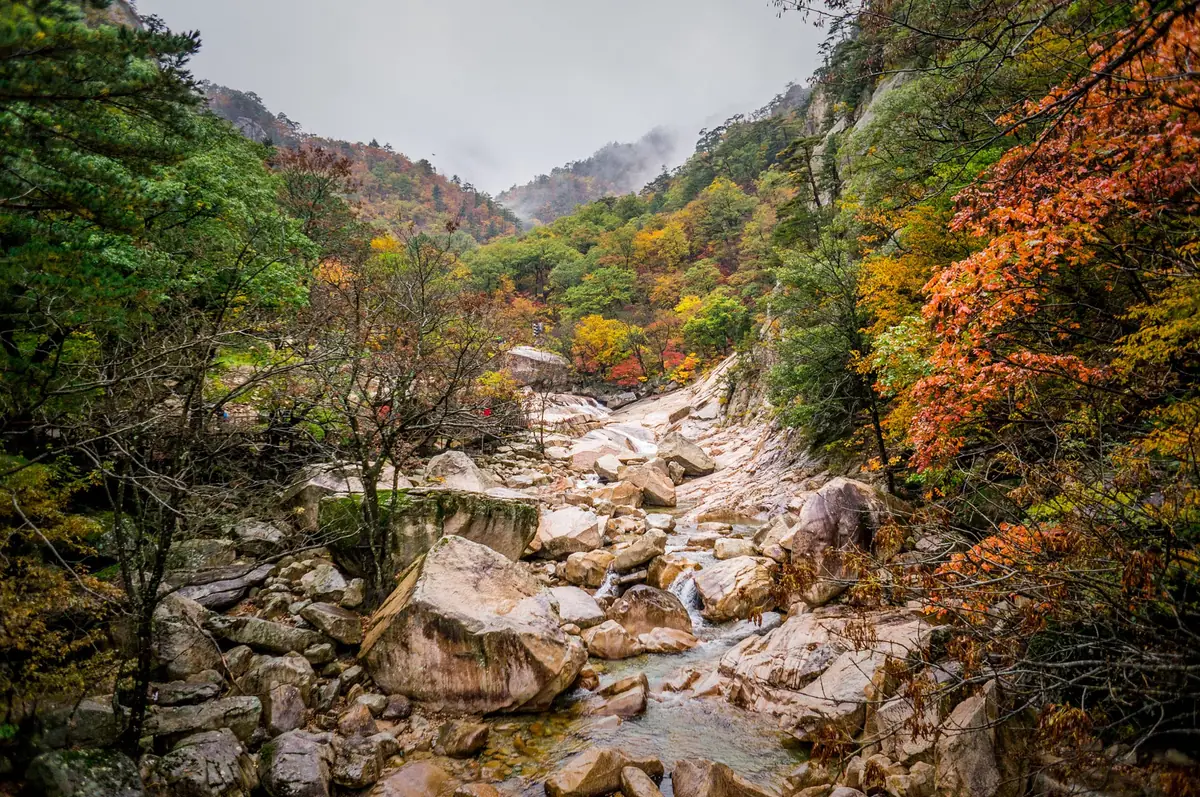
Where the color is right now
The season has already started in the far north.
- On September 14, citizen observers recorded the first color of 2026 at Jeombongsan (점봉산) in Gangwon.
- On September 28, the Korea Meteorological Administration (기상청) announced the first foliage at Seoraksan. That is the same date as the normal year and 4 days earlier than 2025.
So if you are reading this in early or mid October, the north is turning now and most of the country is still green.
Why other forecasts show different dates
You may see Seoraksan listed for October 16, October 20 or October 25 on different sites. This is not always a mistake. Korea has two official agencies that track foliage, and they define "peak" in different ways.
| Korea Forest Service (산림청) | Korea Meteorological Administration (기상청) | |
|---|---|---|
| What it publishes | A forecast map before the season | Actual observations during the season |
| "First foliage" means | — | About 20% of the mountain has changed, starting from the top |
| "Peak" means | About 50% of the leaves on observed trees have changed | About 80% of the mountain has changed |
| Seoraksan peak | October 20, 2026 (forecast) | Normal year October 17; 2025 was October 24 |
Some travel sites also use private weather company forecasts, which add a third set of dates. Use the Forest Service dates to plan your trip. Then check the live observations (next section) a few days before you go.
How to check live foliage conditions
These official tools are in Korean, but you can use them with a translation app.
- KMA foliage map (21 mountains). Go to weather.go.kr and open the foliage menu (현재날씨 > 봄꽃·단풍 > 유명산 단풍현황). It shows photos taken before the color, at first foliage and at peak for 21 famous mountains. It runs from September 21 to November 27, 2026.
- Gangwon foliage service. The Gangwon office of KMA runs a page for Seoraksan, Odaesan, Chiaksan and Taebaeksan with trail conditions, weather and live video: kma.go.kr/gangwon/maple.
- Address search for any place. The Korea National Arboretum lets you type a road address or building name and see the expected peak date for that spot. Open knpn.nature.go.kr and go to the forecast menu (관측기록 > 계절예측).
Show this: 여기 단풍 지금 절정인가요? (Is the foliage here at its peak now?)
Where to go based on your travel dates
Pick the region that matches the week you are free. These are planning guides based on the 2026 forecast, not guarantees.
| If you can travel… | Go here | Why |
|---|---|---|
| Mid October | Seoraksan and other Gangwon mountains | Forecast peak October 20 |
| Late October | Jirisan, Songnisan | Forecast peaks October 27 and 28 |
| Around October 30 – early November | City ginkgo streets and palaces, any region | Ginkgo peak October 30; maple and oak October 31 |
| Early November | Naejangsan, Hallasan | Forecast peaks November 4 and 6 |
If you only have a weekend in Seoul, the ginkgo date matters more than the mountain dates. City trees are easy to reach by subway and do not need a hiking plan.
Tips before you go
- Go on a weekday if you can. Famous foliage spots are busiest on weekends at peak time, and roads into national parks get slow.
- Start early on mountain days. Daylight gets shorter through November, and you should finish a hike before dark.
- Check the live map a few days before. A warm or rainy week can shift the peak, and strong wind can strip leaves quickly.
- Bring layers. Mountain tops are much colder than the city in late October and November.
FAQ
What month is autumn in South Korea? Autumn runs roughly from September to November. For leaves, the best window in 2026 is mid October in the north to early November in the south and on Jeju.
What is the best time to visit Korea for autumn leaves? If you want one week that works for most of the country, aim for the last days of October. That is when the forecast puts ginkgo, maple and oak at peak nationwide.
Sources
- Korea Meteorological Administration press release: first foliage at Seoraksan (Sept 28, 2026, Korean)
- Korea Forest Service 2026 foliage peak map, reported by SBS Biz (Korean)
- Korea Forest Service 2026 foliage peak map, reported by Dongpo News (Korean)
- Korea Forest Service 2026 foliage peak map with Jirisan date, reported by Ardent News (Korean)
Forecast dates are predictions and can change with the weather. Check the live KMA foliage map before you travel.