
Last updated: October 22, 2026
The rule in the law
The rule comes from the Youth Protection Act (청소년 보호법). Article 2 defines a "youth" as a person under 19, but it excludes anyone who has already reached January 1 of the year they turn 19.
Article 28 then bans anyone from selling, lending or giving alcohol and tobacco to a youth. That includes sales through vending machines and unstaffed kiosks.
So your exact birthday does not matter. Only the year does.
| Year you are buying | You can buy if you were born in |
|---|---|
| 2026 | 2007 or earlier |
| 2027 | 2008 or earlier |
Example: you were born on December 31, 2007. Your international age on January 1, 2026 is still 18, but you are no longer a "youth" under the law. You can buy beer at a convenience store that day.
The same age applies to cigarettes. Both alcohol (주류) and tobacco (담배) are listed as "youth-harmful drugs" in Article 2. The ministry in charge of youth protection (성평등가족부) also lists e-cigarette devices among items that cannot go to youths.
Why the 2023 age change did not affect drinking
On June 28, 2023, Korea started counting age the international way in laws and official papers. Our guide to Korean age vs international age explains that change.
The new rule sits in Article 7-2 of the Framework Act on Public Administration (행정기본법). It says administrative age is international age unless another law has a special rule. The Youth Protection Act has its own special rule, the year-of-birth test above, so it kept working the old way.
The Seoul Metropolitan Government said this directly when the change started. It listed alcohol and tobacco purchase age as one of the areas where international age does not apply. It also explained that each law using year-of-birth age would need its own amendment.
As of October 2026, Article 2 of the Youth Protection Act still uses the January 1 test. Nothing has changed for drinking.
ID checks: what to carry
The law puts the duty on the seller. Under Article 28, anyone who sells alcohol or tobacco must check the buyer's age and identity. Since April 2025, Article 49-2 also says a person asked to show ID for an age check should cooperate unless there is a special reason.
The law does not give one fixed list of accepted IDs. It names the resident registration card (and its mobile version) for Korean citizens, then "any other document that can confirm age." In practice, the shop decides what it accepts.
| ID | Who has it | Notes |
|---|---|---|
| Passport | Every tourist | Shows your birth date. The safest choice. |
| Residence Card (외국인등록증) | Registered foreign residents | Korean government ID with your birth date. |
| Mobile Residence Card (모바일외국인등록증) | Registered residents who set it up | The Immigration Act gives it the same effect as the plastic card. |
| Foreign driver's license | Some visitors | Not named anywhere in Korean law. Some shops may take it, some may not. Do not rely on it. |
Two more points for foreigners:
- The Immigration Act (출입국관리법), Article 27, requires foreigners aged 17 and older to carry their passport or Residence Card at all times anyway.
- If you live here and want to go out without the plastic card, set up the Mobile Residence Card first.
Show this: 여권으로 나이 확인해 주세요.
Bars, clubs and convenience stores
Different places follow different rules. The type of business license matters, not the sign outside.
| Place | Can under-age people enter? | Can they be served alcohol? |
|---|---|---|
| Nightclubs licensed as entertainment bars (유흥주점), and danran bars (단란주점) | No, not even with a parent | No |
| Pubs that mainly sell alcohol (소주방·호프 style) | Yes | No |
| Restaurants | Yes | No |
| Convenience stores | Yes | No sale of alcohol or cigarettes |
At entry-banned places, the owner and staff must check the age of everyone who comes in (Article 29). They may also refuse entry to anyone who will not show ID. So expect an ID check at the door of a club, even if you clearly look older than 19.
Shops that sell alcohol or cigarettes must also post a sign saying they do not sell to youths.
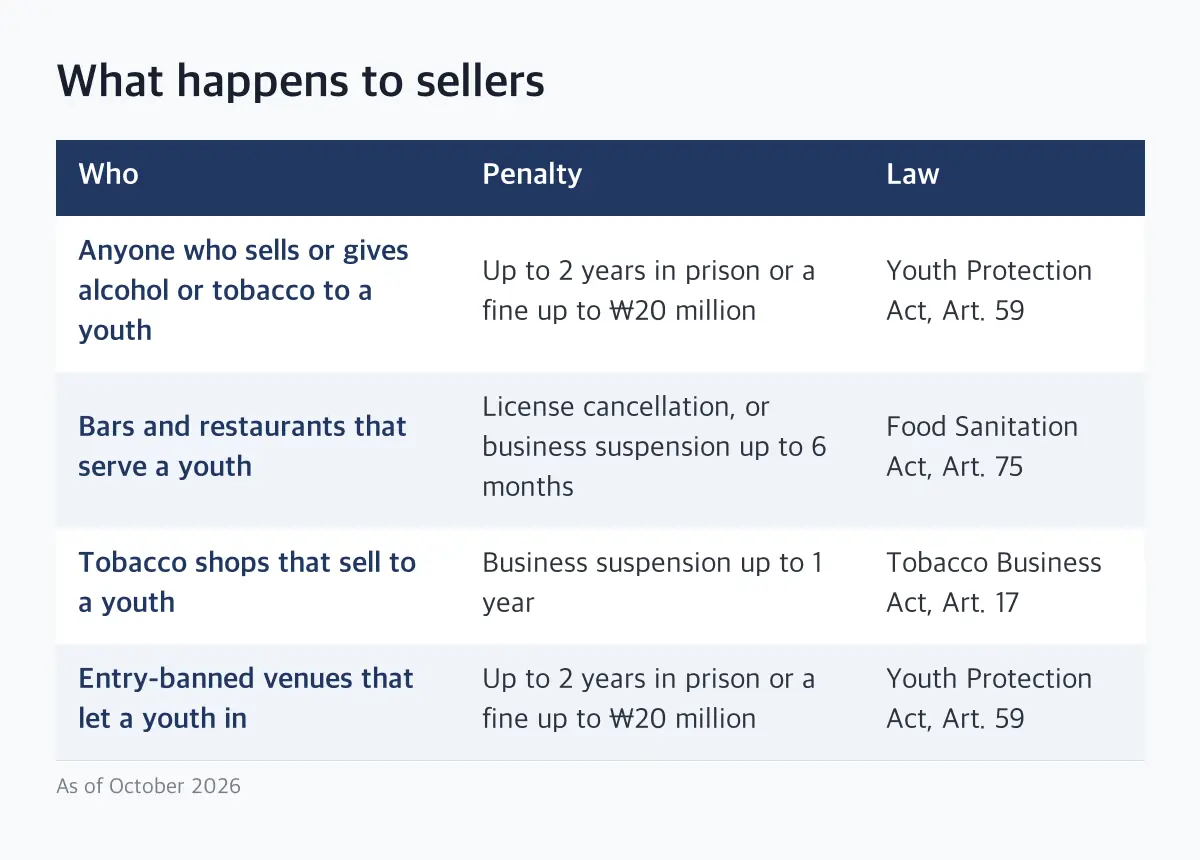
What happens to sellers
Korea punishes the seller, not the young buyer, under these rules.
| Who | Penalty | Law |
|---|---|---|
| Anyone who sells or gives alcohol or tobacco to a youth | Up to 2 years in prison or a fine up to ₩20 million | Youth Protection Act, Art. 59 |
| Bars and restaurants that serve a youth | License cancellation, or business suspension up to 6 months | Food Sanitation Act, Art. 75 |
| Tobacco shops that sell to a youth | Business suspension up to 1 year | Tobacco Business Act, Art. 17 |
| Entry-banned venues that let a youth in | Up to 2 years in prison or a fine up to ₩20 million | Youth Protection Act, Art. 59 |
The fake ID shield for sellers
What if a teenager fooled the staff with a fake ID? The law now gives the business a way out.
The Food Sanitation Act lets officials waive the business penalty when a youth used a forged, altered or borrowed ID, or used violence or threats to stop the check. A decree amendment on March 29, 2024 made this clearer. Officials must waive the penalty when CCTV footage, statements or other evidence show that the owner was fooled. The owner no longer has to wait for a police or prosecutor decision first.
There are limits:
- The waiver covers the business penalty (such as a suspension). It does not cancel a criminal case on its own.
- If a court later finds the owner guilty (other than a suspended sentence), the waiver does not apply.
- Tobacco shops have a similar waiver under the Tobacco Business Act.
For you, the practical result is simple. Staff are not being rude when they ask for ID. Their business license is on the line.
Drinking in public places
There is no nationwide ban on drinking in public in Korea. Instead, the rules are local.
But the National Health Promotion Act (국민건강증진법), Article 8-4, lets each city or county name alcohol-free zones (금주구역) by local ordinance. These are places where many people gather or pass through. The local government must put up signs.
Drinking inside a marked alcohol-free zone can bring a fine of up to ₩100,000 (Article 34). Rules differ by city, so look for the sign, especially in parks and near children's facilities.
Drunk driving: the 0.03% limit
Korea's limit is a blood alcohol level of 0.03%, set in Article 44 of the Road Traffic Act (도로교통법). A small amount of alcohol can be enough to reach it, so the safe plan is not to drive at all after drinking.
The ban covers cars, motorcycles, electric kick scooters and even bicycles.
| Blood alcohol (first offense, car or scooter) | Penalty under Art. 148-2 |
|---|---|
| 0.03% to under 0.08% | Up to 1 year in prison or up to ₩5 million |
| 0.08% to under 0.2% | 1–2 years in prison or ₩5–10 million |
| 0.2% or more | 2–5 years in prison or ₩10–20 million |
Refusing a police breath test is punished at 1–5 years in prison or ₩5–20 million. Repeat offenses within 10 years carry heavier ranges.
If you drink, take the subway, a taxi or a designated driver service (대리운전).
FAQ
Is the drinking age in Korea 18?
No. It is 19, counted by birth year. Some people who are 18 by international age can buy, but only after January 1 of the year they turn 19.
Is the drinking age in Korea 20 in Korean age?
Under the old Korean age system, you turned 20 on January 1 of the year you turn 19 internationally. So "20 in Korean age" and the legal rule land on the same day. Since Korean age is no longer used officially, the clearer way to say it is the birth-year rule above.
Do foreigners and tourists follow the same rule?
Yes. The Youth Protection Act applies to everyone in Korea. There is no separate age for visitors.
Sources
- Youth Protection Act (청소년 보호법), Articles 2, 28, 29, 49-2, 59 — Korea Law Information Center
- Enforcement Decree of the Youth Protection Act — Korea Law Information Center
- Framework Act on Public Administration (행정기본법), Article 7-2 — Korea Law Information Center
- Food Sanitation Act (식품위생법), Articles 44 and 75 — Korea Law Information Center
- Enforcement Decree of the Food Sanitation Act, Article 52 — Korea Law Information Center
- Tobacco Business Act (담배사업법), Article 17 — Korea Law Information Center
- National Health Promotion Act (국민건강증진법), Articles 8-4 and 34 — Korea Law Information Center
- Road Traffic Act (도로교통법), Articles 44 and 148-2 — Korea Law Information Center
- Immigration Act (출입국관리법), Articles 27 and 33 — Korea Law Information Center
- Ministry of Gender Equality (성평등가족부): youth-harmful drugs and items (Korean)
- Seoul Metropolitan Government: what changes with international age (Korean)
This guide is general information, not legal advice. Laws and local rules change, so confirm with the venue, the local government or the police (112) if you are unsure.
Related guides
 Korean Age vs International Age: What Changed in 2023Korean age made everyone one or two years older. Since June 28, 2023, official Korea counts age the international…
 Halloween in Korea 2026: Koreans Celebrate, With Crowd Controls Oct 23–Nov 1Koreans do celebrate Halloween, mostly in nightlife districts and theme parks. Since the 2022 Itaewon crowd crush,…
 Tax Refund in Korea for Tourists: Limits, Steps and Airport CountersYou can claim back Korean VAT on shopping if you spend KRW 15,000 or more per receipt and leave within 3 months.…