
Last updated: November 28, 2026
This guide explains saju as a part of Korean culture. Whether it predicts anything is up to you. Plenty of Koreans who go every January say they do not take it literally.
Saju cafe prices at a glance
| Where and when | Length | Price | Language |
|---|---|---|---|
| Hongdae saju shops, June 2025 (study-abroad student's account) | One session | ₩30,000 at all five shops she asked | Many shops offered English; hers did not, so a friend translated |
| Hongdae saju cafe, March 2025 (Korea Herald) | 30 min | ₩50,000 | Japanese interpreter on site |
| Funnysaju Hongdae Branch 2, English master (Creatrip listing) | 40 min | ₩83,000 | Fluent English |
| Same listing, Premium with compatibility | 50 min | ₩100,000, 1 drink included | Fluent English |
| Same listing, 2 people | 90 min | ₩166,000 (listed down from ₩200,000) | Fluent English |
Prices are set by each shop, so the table shows what people actually paid or what a shop listed, with the date. The English-master prices were checked on November 28, 2026, when the listing showed "Reservations are temporarily unavailable."
What saju is
Saju (사주) means "four pillars." The four pillars are your birth year, month, day and hour. Each pillar is written with two Chinese characters, a heavenly stem and an earthly branch, so the full chart has eight characters. That is why the longer name is saju palja (사주팔자), "four pillars, eight characters." In China the same system is called bazi.
The characters come from the 60-year cycle that East Asia used as a calendar. The cycle last restarted in 1984, the year gapja, and the next gapja year is 2044.
A reader looks at how wood, fire, earth, metal and water show up in your chart. The day you were born matters most, because readers treat that day's character as "you" and read the rest in relation to it. From there they talk about personality, work, money, love and good or hard years ahead.
Saju vs Tojeong Bigyeol: two New Year traditions
You will hear both words in December and January. They are not the same thing.
| Saju (사주) | Tojeong Bigyeol (토정비결) | |
|---|---|---|
| What it reads | Your whole life, plus the coming year | Only the coming year, month by month |
| Birth details used | Year, month, day and hour | Year, month and day only, no birth hour |
| Method | Eight characters, five elements | Three trigrams from numbers, 144 possible results |
| Format | A conversation with a reader | Short verses for each of the 12 months |
| Where people get it | Saju cafes, shops, apps | Books, websites, apps, some readers |
The Encyclopedia of Korean Culture (한국민족문화대백과사전) says Tojeong Bigyeol builds an upper, middle and lower trigram from your age, birth month and birth day, mixed with the numbers for the current year. It uses 144 trigram results and explains the year from the first to the twelfth lunar month in short three-line verses. It is about luck and bad luck, not self-improvement.
The book is credited to Yi Ji-ham, a 16th-century scholar whose pen name was Tojeong. The encyclopedia says it is not certain he wrote it. Older records of New Year customs describe a different fortune method, so it only became a New Year habit after King Jeongjo's reign, in the late Joseon period. A collector who studied about 60 versions told the weekly Kyunghyang that the month-by-month verses were added after 1945.
The practical point: if you do not know your birth hour, Tojeong Bigyeol still works, because it never uses the hour.
What happens in a saju reading
A typical session goes like this:
- You give your birth details. Year, month, day and, if you know it, the hour. The reader asks whether the date is solar or lunar.
- The reader builds your chart. Some use a thick reference book of tables, others a tablet or computer.
- You hear a general reading. Personality, strengths and the overall flow of your life.
- You ask questions. Career, relationships, marriage and money are the most common topics. Readers told the Korea Herald that foreign clients ask about the same things Koreans do.
- Extras, depending on the shop. Palm reading or a couples' compatibility reading.
One student in Hongdae got a palm reading in the same ₩30,000 session, and the English-master listing above sells compatibility as its Premium option.
Sessions in the 2025 reports ran 30 minutes. A Korean news report from January 2024 put a typical New Year session at 30 to 40 minutes per person.
What to bring
- Your exact birth time. Each hour branch covers a two-hour window, so a guess can change the chart. If you do not know it, say so.
- Whether your birthday is solar or lunar. Almost everyone from outside East Asia has a solar (Gregorian) birthday. Say it clearly, because some Korean families still use lunar birthdays.
- Your birth date, not your age. Readers work from the date, so you do not need to work out your Korean age.
- Two or three real questions. A 30-minute session goes fast.
- Cash or a card. Ask how to pay before you sit down if the price is not posted.
Show this: 양력 1995년 3월 14일 오후 2시 30분에 태어났어요.
Show this: 태어난 시간은 몰라요.
How to get a saju reading in English
Not every reader speaks English, and the terms are technical. Foreign visitors get around this in four ways.
| Option | How it works | What to expect |
|---|---|---|
| Book through a travel platform | Creatrip and Korea Travel Easy list saju sessions for foreign visitors | Higher price, booked time, English confirmed |
| Walk in where signs are in English | Cafes in Myeong-dong and Hongdae post signs in English, Japanese and Chinese | Some have a fluent reader or a free interpreter, smaller shops use translation apps |
| Bring a Korean-speaking friend | Your friend translates the whole session | Lowest price, depends on your friend's patience |
| Use a website or app | Enter your birth details and read the result | Many are free, but Koreans themselves often treat them as just for fun |
The Creatrip listing for Funnysaju Hongdae Branch 2 (24 Wausan-ro 21-gil, Mapo-gu, 2nd floor) describes a master with 10 years of experience who explains in English. It runs Wednesday to Saturday, 1 p.m. to 10 p.m., takes up to 2 guests, must be booked at least 5 days ahead, and cannot be cancelled or refunded once confirmed.
A booking platform official told the Korea Herald in 2025 that most of its saju reservations came from travelers from the US, Singapore, Canada and Australia. The state-run Seoul Tourism Organization officially recognized saju cafes as a tourism product in 2024 and started promoting them.
Before you start, ask:
Show this: 영어로 상담 가능한가요?
Show this: 가격이 얼마예요? 몇 분 동안 봐 주세요?
Where saju cafes cluster in Seoul
- Hongdae (홍대): the area foreign visitors and the 2025 English-language reports mention most. One street near Hongik University has a saju or tarot sign on almost every other door.
- Myeong-dong (명동): cafes with signs in several languages aimed at tourists.
- Apgujeong Rodeo Street (압구정로데오거리): a 2024 report counted 5 saju and tarot shops within less than 100 meters of one alley.
- Sinsa-dong (신사동): lit saju cafe signs along the side streets, shown in the same 2024 report.
Why everyone goes in December and January
Getting your fortune for the year, called sinnyeon unse (신년운세), is one of the most common New Year customs in Korea. The season runs from January 1 to Seollal, the Lunar New Year, which falls on February 7, 2027. Tojeong Bigyeol reads the year by lunar months, so some people wait for the lunar year to turn.
A Newsis report from January 9, 2024 gives a sense of the rush:
- At one saju shop in Seongbuk-dong, 6 people were waiting at 9 a.m., an hour before opening. That meant a wait of 3 to 4 hours.
- The shop said waits were over 3 hours even on weekdays after the New Year started.
- A tarot shop owner in Apgujeong said daily customers went from about 100 to over 150.
People quoted in that report said a New Year reading helps them plan the year or calm their nerves. A psychology professor added that a good reading can boost confidence, but warned against giving up on things or making big moves only because of a reading.
If you want a walk-in reading without the wait, go in early December or on a weekday afternoon. If you are already in Seoul for the Bosingak bell on New Year's Eve or out for the first sunrise of 2027, a reading in early January fits the season, but expect queues at well-known readers.
For dates of the long weekends, see the list of Korean public holidays.
Show this: 2027년 신년운세 보고 싶어요.
Born in the Southern Hemisphere?
Saju was built on the seasons of northern China, and the month pillar follows those seasons.
A 2025 Korea Times report found readers in Seoul do not agree on how to read charts for people born in places like Brazil or Australia, where the seasons are reversed. Some think only the month should be adjusted, others make no change. The owner of one Hongdae saju cafe said there is no settled answer. If you were born south of the equator, mention it and ask how the reader handles it.
How Koreans see it
Fortune telling is a big business in Korea. Market research firm InnoForest put it at about ₩1.4 trillion (US$970 million) in 2024, and said the real number is likely higher because many sessions are paid in cash.
Most Koreans treat a reading somewhere between a game and a talk with an advisor. People go before marriage, exams or a job change, and many go once a year in January. A 2015 Korea Times column noted that when a TV show tested famous fortune tellers, most failed a second check visit, and people kept going anyway. Take what is useful and leave the rest.
Sources
- Korea Herald: While in Korea, how about fortunetelling? (March 4, 2025)
- CIEE: I Got a Saju Reading So You Don't Have To (June 2, 2025)
- Creatrip: Korean Fortune-telling (Saju) Cafe Tour, Hongdae
- Korea Times: Brazilian's destiny seen through Korea's fortunetelling lens (February 2025)
- Korea Times: How to Set Saju, 60-Year Cycle
- Korea Times: Finding an accurate fortuneteller (2015)
- Encyclopedia of Korean Culture: Tojeong Bigyeol (토정비결, Korean)
- Weekly Kyunghyang: Tojeong Bigyeol's author is not Tojeong (Korean)
- Newsis: New Year fortune boom, January 10, 2024 (Korean)
Prices and hours change by shop and season. This guide reflects reports and listings dated above.
Related guides
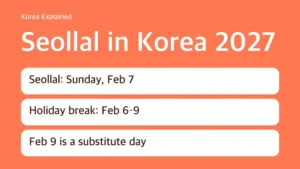 Seollal in Korea 2027 (Lunar New Year): Feb 7, Off Feb 6–9Seollal (Korean Lunar New Year) 2027 is on Sunday, February 7, and the break runs February 6–9. Here is what…
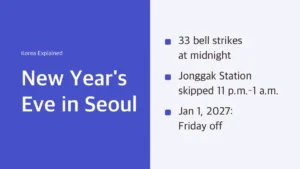 New Year's Eve in Seoul: Bosingak Bell at Midnight, Jan 1 Is OffWhat actually happens on New Year's Eve in Seoul: the 33 midnight bell strikes at Bosingak, which subway stations to…
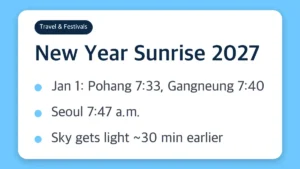 New Year Sunrise Korea 2027: 7:33 a.m. in Pohang, 7:47 in SeoulOn January 1, 2027, the sun rises at 7:33 a.m. in Pohang, 7:40 a.m. in Gangneung and 7:47 a.m. in Seoul, per the…