
Last updated: October 23, 2026
The short version
| Question | Answer |
|---|---|
| Who can use a Korean ER? | Everyone in Korea, including foreigners, has the right to emergency care without discrimination |
| Number to call | 119 (ambulance, fire, and "which ER is open?") |
| Is 1339 an ER line? | No. 1339 is the disease call center of the KDCA |
| Mild case at a big ER | 90% of the ER bill is yours (KTAS levels 4 and 5) |
| Not an emergency at any ER | You pay the whole emergency care management fee yourself |
| 119 ambulance | Free, any distance |
| What to bring | Passport or Residence Card, health insurance details, a payment card |
The ER levels in Korea
Korean law designates hospitals as emergency medical institutions (응급의료기관) at different levels. The name on the sign tells you what kind of ER you are walking into, and it also changes your bill.
| Type | Who designates it | What it is for |
|---|---|---|
| Regional Emergency Medical Center (권역응급의료센터) | Minister of Health and Welfare | Severe emergencies, at a tertiary or general hospital |
| Specialized Emergency Medical Center (전문응급의료센터) | Minister of Health and Welfare | Children, burns, poisoning |
| Regional Trauma Center (권역외상센터) | Minister of Health and Welfare | Serious injuries |
| Local Emergency Medical Center (지역응급의료센터) | City or provincial governor | Emergency care at a general hospital |
| Local Emergency Medical Institution (지역응급의료기관) | Mayor, county head or district head | Emergency care at a general hospital, designated locally |
All of them must be able to see emergency patients 24 hours a day. A hospital that is not designated is not allowed to call itself one of these centers.
Regional centers are where the most serious cases go, so they are also where the government pushes mild cases away with higher charges.
How triage decides what you pay
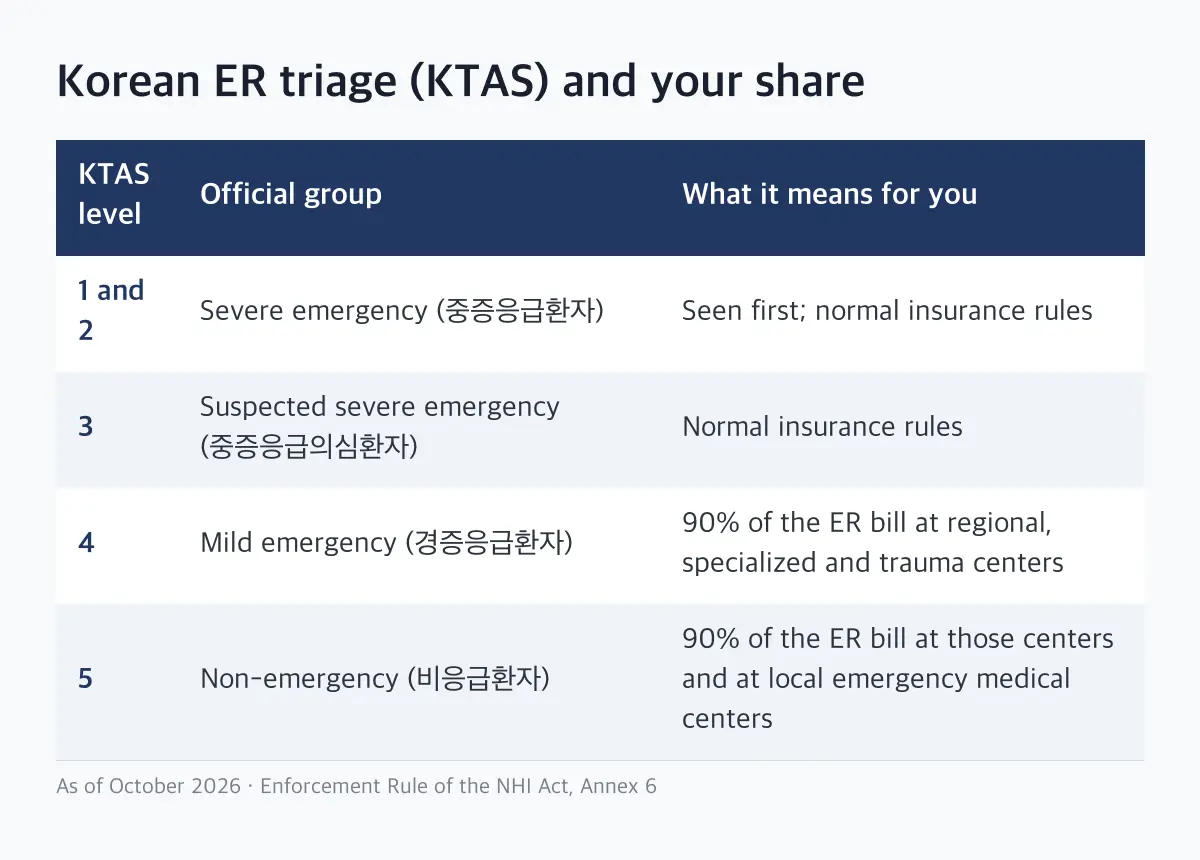
When you arrive, a doctor, nurse or level-1 paramedic sorts you with the Korean Triage and Acuity Scale (KTAS, 한국 응급환자 중증도 분류기준) before you go inside the treatment area.
| KTAS level | Official group | What it means for you |
|---|---|---|
| 1 and 2 | Severe emergency (중증응급환자) | Seen first; normal insurance rules |
| 3 | Suspected severe emergency (중증응급의심환자) | Normal insurance rules |
| 4 | Mild emergency (경증응급환자) | 90% of the ER bill at regional, specialized and trauma centers |
| 5 | Non-emergency (비응급환자) | 90% of the ER bill at those centers and at local emergency medical centers |
The 90% rule comes from the National Health Insurance enforcement rule, amended on September 12, 2024. It covers the ER treatment fees, but not the consultation fee of a tertiary hospital (상급종합병원).
Two things follow from the table:
- A local emergency medical institution (지역응급의료기관) is not on the 90% list at all.
- At a local emergency medical center, only level 5 triggers 90%.
If the doctor decides you are not an emergency patient, the hospital may also refer you to a regular clinic or another hospital instead of treating you in the ER. They cannot refuse or stop care for a real emergency without a valid reason.
What you pay with National Health Insurance
If you are enrolled in Korea's National Health Insurance (국민건강보험), the normal patient share for outpatient care is set by law:
| Where | Your share of covered costs |
|---|---|
| Tertiary hospital (상급종합병원) | 60% of covered costs, plus the full consultation fee |
| General hospital (종합병원) in a city area | 50% |
| General hospital in a town or township (읍·면) | 45% |
| Hospital admission (입원) | 20% of covered costs, plus 50% of meals |
The 90% rule replaces these shares for mild and non-urgent ER visits at the centers above. Items that insurance does not cover at all are charged on top.
There is one more charge to know. Every designated ER bills an emergency care management fee (응급의료관리료) on your first day. If you are not an emergency patient under the law, you pay that fee in full yourself, at any level of ER.
After you get home, you can ask the Health Insurance Review and Assessment Service (HIRA, 건강보험심사평가원) to check whether the hospital charged you correctly. On the HIRA website, look for the bill check menu (진료비 확인).
Without Korean health insurance
Tourists and newly arrived residents who are not yet enrolled are treated the same way in the ER, but insurance does not pay any share. The hospital bills you as an uninsured patient, so the whole amount is yours.
Practical steps:
- Call your travel insurer as soon as you can. Many policies have a 24-hour assistance line and may ask you to call before or soon after treatment.
- Pay with a card if you can, and keep every receipt.
- Ask for documents in English if the hospital offers them, or in Korean if not. Insurers usually want the receipt (진료비 영수증), the itemized bill (진료비 세부내역서) and a medical certificate or doctor's note (진단서 or 소견서). Hospitals may charge for certificates.
Show this: 여행자보험 청구용으로 진료비 영수증, 진료비 세부내역서, 진단서를 영어로 받을 수 있을까요?
If you cannot pay right away
Korea has an emergency medical cost advance payment system (응급의료비 대지급제도). If an emergency patient cannot pay, the hospital can claim the unpaid patient share from HIRA. HIRA then collects it from you, your spouse or close family later, and you can ask to repay in installments over up to 48 months. It is a loan, not a free pass. HIRA answers questions on 1644-2000.
What to bring to the ER
Since May 2024, hospitals must check your identity and insurance status with an ID before they apply National Health Insurance. Accepted IDs include:
- Passport
- Residence Card (외국인등록증), including electronic versions allowed by law
- Driver's license or another government photo ID with your registration number
The rule makes an exception for emergency patients when stopping to check an ID could put your life or body at risk. So in a true emergency, go first and sort out the paperwork later.
If you have a few minutes to pack:
- Passport or Residence Card
- Your Korean phone, charged, plus a charger
- A payment card with enough room for a hospital bill
- Your travel insurance policy number and assistance phone number
- A list of your medicines and allergies, in English and, if you can, Korean
- The name and number of someone the hospital can call
Show this: 외국인이에요. 건강보험 있어요. 외국인등록증 여기 있어요.
How to get there and find an open ER
Call 119 for an ambulance
The 119 ambulance run by the fire service is free anywhere in Korea, no matter how far it goes. It is only for urgent situations. 119 can also tell you which nearby ER can take patients right now.
Private ambulances, and ambulances owned by hospitals, charge by law. For a basic ambulance run by a hospital or similar operator, the base fare is 40,000 won for the first 10 km, then 1,500 won per km. A special ambulance with more equipment starts at 95,500 won. Night (18:00 to 09:00), Saturday and holiday trips add 20%.
Find an ER yourself
- E-Gen (e-gen.or.kr), run by the National Emergency Medical Center, has an ER search (응급실 찾기). HIRA's site also lists hospitals.
- The Ministry of Health and Welfare's Emergency Medical Information app (응급의료정보제공) shows real-time ER bed information, a 119 call link and first aid guides. The app is in Korean only.
- Call the hospital before you go if you can. Ask whether the ER is taking patients and whether anyone speaks English.
Show this: 지금 응급실 진료 가능한가요? 영어 가능한 의사나 통역이 있나요?
Getting an interpreter
Korean ERs do not promise English at every hour. Your options:
- 119 can bring a third-party interpreter onto the call.
- 1330, the Korea Travel Hotline run by the Korea Tourism Organization, offers interpretation by phone in 8 languages. Hand the phone to the nurse or doctor.
- The KDCA 1339 call center connects foreigners to 1330 or the 1345 immigration line for three-way calls about diseases and infections.
- A translation app works for simple questions, but ask for a human interpreter before you sign consent for surgery or a procedure.
Show this: 한국어를 잘 못해요. 통역을 연결해 주세요.
For a quick reference on every number above, see our guide to emergency numbers.
Before you go: is it really an ER problem?
Use the ER for chest pain, trouble breathing, signs of a stroke, a serious injury, heavy bleeding, a high fever in a baby, or anything that feels life-threatening. Call 119 and do not drive yourself if symptoms are severe.
For a cold, a mild sore throat or a small cut, a neighborhood clinic (의원) the next morning will usually cost far less than a regional emergency medical center, where a mild case now pays 90% of the ER bill.
Sources
- Easy Law (Ministry of Government Legislation): Emergency care concept and the rights of foreigners
- Easy Law: Types of emergency medical institutions and how to find an ER
- Easy Law: Paying ER bills and ambulance fees
- Easy Law: Emergency medical cost advance payment system
- Easy Law: No refusal of emergency care, and transfers
- Enforcement Rule of the National Health Insurance Act, Annex 6 (90% ER share)
- Enforcement Decree of the National Health Insurance Act, Annex 2 (patient shares)
- National Health Insurance Act, Article 12 (ID check at hospitals)
- Enforcement Rule of the National Health Insurance Act, Articles 7 and 7-2 (accepted IDs, emergency exception)
- Ministry of Health and Welfare notice: Korean Triage and Acuity Scale (KTAS)
- Ministry of Health and Welfare notice: Emergency medical fee standards (management fee)
- Emergency Medical Information app (응급의료정보제공) by the Ministry of Health and Welfare (App Store)
- KDCA 1339 Call Center
- Yeongdeungpo-gu: Free interpretation services (1330)
- Incheon Fire Headquarters: 119 third-party interpretation for foreign workers
This guide is general information, not medical or legal advice. In an emergency, call 119 first. Fees and rules change, so confirm with the hospital, HIRA or your insurer.
Related guides
 Emergency Numbers in Korea: 112 Police, 119 Ambulance, in EnglishThe emergency numbers in Korea every foreigner should save: 112, 119, 1330, 1345 and 120. How interpretation works…
 Health Insurance for Foreigners in Korea (2026): Who Must Join and What You PayMost foreigners staying in Korea are enrolled in national health insurance automatically. Here is when coverage…
 Korean SIM Card: Tourist eSIM From ₩6,500, Real Line With Passport or ARCWhere to get a Korean SIM card or eSIM, what it costs, and what you need to show. Tourist prices from the carriers'…