
Last updated: October 24, 2026
This guide uses the NTS "2025 Easy Guide for Foreigners' Year-end Tax Settlement" (published December 2025), which covers income earned in 2025. The NTS publishes a new English guide every year, usually in December, so the guide for 2026 income is not out yet. Dates for the settlement in early 2027 may shift by a few days.
What the year-end tax settlement is
Every month, your employer withholds income tax from your salary using a simplified tax table. That table is an estimate. The year-end tax settlement replaces the estimate with your real tax for the calendar year, after your deductions and credits.
- If too much was withheld, the difference is refunded through your salary.
- If too little was withheld, the shortfall is taken from your salary.
- The employer gives you a receipt for wage & salary income tax withholding (근로소득 원천징수영수증) by the end of February.
If your only income is a salary from one Korean employer, the settlement finishes your tax for the year. You do not file a separate return in May.
Who must do it
The settlement covers employees on a Korean payroll, except daily workers. Your nationality does not matter, but your tax residency does.
| Status | Who | What is taxed | Deductions |
|---|---|---|---|
| Resident | Domicile or residence in Korea for 183 days or more | Worldwide income | Full range, including family and special credits |
| Short-term resident | Resident who lived in Korea 5 years or less in the last 10 years | Korean income, plus foreign income paid in or sent to Korea | Same as resident |
| Non-resident | Everyone else | Korean-source income only | Yourself only; no special credits, child credit or card deduction |
Some workers settle in other ways:
- Paid by a company abroad with no Korean payroll: you file your own return in May, unless you join a taxpayers' association (납세조합) that settles for you.
- Two jobs at once: give the second employer's withholding receipt to your main employer before February pay. Otherwise you must file in May.
Timeline for the settlement
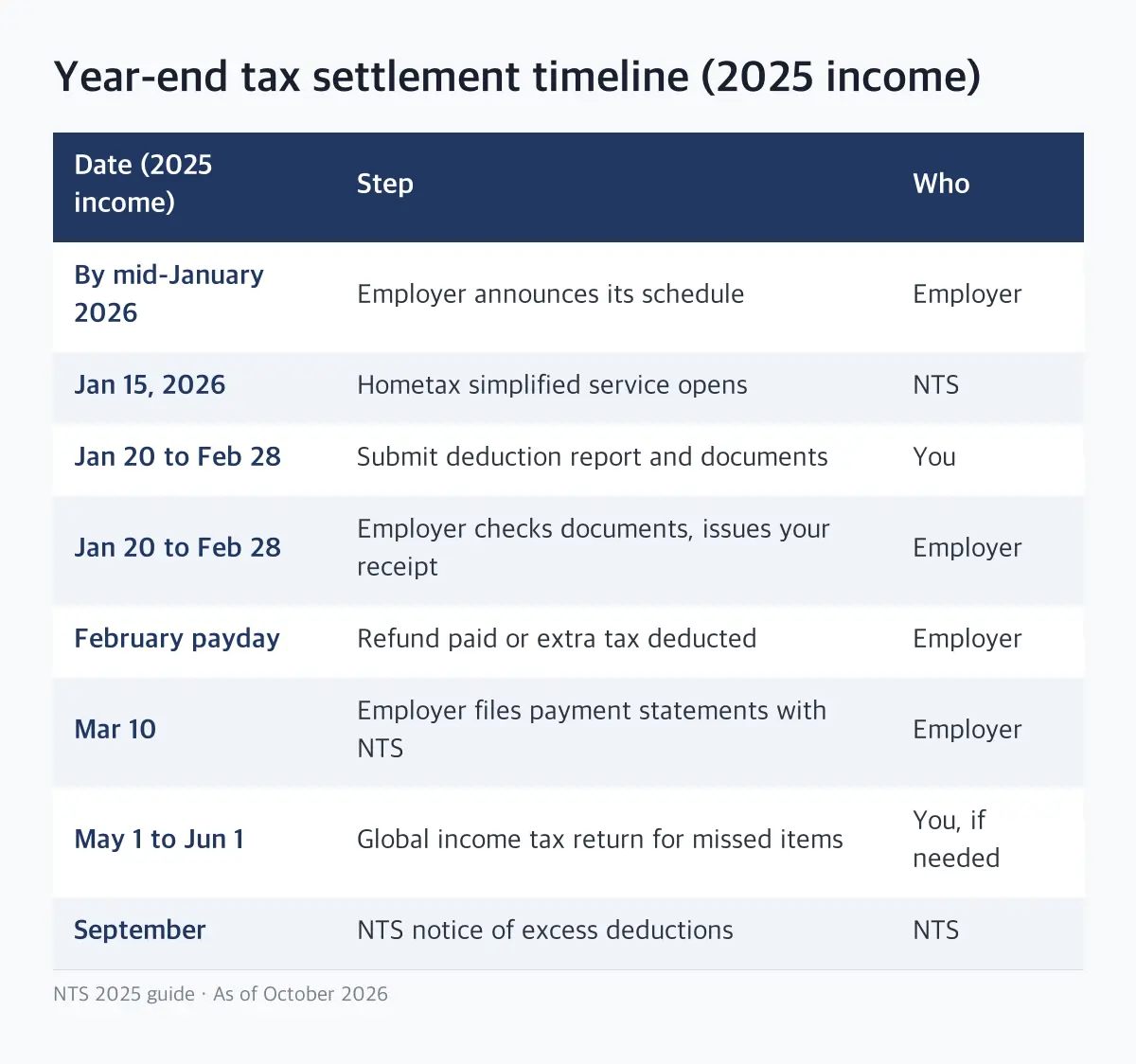
The NTS schedule for income earned in 2025 looked like this. Expect a similar pattern in January to March 2027 for 2026 income.
| Date (2025 income) | Step | Who |
|---|---|---|
| By mid-January 2026 | Employer announces its schedule | Employer |
| Jan 15, 2026 | Hometax simplified service opens | NTS |
| Jan 20 to Feb 28 | Submit deduction report and documents | You |
| Jan 20 to Feb 28 | Employer checks documents, issues your receipt | Employer |
| February payday | Refund paid or extra tax deducted | Employer |
| Mar 10 | Employer files payment statements with NTS | Employer |
| May 1 to Jun 1 | Global income tax return for missed items | You, if needed |
| September | NTS notice of excess deductions | NTS |
Your company's internal deadline is usually earlier than the NTS dates, so watch for its email in January.
What you actually do
- Get a certificate for Hometax. Foreigners can only log in with a certificate issued under their alien registration number (외국인등록번호). A joint certificate from your bank app works.
- Download your data. On Hometax, open the incentives and year-end settlement menu (장려금·연말정산·기부금), then the simplified service (연말정산간소화), then the deduction data lookup (소득·세액공제 자료 조회). Use the one-click view (한번에 조회하기) or the PDF download (PDF 다운로드) to save everything.
- Collect what is missing. Hospitals, landlords and some schools do not always send data. Get paper receipts for those.
- Submit to your employer. Hand in the deduction report (소득·세액 공제신고서), the Hometax PDF and your receipts.
- Check your receipt in February. If something is wrong, ask your employer to correct it.
Records are collected by alien registration number only. If you bought insurance under your passport number, it will not appear in Hometax.
Show this: 연말정산 서류를 어디에 제출하면 되나요?
The 19% flat rate option
Foreign employees can choose to pay a flat 19% on their total salary instead of the progressive 6% to 45% rates. Local income tax of 10% of the income tax is added on top either way.
| Point | Rule in the 2025 guide |
|---|---|
| Who | Foreign employees without Korean nationality on December 31, not daily workers |
| Cutoff | You first worked in Korea on or before Dec 31, 2026 |
| How long | Taxable years ending within 20 years of your first work day in Korea |
| What is taxed | Total salary, including normally non-taxable pay such as meal allowances |
| What you lose | All deductions, credits and tax exemptions |
| How to apply | Attach the application for the flat tax rate (외국인근로자 단일세율적용신청서) to your deduction report |
Two points other guides miss:
- The cutoff date. Under the law described in the guide, the option only covers people whose first Korean work day falls on or before December 31, 2026. If you arrive in 2027, check whether the deadline has been extended before you count on it.
- You can switch at year end. Even if your employer withheld 19% every month, the guide says you can still choose the normal rates at settlement time.
When the flat rate pays off
The NTS guides include two worked examples:
| Example (2025 income) | Normal rates | 19% flat rate | Better choice |
|---|---|---|---|
| Salary ₩66,100,000, wife, two kids, mother | ₩2,727,250 | ₩12,559,000 | Normal rates |
| Salary ₩200,000,000, wife, few deductions | ₩44,973,000 | ₩38,000,000 | 19% flat rate |
For most middle incomes with family deductions, the normal rates win. The flat rate tends to help high earners with few deductions. Ask your payroll team to run both numbers.
Deductions you can and cannot claim
Residents get the same deductions and credits as Korean employees, with a few limits for things paid abroad.
| Item | Can a foreign resident claim it? |
|---|---|
| Basic deduction for yourself | Yes, ₩1.5 million |
| Parents living in your home country | Yes, if you actually support them and they meet age and income limits |
| Spouse or child with income of ₩1 million or less | Yes |
| Child tax credit (age 8 and up) | Yes, ₩250,000 for one child, ₩550,000 for two |
| Medical bills at Korean hospitals | Yes, above 3% of your salary |
| Medical bills at hospitals abroad | No |
| Your kids' school fees abroad | No (only Korean nationals) |
| Credit card spending abroad | No |
| Monthly rent credit | Yes, if registered as a foreigner, salary ₩80 million or less, no house |
| National pension and health insurance premiums | Yes, the full amount |
For parents abroad, the guide sets the age line at 60 or older (born on or before December 31, 1965, for 2025 income). Be ready to show proof of the family relationship and that you send them support. If you send money home through a bank, keep those transfer records.
If you hand in nothing at all, your employer can only apply the basic deduction for yourself and the standard tax credit of ₩130,000.
Leaving Korea or quitting mid-year
When you leave a job during the year, the settlement happens with your last month's pay, not in February.
- Submit your deduction report and documents before your final payday.
- If you start a new job in Korea the same year, give your old withholding receipt to the new employer so both incomes are settled together.
- If you leave and the company delays your refund, the refund is owed by the company, not the tax office. The NTS guide says you can claim it like unpaid wages through the Ministry of Employment and Labor center at 1350.
Missed a deduction? You can claim it in the global income tax filing period in May of the next year, or request a correction within 5 years.
Refunds and extra tax
- Refunds come through your employer's payroll. The tax office does not pay employees directly.
- Extra tax over ₩100,000 can be split over three paydays: February, March and April.
- After the employer applies for a refund with its March 10 filing, the NTS refunds the company within 30 days.
Where to get help in English
- NTS foreigner helpline: 1588-0560 (English).
- NTS consultation center: 126, then press 1 and 5 for the simplified service.
- Every district tax office has a help desk for foreign taxpayers.
- The NTS English website posts the Easy Guide and the year-end tax settlement manual each year.
Sources
- NTS: Easy Guide for Foreigners' Year-End Tax Settlement 2025 (publication page)
- NTS: Easy Guide for Foreigners' Year-End Tax Settlement 2025 (PDF)
- NTS: 2025 Year-End Tax Settlement Manual for Foreigners, English (publication page)
- NTS: 2025 Year-End Tax Settlement Manual for Foreigners, English (PDF)
This guide is general information, not tax advice. Rules change every year, so confirm with your employer's payroll team or the NTS foreigner helpline (1588-0560) before you file.
Related guides
 Korea Joint Certificate: Free From Your Bank App, Valid 1 YearWhat the joint certificate (공동인증서, formerly 공인인증서) is, what a foreign resident needs to get one, the free and ₩4,400…
 Health Insurance for Foreigners in Korea (2026): Who Must Join and What You PayMost foreigners staying in Korea are enrolled in national health insurance automatically. Here is when coverage…
 Send Money Abroad From Korea as a Foreigner: $50,000 a YearYou work in Korea and want to send won home. Here is the yearly limit, what a foreign exchange bank is, what to…