
Last updated: October 24, 2026
When is Dongji in 2026?
Dongji is the day the sun reaches 270 degrees of celestial longitude, the point farthest south in its yearly path. In Korea it lands on December 21, 22 or 23, and in 2026 it is a Tuesday.
| Item | 2026 |
|---|---|
| Date | Tuesday, December 22, 2026 |
| Exact solstice moment | 5:50 a.m. Korea Standard Time |
| Sunrise in Seoul | 7:43 a.m. |
| Sunset in Seoul | 5:18 p.m. |
| Lunar calendar date | 11th lunar month, day 14 |
| Day off? | No, a normal workday |
The Korea Astronomy and Space Science Institute (한국천문연구원) publishes these times in its yearly astronomical calendar. Sunrise and sunset are for Seoul City Hall, so you get only about 9 and a half hours of daylight.
Dongji is one of the 24 solar terms (24절기) on the traditional Korean calendar. Because it follows the sun, its solar date barely moves. The lunar date, however, changes every year, and that matters for what people eat (more on that below).
Is the winter solstice a holiday in Korea?
No. Dongji is not on Korea's list of public holidays, and it was not a day off in 2025 either. Shops and restaurants keep normal hours, and nothing closes.
The nearest real holiday is Christmas Day, Friday, December 25, 2026, three days later. So the solstice week ends with a three-day weekend, which is a good time to visit a museum or palace if you missed a Dongji event on Tuesday.
Why do Koreans eat red bean porridge on Dongji?
The short answer is the color red. In the old yin-yang view, the longest night of the year is the peak of yin (음) energy, the dark side. Ghosts and disease spirits were thought to be strongest on that night. Red stood for yang (양), the sun and fire, so red beans were believed to push those spirits away.
The National Folk Museum of Korea's encyclopedia traces the story to an old Chinese almanac, the Jingchu Suishiji (형초세시기). In the tale, a man named Gonggong had a useless son who died on the winter solstice and became a plague spirit. The son had feared red beans, so people cooked red bean porridge on that day to drive him off. Nobody knows when the custom reached Korea, but the late Goryeo scholar Yi Saek already wrote about solstice porridge.
What families did with the porridge:
- Offered the first bowl at the family shrine as a small ancestral rite (동지고사).
- Set a bowl in each room, the storage shed and beside the sauce jars to keep spirits out of the house.
- Sprinkled porridge on the front gate or nearby walls as a charm.
- Ate it together once it cooled, often sharing with neighbors.
The "one year older" saying
Dongji was called "Little Seollal" (작은설), a small new year, because the days start getting longer again. That is why older Koreans say you only really turn a year older once you eat Dongji patjuk.
The porridge contains small balls of glutinous rice dough called saealsim (새알심), which means "bird egg center" because of their size. Some families put in as many balls as each person's age.
Aedongji: some years you get rice cake instead
This is the part most English guides skip. The solstice has a fixed solar date, but where it falls in the 11th lunar month changes. Koreans name the solstice by that lunar timing.
| Type | Lunar date of Dongji | What people traditionally eat |
|---|---|---|
| Aedongji (애동지, "baby Dongji") | Days 1–10 of the 11th lunar month | Red bean rice cake (팥시루떡), not porridge |
| Jungdongji (중동지, "middle Dongji") | Days 11–20 | Either rice cake or porridge |
| Nodongji (노동지, "old Dongji") | Days 21–30 | Red bean porridge |
In an aedongji year, families with young children skip the porridge because it was said to be bad for the kids. They steam a red bean rice cake instead, which keeps the protective red color.
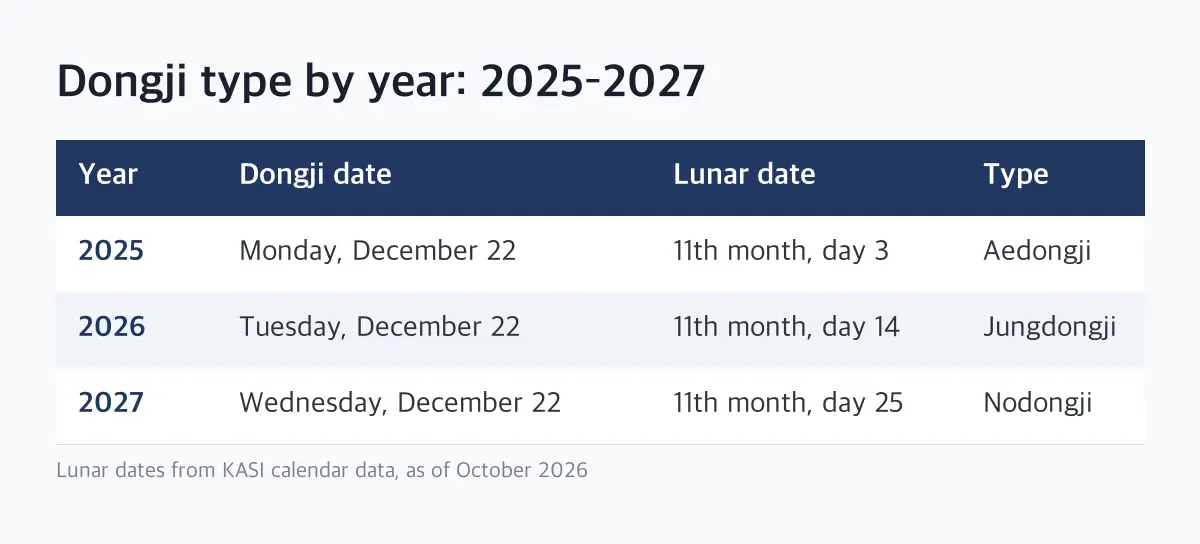
Here is how the last few years line up:
| Year | Dongji date | Lunar date | Type |
|---|---|---|---|
| 2025 | Monday, December 22 | 11th month, day 3 | Aedongji |
| 2026 | Tuesday, December 22 | 11th month, day 14 | Jungdongji |
| 2027 | Wednesday, December 22 | 11th month, day 25 | Nodongji |
So 2026 is a middle year. Porridge is back on most tables, and rice cake is also fine. In 2025, an aedongji year, the National Folk Museum and Namsangol Hanok Village handed out red bean rice cake and red bean tea instead of patjuk.
You can check any year yourself with the free solar-to-lunar converter on the Korea Astronomy and Space Science Institute website.
What patjuk tastes like
Patjuk is thick, dark red-brown and earthy, a bit like a smooth bean soup. The traditional version is seasoned with salt, and some people stir in sugar at the table. A sweet dessert version called danpatjuk (단팥죽) is sold in cafes and porridge shops too, so check which one you are ordering.
It is usually served with a side of dongchimi (동치미), a cold radish water kimchi. The cold, tangy broth cuts through the heavy beans.
Where to try patjuk in Korea
Porridge chains. The easiest option is a porridge restaurant. Bonjuk (본죽), a porridge chain with branches across the country, has long sold a "Dongji patjuk" with rice balls and a side of dongchimi, next to a sweet red bean porridge. Prices vary by branch, and the solstice itself is the busiest day, so takeout ordered a day ahead saves a wait.
Free events in Seoul. Each year, a few traditional sites hold Dongji events. The 2026 programs had not been announced as of October 24, 2026. This is what happened in 2025, which gives you a good idea of what to expect:
| Place | 2025 event | What was served |
|---|---|---|
| National Folk Museum of Korea (국립민속박물관), Jongno-gu | December 22: Dongji rite in the yard of Ochondaek house, mask dance, crafts | Red bean rice cake (aedongji year) |
| Unhyeongung Palace (운현궁), Jongno-gu | December 22, 11 a.m. to 4 p.m.: porridge sharing, calendar handout, folk games | Red bean porridge |
| Namsangol Hanok Village (남산골한옥마을), Jung-gu | Saturday, December 20, 10 a.m. to 5 p.m.: charm making, calendar handout | Glutinous rice cake and red bean tea |
All three events in 2025 were free with no booking. The National Folk Museum is open 9 a.m. to 5 p.m. from November to February, with last entry one hour before closing, and admission is free.
Outside Seoul, the Korean Folk Village (한국민속촌) in Yongin has served patjuk to visitors on past solstices. Check its website in December for the current year's program.
Show this: 동지팥죽 하나 주세요.
That means "One Dongji red bean porridge, please." If you want the sweet one, ask for danpatjuk instead.
Show this: 단팥죽 말고 동지팥죽이요.
That means "Not the sweet one, the Dongji porridge, please."
Other Dongji customs you may notice
- Free calendars. In the Joseon era, the royal observatory made the new year's calendar for Dongji, and officials passed copies to friends. Koreans still swap new calendars at the end of the year, and the 2025 Seoul events handed out 2026 calendars.
- Socks as gifts. At the Joseon court, socks (버선) were presented on Dongji, a custom called dongji heonmal (동지헌말). That is why the 2025 museum event had a sock-shaped bookmark craft.
- Upside-down charms. Some households pasted the character for snake (蛇) upside down to keep bad spirits out. You may see this as a stamp activity at museum events.
- Weather omens. A cold, snowy Dongji was read as a sign of a good harvest. A warm one meant illness in the year ahead.
Sources
- Korea Astronomy and Space Science Institute: 2026 astronomical calendar (PDF)
- Korea Astronomy and Space Science Institute: 2026 calendar data
- Korea Astronomy and Space Science Institute: solar and lunar date converter
- Encyclopedia of Korean Folk Culture: Dongji (동지)
- Encyclopedia of Korean Folk Culture: Dongji patjuk (동지팥죽)
- Encyclopedia of Korean Folk Culture: Aedongji (애동지)
- Seoul Metropolitan Government: 2025 Dongji events at Namsangol and Unhyeongung
- Seoul Metropolitan Government: 2025 Dongji event at the National Folk Museum
- Ministry of Culture, Sports and Tourism: Koreans celebrate Winter Solstice with special annual dish
- Korea.net: patjuk red bean porridge
- Toyo Economy: Bonjuk Dongji patjuk menu (Korean)
Related guides
 Kimjang in Korea: Why Koreans Make Kimchi Every NovemberEvery November, Korean families and neighbors make a year's worth of kimchi in a few days. Here is what kimjang is,…
 Christmas in Korea: A Public Holiday Spent Like Valentine's DayYes, Korea has Christmas, and it is a day off. Here is why it feels more like Valentine's Day, what is open on…
 Korean Public Holidays 2027: 24 Days Off and 10 Long WeekendsThe full 2027 holiday calendar for Korea, checked against the official 2027 calendar guidelines and the amended…