
Last updated: October 27, 2026
Who can sponsor you
Dependent status exists only inside workplace insurance. Your sponsor must be an employee-insured member, meaning someone who works for a company, a public body or a school and has their health insurance through that job. The sponsor can be a Korean or a foreigner, but must be registered as an employee member of the NHIS.
A person on regional insurance (지역가입자) cannot register dependents. If your spouse is a freelancer, a business owner or a regional member, you pay your own premium as a regional member instead. The health insurance guide covers that route.
The six-month rule and who skips it
Since April 3, 2024, a foreigner who enters Korea must live here for six months before becoming a dependent. The same wait already applied to regional members. The law makes two kinds of exceptions.
| Who | Six-month wait? |
|---|---|
| Spouse of the employee-insured sponsor | Skipped |
| Child under 19 (including the spouse's child) | Skipped |
| Permanent resident (F-5), marriage migrant (F-6), non-professional worker (E-9) | Skipped (the visa is the reason to stay) |
| Student (D-2) or primary and secondary school trainee (D-4-3) | Skipped |
| Parent, adult child, sibling or anyone else | Required |
The source for the first two rows is the National Health Insurance Act, Article 109(4)3. The visa rows come from the Ministry of Health and Welfare's list of residence reasons (Enforcement Rule, Article 61-2). A newborn is a dependent from the birth date when the baby is born in Korea to a parent who was already employee-insured.
How the six months are counted. The count starts at your first entry date. Trips abroad of 30 days or fewer in total during those six months still count as living in Korea. You become eligible the day after the six months end.
The family tie: who counts
Next, the NHIS checks whether the sponsor supports you. The relationships it accepts are listed in Table 1 of the Enforcement Rule. Living together is simple, so the table shows what happens when you do not live with the sponsor.
| Your relationship to the sponsor | If you live apart |
|---|---|
| Spouse | Accepted |
| Parent, parent-in-law | Accepted only if no sibling (or spouse's sibling) lives with the parent, or that person has no pay or income |
| Child | Accepted if unmarried |
| Grandparent, grandchild | Accepted under a similar "no one else supports them" test |
| Spouse's child | Not accepted |
| Child's spouse | Not accepted |
| Sibling (under 30, 65 or older, or registered disability) | Accepted if unmarried and no parent or other sibling with income supports them |
If you live with the sponsor, nearly all of these ties are accepted as they are.
The income and property limits
Both tests apply to you, the person who wants to become a dependent. They come from Table 1-2 of the National Health Insurance Enforcement Rule (amended April 23, 2025).
Income. Your total yearly income, counted from every source NHIS tracks (pay, interest, dividends, pensions and so on), must be ₩20 million or less. There is also a business-income rule:
- You must have no business income.
- The one exception: if you have no business registration (or a registered disability), business income of ₩5 million a year or less is treated as none.
- Housing rental income removes that exception, so any amount counts as business income.
Property. You need to meet one of these:
| Property tax base (재산세 과세표준) | Extra condition |
|---|---|
| ₩540 million or less | None |
| Over ₩540 million, up to ₩900 million | Total income of ₩10 million a year or less |
| Sibling dependents only: ₩180 million or less | None |
The property tax base is the figure on the Korean property tax bill, which is lower than the market price. A dependent who is married must pass the income tests as a couple, so both spouses need to qualify.
Documents
The sponsor files the application on the Dependent Qualification Report (피부양자 자격 취득 신고서). For a foreigner, add:
- A copy of your Residence Card (외국인등록증). NHIS can skip this when its systems already show your registration.
- A document that proves the relationship, such as a marriage certificate or a birth certificate.
- For anything issued abroad, the paperwork must pass two checks.
Authentication. The document must carry one of these: confirmation by the foreign ministry of the issuing country, an apostille if the country joined the Hague Convention, or confirmation by a body NHIS recognizes. The apostille guide explains how to get one.
Korean translation. Attach a Korean translation that is either notarized or made by a licensed translation agent (외국어번역행정사) with a translation certificate. If NHIS has already accepted a translation, you do not need a new one.
How to apply
- The sponsor confirms they are employee-insured and that you hold a valid Residence Card.
- Gather the documents above, with apostille and Korean translation for foreign papers.
- The sponsor submits the form to NHIS. Many employers' HR teams handle this for staff.
- NHIS checks the relationship, your income and your property, and issues your coverage.
Show this: 건강보험 피부양자 자격 취득 신고하러 왔어요.
Timing. The Enforcement Rule says the start date moves back to the sponsor's enrollment date only when the form is filed within 90 days of that date. Later, coverage starts on the filing date. If you must wait six months, you become eligible the day after they end, so file as soon as that day arrives.
When you cannot be a dependent
- Your stay in Korea breaks the law, for example an overstay.
- You are already covered by a foreign plan or an employer contract that matches Korean benefits and the sponsor asks NHIS to leave you out.
- Your income or property goes over a limit. Coverage ends the day after NHIS finds that you no longer meet the criteria.
- You start a job at a company with employee insurance. You then become an employee member yourself.
Sources
- National Health Insurance Act, Article 109 (special rules for foreigners)
- National Health Insurance Enforcement Rule, Articles 2 and 61-2 to 61-3 (Korean)
- Notice on health insurance for overseas Koreans and foreigners, Articles 4 to 5-2 (Korean)
- InvestKOREA: Health and medical
- Korea.net: 6-month stay for expats required from April for health insurance
This guide is general information, not legal advice. Rules change, so confirm with HiKorea or the 1345 Immigration Contact Center before you apply.
Related guides
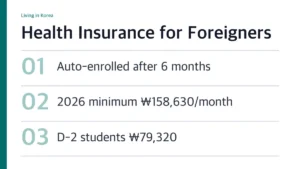 Health Insurance for Foreigners in Korea (2026): Who Must Join and What You PayMost foreigners staying in Korea are enrolled in national health insurance automatically. Here is when coverage…
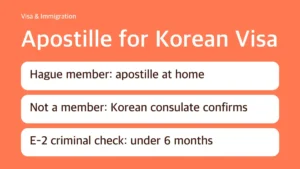 Apostille for Korean Visa: Needed If Your Country Joined the HagueWhich countries use an apostille for Korean visa documents, which ones need a Korean consulate instead, who issues…
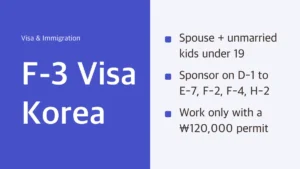 F-3 Visa Korea: Spouse and Kids Under 19, Apply From AbroadWho can get Korea's F-3 dependent visa, which sponsor visas qualify, the documents a consulate asks for, why…