
Last updated: November 8, 2026
What happens on New Year's Eve in Seoul
Koreans do celebrate the solar New Year. It is quieter than the big family holiday, Seollal, but December 31 is a night out. The main public event is the bell ringing at Bosingak Pavilion (보신각), a bell house on Jongno street right in the old city center.
The Seoul Metropolitan Government runs it every year. Here is how the most recent one (for the start of 2026) was set up:
| Item | 2025–26 ceremony (latest official plan) |
|---|---|
| Date | Wednesday, December 31, 2025 |
| Time | 10:50 p.m. to 12:20 a.m. on the official event page |
| Place | Around Bosingak Pavilion, Jongno |
| Main moment | Countdown, then 33 bell strikes at midnight |
| Program | Pre-show performances, bell ringers introduced, countdown, bell, after-show concert |
| Cost | Free, no sign-up needed |
| Bell ringers | 11 citizens and public figures chosen by the city |
The city's press release described the show as about 50 minutes of stage performances before the bell, including pansori (Korean traditional singing) and a choir, plus media art projected on the front of the pavilion. After the 33rd strike, the rock band Crying Nut played a New Year concert.
The 2026–27 plan is not out yet. Seoul released last year's transport and safety plan on December 30, 2025, one day before the event. Expect this year's details in the last days of December. The format has been the same for years, so the times above are a reasonable guide.
Do not plan on Jonggak Station
Many guides tell you to take Line 1 to Jonggak Station (종각역). Last year that did not work. To prevent dangerous crowding inside the station, Seoul Metro ran trains straight through Jonggak without stopping from 11 p.m. on December 31 to 1 a.m. on January 1.
The city told people to use these stations instead:
| Station | Lines |
|---|---|
| City Hall (시청역) | Lines 1 and 2 |
| Jongno 3-ga (종로3가역) | Lines 1, 3 and 5 |
| Euljiro 1-ga (을지로입구역) | Line 2 |
| Gwanghwamun (광화문역) | Line 5 |
You can still walk to Bosingak from any of them. Jonggak opens again for trains after 1 a.m., but the platforms are packed right after the bell.
How late does the subway run on New Year's Eve?
For the 2025–26 night, Seoul extended service on Lines 1 to 9 (Seoul Metro sections), the Ui-Sinseol Line and the Sillim Line. The last trains were timed to reach the end of each line at about 2 a.m. instead of the usual 1 a.m., with 104 extra runs at 10 to 30 minute intervals.
These were the last trains from stations near Bosingak that night:
| Station | Direction | Last train |
|---|---|---|
| City Hall (Line 1) | toward Dongmyo | 1:44 a.m. |
| City Hall (Line 1) | toward Seoul Station | 1:56 a.m. |
| City Hall (Line 2) | outer loop, toward Hongik Univ. | 1:54 a.m. |
| City Hall (Line 2) | inner loop, toward Seongsu | 1:43 a.m. |
| Euljiro 1-ga (Line 2) | outer loop, toward Hongik Univ. | 1:52 a.m. |
| Euljiro 1-ga (Line 2) | inner loop, toward Seongsu | 1:45 a.m. |
| Jongno 3-ga (Line 3) | toward Dongnimmun | 1:53 a.m. |
| Jongno 3-ga (Line 3) | toward Yaksu | 1:54 a.m. |
| Jongno 3-ga (Line 5) | toward Aeogae | 1:51 a.m. |
| Jongno 3-ga (Line 5) | toward Gunja | 1:44 a.m. |
| Gwanghwamun (Line 5) | toward Aeogae | 1:53 a.m. |
| Gwanghwamun (Line 5) | toward Gunja | 1:41 a.m. |
The 2 a.m. extension was for Seoul subway lines, not for trains deep into Incheon or Gyeonggi Province. If you live that far out, a train from central Seoul near 1:45 a.m. may not connect to your last suburban train, so leave right after the bell.
Buses: 45 bus routes passing the event area ran their last service through the area at about 2 a.m. Because the streets around Bosingak were closed, 47 city bus routes took detours from 6 p.m. to 7 a.m.
Show this: 시청역은 어느 쪽으로 가요?
Road closures, bikes and scooters
Last year, the city fully closed these roads from 6 p.m. on December 31 to 7 a.m. on January 1:
- Jongno, from Sejong-daero to Jongno 2-ga
- Cheonggyebuk-ro, from Cheonggye Plaza to Cheonggye 2-ga
- Ujeongguk-ro, from Gongpyeong Rotary to Gwanggyo intersection
Taxis and ride apps cannot drop you at the door, so plan to walk the last few blocks. A few other changes caught visitors off guard:
- Ttareungyi (따릉이), Seoul's public bike, closed 16 rental stations near the venue from noon on December 31 to 9 a.m. on January 1.
- Shared e-scooters and e-bikes (Kickgoing, Gcoo, Swing, Beam, Xingxing and Socar Elecle) could not be rented or returned in the zone from 6 p.m. to 6 a.m.
- Parking enforcement ran from 7 p.m. to 1 a.m. on nearby roads.
How crowded is it, and how cold?
News agency Newsis counted about 15,000 people around Bosingak and Gwanghwamun Square when the first bell rang on January 1, 2026. That is still a dense crowd in a few blocks.
The city put about 820 safety and traffic staff on the streets, and police and other agencies added about 1,700 more. Seoul Metro raised staff at 9 nearby stations from the usual 28 to 160 people.
It is also cold. For the 2025–26 holiday, forecasters expected morning lows of around minus 10°C in most inland areas. You will stand outside for an hour or more, so wear a hat, gloves and warm shoes.
On site, the city ran info booths with medical help and warming shelters at Jongno Tower, the SC First Bank building and Youngpoong Building, plus temporary toilets at each corner of the Jongno 1-ga intersection. If someone in your group gets hurt or lost, use the Korean emergency numbers: 112 for police and 119 for an ambulance, both with English interpreters.
Other places to count down in Seoul
Bosingak is the traditional choice, but not the only one. On the night of December 31, 2025, Newsis reported:
- Dongdaemun Design Plaza (DDP): a light show on the building's curved walls and a DJ set.
- Lotte World Tower in Songpa: a countdown with a rainbow laser light show and a New Year message on the tower. Several older guides call it fireworks, but last year's show was lasers.
If you want lights without the bell crowd, the Seoul Lantern Festival on Cheonggyecheon stream is another option. Cheonggyebuk-ro along the stream is inside last year's closed zone, so expect it to be busy on the 31st.
Is New Year's Day a holiday in Korea?
Yes. January 1 is on the official list of public holidays in Korea's Regulations on Public Holidays. Here is how it falls this season:
| Date | Day | Status |
|---|---|---|
| December 31, 2026 | Thursday | Normal workday |
| January 1, 2027 | Friday | Public holiday |
| January 2–3, 2027 | Saturday–Sunday | Weekend |
The government's 2027 calendar counts January 1 to 3 as the first long weekend of 2027. New Year's Eve itself is not a holiday, so most offices work a full day on December 31.
What closes on January 1:
- Government offices, post offices and banks close, as on every public holiday.
- The National Museum of Korea closes on January 1.
- The National Palace Museum of Korea next to Gyeongbokgung Palace also lists January 1 as a closed day.
- Cafes, restaurants and convenience stores mostly stay open, since January 1 is a one-day holiday and not a family travel day like Seollal.
For every day off next year, see our list of Korean public holidays.
Where to see the first sunrise of the year
Watching the first sunrise of the year, called haemaji (해맞이), is a popular New Year's Day trip. Many people head to the east coast on December 31 and wait on the beach or a cape before dawn.
The Korea Astronomy and Space Science Institute (KASI, 한국천문연구원) publishes sunrise times each year. These were the times it gave for January 1, 2026:
| Place | Region | Sunrise (Jan 1, 2026) |
|---|---|---|
| Dokdo | East Sea islets | 7:26 a.m. (first in Korea) |
| Ganjeolgot | Ulsan | 7:31 a.m. (first on the mainland) |
| Homigot | Pohang | 7:32 a.m. |
| Haeundae | Busan | 7:32 a.m. |
| Seongsan Ilchulbong | Jeju | 7:36 a.m. |
| Jeongdongjin | Gangneung | 7:39 a.m. |
| Seoul | Seoul | 7:46 a.m. |
Sunrise on the same date shifts by only about a minute from one year to the next, so expect almost the same times on January 1, 2027. Be in place 30 minutes early. The sky starts to glow well before the sun appears.
Quick notes on the three famous spots:
- Jeongdongjin: a beach in Gangneung, the classic east coast choice from Seoul.
- Homigot: the tip of a cape in Pohang, known for the giant bronze hand sculpture standing in the sea.
- Seongsan Ilchulbong: a volcanic crater on Jeju. Its name literally means "sunrise peak."
Weather matters more than the spot. Last year forecasters expected clear skies in most regions, but cloud along parts of the west coast, Jeju and Ulleungdo.
New Year's Day vs. Seollal: two different New Years
Korea has two New Years, and newcomers often mix them up.
| New Year's Day (신정) | Seollal (설날) | |
|---|---|---|
| Calendar | Solar, January 1 | Lunar, 1st day of the 1st lunar month |
| Next date | Friday, January 1, 2027 | Sunday, February 7, 2027 |
| Days off | 1 day | 3 days plus a substitute day: February 6–9, 2027 |
| How people spend it | Countdown, sunrise trips, a day of rest | Family visits, ancestral rites, bowing to elders |
Seollal is the big family holiday when people travel home. January 1 is more of a fresh-start day with friends. Our Seollal guide explains the customs and what closes in February.
Sources
- 2025–26 New Year's Eve bell ringing ceremony: schedule, road closures, transit, last trains, Seoul Metropolitan Government
- Bosingak bell ringing on December 31, subway and bus service extended (December 30, 2025), Seoul Metropolitan Government
- Seoul to hold Bosingak bell ringing for 2026 (program details), News Seoul
- New Year 2026 at Bosingak, DDP and Lotte World Tower, Newsis
- Regulations on Public Holidays, Article 2 (holiday list), Korean Law Information Center
- 2027 calendar data, Korea Astronomy and Space Science Institute
- 2027 long weekends and Seollal date, Herald Korea
- Visitor information, National Museum of Korea
- General information, National Palace Museum of Korea
- First sunrise of 2026 by city (KASI figures), Newsis
- New Year 2026 sunrise weather and times (KASI figures), Financial News
- 2026 sunrise spots and times, KB Think
This guide is general information. Event times and transit plans are set each December, so the 2025–26 figures above may change for 2026–27.
Related guides
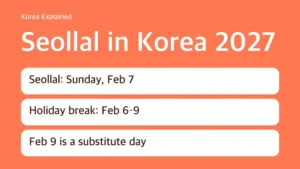 Seollal in Korea 2027 (Lunar New Year): Feb 7, Off Feb 6–9Seollal (Korean Lunar New Year) 2027 is on Sunday, February 7, and the break runs February 6–9. Here is what…
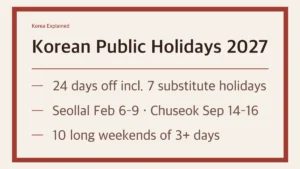 Korean Public Holidays 2027: 24 Days Off and 10 Long WeekendsThe full 2027 holiday calendar for Korea, checked against the official 2027 calendar guidelines and the amended…
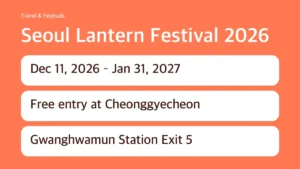 Seoul Lantern Festival 2026: Dec 11–Jan 31, Free EntryThe 2026 Seoul Lantern Festival lights up Cheonggyecheon Stream from December 11, 2026, to January 31, 2027, as part…