
Last updated: October 13, 2026
What the D-10 visa is, and what it is not
D-10 (구직) is the status for people who want to find a professional job in Korea or get a tech start-up ready. It is not a work visa. You use the time to apply, interview, and do short internships. When a company hires you, you change to a work status such as E-7.
The rules below come from the HiKorea stay manual dated September 18, 2026 and the visa manual dated September 1, 2026, the latest versions posted by the Korea Immigration Service.
| Type | Who it is for | What you can do |
|---|---|---|
| D-10-1 General job seeking (일반구직) | Degree holders looking for work in E-1 to E-7 fields | Job hunting, plus short internships paid with a training allowance before formal hiring |
| D-10-2 Tech start-up prep (기술창업준비) | Degree holders with a patent, design right, or start-up program record | Start-up education, patent filing, preparing to set up a company. No internships |
| D-10-3 High-tech intern (첨단기술인턴) | Students or recent graduates of top universities abroad, under 30 (under 35 with a master's) | A paid internship at an approved tech company |
| D-10-T Top-Tier job seeking (최우수인재) | Master's or higher from a world top-100 university within the last 5 years | Job hunting while you look for a Top-Tier job |
E-1 to E-7 covers professor, English teacher, researcher, technical guidance, professional, arts and sports, and the E-7 special activity jobs. For E-6, only pure arts and sports count, not entertainment venues.
Who qualifies for D-10-1
You can apply under the points test if you:
- Hold a bachelor's degree or higher. A Korean associate degree (전문학사) also counts, but an associate degree from abroad does not.
- Are staying in Korea legally when you apply for a change of status, or apply for a D-10 visa at a Korean embassy.
- Score at least 60 of 190 points, with at least 20 points from the basic items (age and education).
One exception raises the bar. Nationals of countries designated by the Minister of Justice who are switching from B-1, B-2, C-1, C-3, C-4, D-3, E-9, E-10, or G-1 status need 80 points, not 60. This applies to that switch only, not to every applicant from those countries.
Groups that skip the points test
| Group | Condition |
|---|---|
| New Korean graduates | Graduated from a Korean college or university (associate degree or higher) on a D-2 visa and are switching to D-10-1 for the first time |
| Korean graduates with strong Korean | Degree from a Korean university within the last 3 years, plus TOPIK level 4 or higher, or a pass on the KIIP level 4 mid-term test |
| Young people raised in Korea | Age 18 to 24, finished elementary, middle, and high school in Korea, and staying legally |
| Promising talent (유망인재) | Age 29 or under and graduated abroad, with either a bachelor's or higher from a THE or QS top 200 school, or TOPIK level 6 after majoring in Korean studies |
| Care worker trainees | Finished the care worker professional training course and will sign an internship contract with a senior care facility |
| Former professional workers | Held E-1 to E-7 status and the job ended, but you want to keep working in Korea |
| Foreign embassy interns | Interns at a foreign embassy in Korea |
The D-10 points test: how the 190 points work
The test has four parts: basic items (up to 50 points), optional items (up to 70), bonus points (up to 70), and deductions for law violations.
Basic items: age and education (you need at least 20)
| Item | Points |
|---|---|
| Age 20 to 24 | 10 |
| Age 25 to 29 | 15 |
| Age 30 to 34 | 20 |
| Age 35 to 39 | 15 |
| Age 40 to 49 | 5 |
| Korean associate degree | 15 |
| Bachelor's degree (Korea or abroad) | 15 |
| Master's degree | 20 |
| Doctorate | 30 |
Age is your international age. Only the degree certificate counts for education. A diploma of completion or a license does not.
Optional items (up to 70)
| Item | Points |
|---|---|
| Related work in the last 10 years: 1 to 2 years in Korea, or 3 to 4 years abroad | 5 |
| 3 to 4 years in Korea, or 5 to 6 years abroad | 10 |
| 5 years or more in Korea, or 7 years or more abroad | 15 |
| Studied 2+ years at a Korean school, graduated within the last 3 years (any degree) | 30 |
| Same, graduated more than 3 years ago: associate / bachelor's / master's / doctorate | 5 / 10 / 15 / 20 |
| Research student, exchange student, or public or private training in Korea: 1 year to 1 year 6 months | 3 |
| Same, 1 year 7 months or more (Korean language course, D-4-1, stays at 3) | 5 |
| Korean: TOPIK 5 or KIIP level 5 | 20 |
| Korean: TOPIK 4 or KIIP level 4 (or KIIP pre-test score 81+) | 15 |
| Korean: TOPIK 3 or KIIP level 3 (or pre-test 61+) | 10 |
| Korean: TOPIK 2 or KIIP level 2 (or pre-test 41+) | 5 |
Work experience must be in a field related to your degree and earned after the degree. Internships done while job hunting do not count. A TOPIK score is valid for 2 years. KIIP (Korea Immigration and Integration Program, 사회통합프로그램) level completions have no expiry, but a KIIP pre-test score expires after 2 years.
Bonus points (up to 70, they stack)
| Bonus | Points |
|---|---|
| Recommendation from a Korean ministry or a Korean embassy | 20 |
| Graduate of a THE top 200 or QS top 500 university | 20 |
| STEM graduate of a QS top 1,000 university in Vietnam, China, Thailand, Japan, India, Indonesia, Malaysia, Singapore, or the Philippines (age 29 or under, TOPIK 2+, trial until October 2027) | 20 |
| 1+ year at a Fortune Global 500 company | 20 |
| STEM bachelor's degree (Korean associate degree also counts) | 5 |
| Last job paid $50,000 a year or more | 5 |
Deductions
Immigration Act fines (범칙금) and criminal fines (벌금형) from the last 5 years are added up by type, and both deductions can apply. Administrative penalties (과태료) do not count.
| Total amount | Immigration fine | Criminal fine |
|---|---|---|
| ₩3 million or more | -30 | -30 |
| ₩1 million to under ₩3 million | -10 | — |
| ₩2 million to under ₩3 million | — | -10 |
| ₩500,000 to under ₩1 million | -5 | — |
| Under ₩2 million | — | -5 |
Two worked examples
| Applicant A | Applicant B | |
|---|---|---|
| Age | 31 → 20 | 26 → 15 |
| Degree | Master's abroad → 20 | Bachelor's abroad → 15 |
| Work | 5 years abroad → 10 | 3 years abroad → 5 |
| Korean | TOPIK 3 → 10 | TOPIK 2 → 5 |
| Bonus | STEM degree → 5 | None |
| Total | 65: passes, 1 year in 6-month steps | 40: does not pass |
Applicant B would need 20 more points. A TOPIK 4 adds 10 over TOPIK 2, and a degree from a QS top 500 university adds 20.
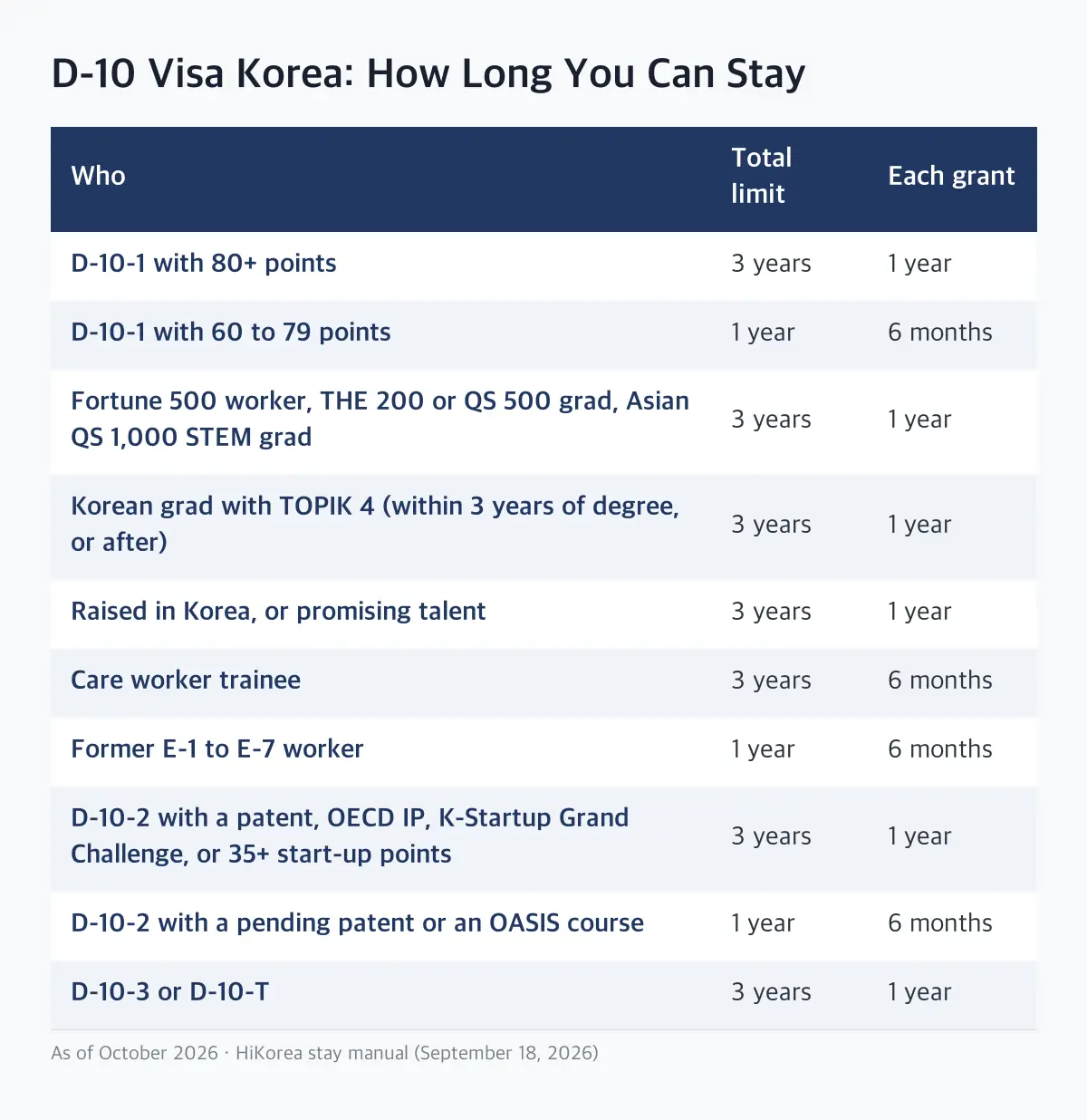
How long you can stay on D-10
Your total time on D-10 is capped, and the cap depends on your group or score. The time adds up while you stay in Korea. It starts again only if you fully leave Korea and come back on a new D-10 visa.
| Who | Total limit | Each grant |
|---|---|---|
| D-10-1 with 80+ points | 3 years | 1 year |
| D-10-1 with 60 to 79 points | 1 year | 6 months |
| Fortune 500 worker, THE 200 or QS 500 grad, Asian QS 1,000 STEM grad | 3 years | 1 year |
| Korean grad with TOPIK 4 (within 3 years of degree, or after) | 3 years | 1 year |
| Raised in Korea, or promising talent | 3 years | 1 year |
| Care worker trainee | 3 years | 6 months |
| Former E-1 to E-7 worker | 1 year | 6 months |
| D-10-2 with a patent, OECD IP, K-Startup Grand Challenge, or 35+ start-up points | 3 years | 1 year |
| D-10-2 with a pending patent or an OASIS course | 1 year | 6 months |
| D-10-3 or D-10-T | 3 years | 1 year |
Older guides that say "6 months at a time, 2 years in total" describe the rules before the late-2025 reform the Ministry of Justice announced. The September 2026 manual says 3 years at most.
Switching from D-2 to D-10 after graduation
This is the most common route, and it is the easiest one.
- No points test the first time. If you finished an associate degree or higher at a Korean school on a D-2 visa, your first change to D-10-1 skips the points test. You get 1 year.
- The extension uses points. When you extend after that first year, the points test applies. The exception is a graduate within 3 years of the degree who holds TOPIK 4 or KIIP level 4. That person stays on the 3-year track without a score.
Two more rules apply to new graduates:
- Already left Korea? You can still get a points-free D-10 visa at an embassy within 1 year of your graduation date. If you held D-10 before, it is not a first switch and the points test applies.
- No proof of funds for the first switch.
- Apply right away. The manual says to apply as soon as your status changes (or is about to) at the immigration office for your address. Book a visit on HiKorea.
Documents for the first switch: application form, photo, passport copy, fee, a copy of your Residence Card, a job-seeking activity plan (구직활동 계획서), your Korean degree certificate or graduation certificate, and proof of your place of stay.
Show this: 졸업 후 구직(D-10) 자격으로 체류자격 변경하러 왔어요.
Documents and fees for the points route
If you apply under the points test, bring:
- Application form, photo, passport copy, fee, and ID copy
- Job-seeking activity plan
- Degree certificate (skipped if immigration can already see it in the student system)
- Proof for each point you claim: career certificate, training completion certificate, TOPIK or KIIP results, university ranking proof, ministry or embassy recommendation, or income proof from your government
- Proof of funds
How much money you need in the bank
The manual sets the amount as the yearly housing benefit standard for a 1-person household × the months of stay. For 2026 that standard is ₩1,230,834 a month.
| Grant | Bank balance to show (2026) |
|---|---|
| 6 months | ₩1,230,834 × 6 = about ₩7,385,004 |
| 1 year | ₩1,230,834 × 12 = about ₩14,770,008 |
Some university and agency guides still quote a flat monthly amount from older rules. Use the 2026 figure above. You do not need to show funds if you are a new Korean graduate on your first switch, a Korean graduate with TOPIK 4, someone raised in Korea, promising talent, or a former E-1 to E-7 worker switching to D-10 for the first time.
Fees
| Application | Fee |
|---|---|
| Change of status to D-10 | ₩100,000 |
| Extension of stay | ₩60,000 |
| Residence Card issue | ₩35,000 |
| Part-time work permit (activity outside your status) | ₩120,000 |
Fees are review fees, so you do not get them back if you are refused.
Applying from outside Korea
You apply at the Korean embassy or consulate in your country, or in the country where you live long term. A consul can issue a single-entry D-10 visa with a 6-month stay. Documents issued abroad must be translated into Korean or English and carry an apostille or your government's notarization. Former E-1 to E-7 workers cannot use this route; they can only change status inside Korea.
After you arrive, register for a Residence Card (외국인등록증) at immigration. The fee is ₩35,000.
What you can and cannot do on D-10
Internships
- D-10-1 holders can do internships in E-1 to E-7 fields while they job hunt.
- Report the start of an internship, or a change of company, to immigration within 15 days.
- One company can host you for up to 1 year. If you already have 1 year of internship at the same company during your D-10 time, a new report there is refused.
- D-10-2 holders cannot do internships. Neither can people who moved to D-10-1 from E-1 to E-7 work.
- Companies that took on many interns in the last year and hired none of them can be blocked from new interns.
Part-time work
D-10 does not let you take any job you like. D-10-1 holders can apply for a part-time work permit if they meet all of these:
- A Korean associate degree or higher, earned less than 3 years ago
- TOPIK level 4 or KIIP level 4 or higher
- Never held E-1 to E-7 status
Allowed work is in manufacturing (KIIP level 4 required, TOPIK alone is not accepted) and agriculture (no Korean language requirement). You can work 25 hours on weekdays, or 30 hours with KIIP level 5, and without a limit on weekends and public holidays. Get the permit before your first shift. Working without one can lead to penalties for both you and the employer.
When you get a job
D-10 is the step before a work visa. When a company hires you for a professional role, apply for a change of status to that work status, such as an E-7 work visa.
Extending your D-10
For an extension under the points test, bring the application form, photo, passport copy, fee, ID copy, a job-seeking activity plan, proof of your place of stay, proof of funds, and any documents for your points. If you moved, report your new address before you apply.
Check one more thing first. Immigration looks up unpaid taxes and health insurance premiums when you apply. If you have unpaid amounts and do not pay them, the extension is limited to 6 months or less in principle. Pay them first, and the extension is handled normally.
Show this: 구직(D-10) 체류기간 연장하러 왔어요.
Who cannot get D-10
You are refused if, counting back from your application date, you:
- Were sentenced to imprisonment (금고) or heavier in the last 5 years
- Got a deportation or departure order under the Immigration Act in the last 5 years
- Were fined ₩3 million or more under Korean law in the last 3 years
- Got immigration fines high enough to block stay permits: ₩5 million or more on a first offense, or ₩7 million or more in total within 3 years on repeat offenses
For D-10-1, you also need your previous job contract to be over, or a release letter (이적동의서) from your employer.
D-10-2 tech start-up prep in short
You need a bachelor's degree (or a Korean associate degree) plus one of these: a Korean patent, utility model, or design right (owned or filed), current or recent (within 3 years) participation in the OASIS start-up immigration program, a K-Startup Grand Challenge recommendation, or intellectual property registered in an OECD country. You submit a tech start-up plan and proof of funds. The usual next step is the D-8-4 start-up visa.
Sources
- HiKorea notice: latest integrated stay and visa manuals (stay manual September 18, 2026, visa manual September 1, 2026)
- Ministry of Justice: D-10 job seeker visa reform card news (December 2025)
- Ministry of Justice: unpaid tax and health insurance check before visa extension
- Easy to Find, Practical Law: extension of stay and change of status (fees)
- Gov24: foreigner registration (Residence Card fee)
- Seoul Housing Portal: 2026 housing benefit standard (1-person household ₩1,230,834)
- Korea Immigration Service: Immigration Contact Center 1345
Need help in English? Call 1345 inside Korea or +82-1345 from abroad, 09:00 to 22:00 on weekdays.
This guide is general information, not legal advice. Rules change, so confirm with HiKorea or the 1345 Immigration Contact Center before you apply.
Related guides
 Change Visa Status in Korea: Get Permission First (HiKorea, ₩100,000 Fee)Who can switch status of stay inside Korea and who must leave first, the common switches (D-2 to D-10 or E-7,…
 Korea Visa Extension: HiKorea Up to 4 Months Early, Fee ₩60,000When and how to extend your period of stay in Korea: the 4-month window, HiKorea e-Application versus a visit…
 How to Get ARC in Korea (Residence Card): Book Within 90 Days, Pay ₩35,000Staying in Korea longer than 90 days? You need a Residence Card, still called an ARC. Here are the documents, the…