
The fee is ₩100,000 (₩200,000 when the new status is F-5 permanent residency). People who came in on a short-term visa, such as a C-3 tourist visa, generally cannot switch inside Korea and must apply for the new visa from abroad.
Last updated: October 13, 2026
What counts as a change of status
Korean law calls it a change of status of stay, not a visa change. Your visa let you enter; your status of stay (체류자격), such as D-2 or E-7, decides what you may do while you are here. Article 24 of the Immigration Control Act (출입국관리법) says that if you want to do activities that belong to a different status, you must get the Minister of Justice's permission in advance.
The government's Easy to Find Practical Law service gives three typical cases:
- A short-term visitor (C-3) who wants to invest in Korea and move to D-8.
- A student finishing a degree (D-2) who wants to work in Korea on E-7.
- A foreigner who marries a Korean citizen and moves to marriage migrant status (F-6).
Guri City's foreigner guide adds a fourth common one: a language student (D-4) who finishes the language course and starts university (D-2).
This is different from an extension of stay (체류기간 연장), where you keep the same status and only ask for more time. If your job, school, or family situation is changing, you almost always need a change of status, not an extension.
There is one special deadline. Diplomats, officials, and people under an agreement (A-1, A-2, A-3) whose official position changes must get a change of status within 30 days of the change.
Can you switch from a short-term visa?
Usually not. Guri City's English guide states the basic principle plainly: if you want to start activities under a different status, you are expected to leave Korea, get the right visa, and re-enter. A change inside Korea is the exception, granted only after strict screening.
The rule is written into the visa itself for some short-term visas. Under Article 9 of the Enforcement Rule of the Immigration Control Act (출입국관리법 시행규칙), when a consulate issues these visas, it must tell the applicant that a change of status after entry will not be allowed:
| Visa issued abroad | Change after entry |
|---|---|
| C-3 short-term visit, stay of 90 days or less | Applicant is told it will not be allowed |
| C-1 temporary news coverage, single entry, 90 days or less | Applicant is told it will not be allowed |
| C-4 short-term employment, single entry, 90 days or less | Applicant is told it will not be allowed |
InvestKorea, the government's investment agency, gives a concrete list for the investor visa. People who entered for group or personal tours, including on a tourist C-3 visa, and holders of D-3, E-9, E-10, H-2, G-1, and H-1 status cannot change to D-8 while staying in Korea.
There are narrow cases where a short-term entrant does switch. The government's Study in Korea portal gives the example of a Canadian who entered visa-free (B-2), stayed 5 months, and then applied to change status. That person registers as a foreign resident when applying for the change, and must also report a place of stay (address), which Study in Korea says is mandatory when moving from a short-term to a long-term status.
If you are on a tourist entry and planning to work, assume you will have to apply from your home country. Call 1345 before you plan around an in-country switch.
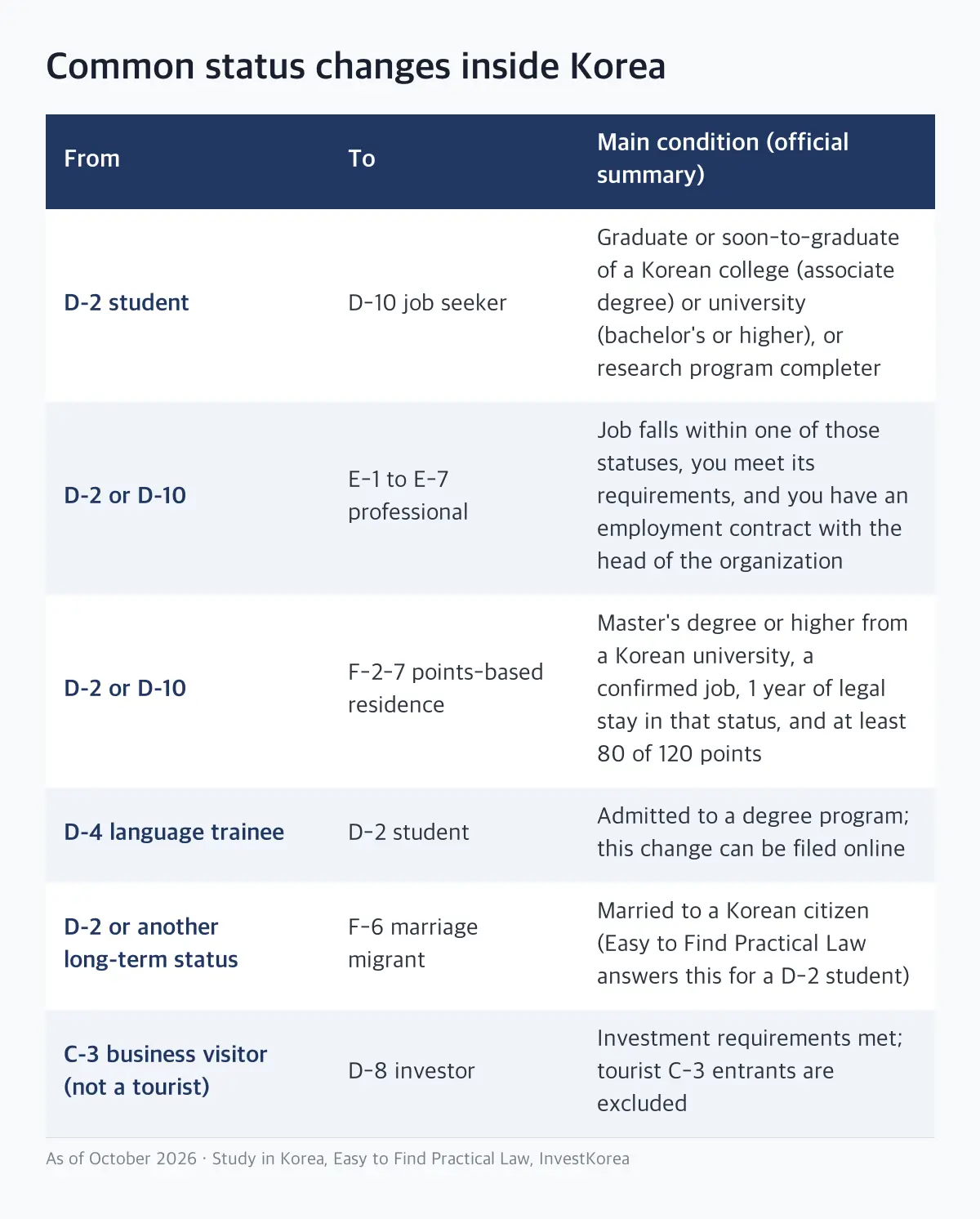
The common switches and what each needs
| From | To | Main condition (official summary) |
|---|---|---|
| D-2 student | D-10 job seeker | Graduate or soon-to-graduate of a Korean college (associate degree) or university (bachelor's or higher), or research program completer |
| D-2 or D-10 | E-1 to E-7 professional | Job falls within one of those statuses, you meet its requirements, and you have an employment contract with the head of the organization |
| D-2 or D-10 | F-2-7 points-based residence | Master's degree or higher from a Korean university, a confirmed job, 1 year of legal stay in that status, and at least 80 of 120 points |
| D-4 language trainee | D-2 student | Admitted to a degree program; this change can be filed online |
| D-2 or another long-term status | F-6 marriage migrant | Married to a Korean citizen (Easy to Find Practical Law answers this for a D-2 student) |
| C-3 business visitor (not a tourist) | D-8 investor | Investment requirements met; tourist C-3 entrants are excluded |
A few details from the official pages that competitors often skip:
- D-2 straight to E-7 is possible. Study in Korea lists D-2 holders as eligible for E-1 to E-7, as long as they are graduating students who would also qualify for D-10. If you already hold a bachelor's degree from your home country or a third country and meet the career requirement, you can switch even while still enrolled.
Two more points matter once you have a job offer:
- E-7 and your major. With a Korean associate degree, the job must relate to your major. With a Korean bachelor's degree or higher, the job does not have to match your major, and no work experience is required.
- Employer limits for E-7. Study in Korea's summary says immigration restricts additional E-7 hiring at domestic-market companies with fewer than 5 Korean employees, or where E-7 holders already exceed 20% of the Korean staff.
- D-10 restriction. You cannot get D-10 if, within the past 1 year, you quit a job on your own (not the employer's fault) and then changed to D-10.
Online or in person?
| Route | Who can use it | Notes |
|---|---|---|
| HiKorea e-Application (전자민원) | Change to D-2 only (Sejongno Immigration Office guidance, February 2026; D-10 changes are in person) | 20% fee discount for e-applications |
| Visit reservation (방문예약), then the office | Everyone else | Mandatory booking under Article 34-2 of the Enforcement Decree |
| Authorized agent | Anyone | A lawyer or licensed administrative agent (행정사) designated by the Ministry of Justice files for you; immigration may still call you in |
The visit reservation is required for a change of status unless you belong to an exempt group: pregnant women (and their spouses), women who gave birth in the past 12 months, infants born in the past 12 months, people with disability ratings 1 to 3, people aged 70 or older, and people who need urgent medical care.
Two more rules apply to everyone:
- You must be in Korea. The Visa Navigator says you cannot file a change of status from abroad, and an agent cannot file for you while you are abroad.
- Applicants under 17 who do not file themselves are filed for by a parent, guardian, sibling, guarantor, or another person living with them.
Show this: 체류자격 변경 신청하러 왔어요. 방문예약 했습니다.
Step by step
- Confirm you are allowed to switch. Check the tables above and HiKorea's Immigration/Stay Guide. Tourist entrants should call 1345 first.
- Collect documents from the other side. Your employer, school, or spouse supplies papers such as the employment contract, business registration, admission letter, or marriage certificate.
- Book a HiKorea visit reservation (Petition Application, then Visit Reservation), or file online if you are changing to D-2.
At the office:
- Submit the form and documents at the immigration office for your address, and pay the fee.
- Keep your receipt. The office sends your file to the Ministry of Justice with its opinion (Enforcement Decree Article 30).
- Collect the result. Approval goes in your passport as a stamp or sticker, or you get a new Residence Card (외국인등록증) instead.
Documents
Every change of status starts with the same base set (Enforcement Rule Article 76 and Table 5-2, as summarized by Easy to Find Practical Law):
| Document | Note |
|---|---|
| Application form (통합신청서, Form 34) | Available on HiKorea and at the office |
| Passport (여권) | Must be valid |
| Residence Card (외국인등록증) | If you are already registered |
| TB clearance certificate from a public health center | Only if required for you |
| Documents for the new status | See below |
Examples from Study in Korea for students moving to work or job seeking:
| Target status | Extra documents |
|---|---|
| E-7 specific activities | Employment contract, one or two company documents (business registration, corporate register), proof of career, copies of licenses, a letter of recommendation or proof the company needs to hire you |
| E-1 to E-5 | Employment contract, company documents, plus status-specific papers such as a criminal record check and medical check for E-2 |
| D-10 job seeking (from D-2) | Diploma or transcript (not needed if immigration can see it in its system), a job-seeking activity plan, a national technical license if you have one |
| D-10 tech start-up (from D-2) | Bachelor's degree or higher, a start-up plan, patent or design registration copies if any, OASIS course certificate if any |
Immigration can ask for more or fewer documents during review, so treat these lists as the minimum.
Fees
Fees come from Article 72 of the Enforcement Rule, checked against the version in force on October 13, 2026 (Article 72 itself was last amended in December 2024):
| Application | Fee |
|---|---|
| Change of status of stay | ₩100,000 |
| Change of status to F-5 permanent residency | ₩200,000 |
| Filed through HiKorea e-Application (change to D-2) | 20% off |
| For comparison: extension of stay | ₩60,000 |
Some visa agency blogs list a separate ₩40,000 fee for F-6 status changes. In the rule, the ₩40,000 F-6 rate belongs to a different permission, granting of status of stay (체류자격부여), which is for people such as babies born in Korea. A change to F-6 is charged the standard ₩100,000.
While your application is pending
- Do not start the new activity yet. The law requires permission in advance. Working or studying under a status you do not have yet can bring up to 3 years in prison or a fine of up to ₩30 million, and deportation.
- Stay in Korea. Applications are handled only while you are in the country.
- Expect no fixed processing time. None of the official guides used here gives one for changes of status. File as early as your paperwork allows, and well before your current stay expires.
If the change is refused, immigration gives you a written notice. Under Article 33 of the Enforcement Decree, the notice sets a departure deadline of up to 14 days from the date it is issued. The current version of Article 33 (amended in December 2023) also lets the Minister of Justice keep you on the status you already have, in which case no departure deadline needs to be written. If your current status still has time left, ask at the counter which of the two applies to you.
Approval can also be taken back later. Under Article 89 of the Act, a change of status can be canceled if it was obtained through false documents, if a guarantor withdraws, if the conditions of the permission are broken, or if circumstances change so much that the status can no longer be kept.
Where to ask
- Immigration Contact Center 1345: dial 1345 inside Korea, or +82-1345 from abroad.
- HiKorea (hikorea.go.kr): Immigration/Stay Guide by status, e-Application, and visit reservations.
- Go to the immigration office that covers your address. The Korea Immigration Service headquarters in Gwacheon does not handle individual cases.
Sources
- Easy to Find Practical Law: Extension of Stay and Change of Status of Stay
- Easy to Find Practical Law Q&A: changing from a student visa to F-6 (Korean)
- Immigration Control Act, Article 24 (Korean, law.go.kr)
- Enforcement Decree, Article 30 (Korean)
- Enforcement Decree, Article 33 (Korean)
- Enforcement Rule, Article 9 (Korean)
- Enforcement Rule, Article 72: fees (Korean)
- Korea Immigration Service: Visa Navigator, Customized Stay Guide for Foreign Residents (PDF, Ver 2023.05)
- Sungshin Women's University: Sejongno Immigration Office e-application and visit schedule, February 20, 2026
- Study in Korea: Employment system for international students (Korean)
- Study in Korea: Residence status and period of stay (Korean)
- Guri City (English): Extension and Change of Status of Stay
- InvestKorea: Application for Visas by Status of Sojourn
- Korea Immigration Service: Immigration Contact Center 1345
This guide is general information, not legal advice. Rules change, so confirm with HiKorea or the 1345 Immigration Contact Center before you apply.
Related guides
 Korea Visa Extension: HiKorea Up to 4 Months Early, Fee ₩60,000When and how to extend your period of stay in Korea: the 4-month window, HiKorea e-Application versus a visit…
 How to Get ARC in Korea (Residence Card): Book Within 90 Days, Pay ₩35,000Staying in Korea longer than 90 days? You need a Residence Card, still called an ARC. Here are the documents, the…
 HiKorea Address Change: Report Within 15 Days, Free, Online (Foreigners)You moved to a new place in Korea. Here is where to report your change of address, what to bring, how the HiKorea…