
On top of the fine, immigration can issue a departure order or a deportation order, and a deportation can lead to an entry ban of up to 5 years. The 2025 special voluntary departure program ended on February 28, 2026, so today the regular voluntary departure rules apply: report 3 to 15 days before your flight and pay the fine to avoid an entry ban.
Last updated: October 22, 2026
There is no grace period
Your period of stay ends on the date on your Residence Card (외국인등록증) or your entry stamp. Article 25 of the Immigration Control Act (출입국관리법) says that if you want to stay longer, you must get an extension before that date. Staying even one day past it without permission counts as overstaying.
Two articles of the act cover it:
- Article 94, item 17: staying past your period of stay without an extension permit.
- Article 94, item 7: staying outside the scope of your status or period of stay (Article 17(1)).
Both carry the same criminal ceiling: up to 3 years in prison or a fine of up to ₩30 million. Overstaying is also listed as a ground for deportation (Article 46(1), item 8).
If your date has not passed yet, stop reading here and apply for an extension of stay, or for the no-fee extension of stay for departure if you only need a few more days to leave.
The fine table by overstay length
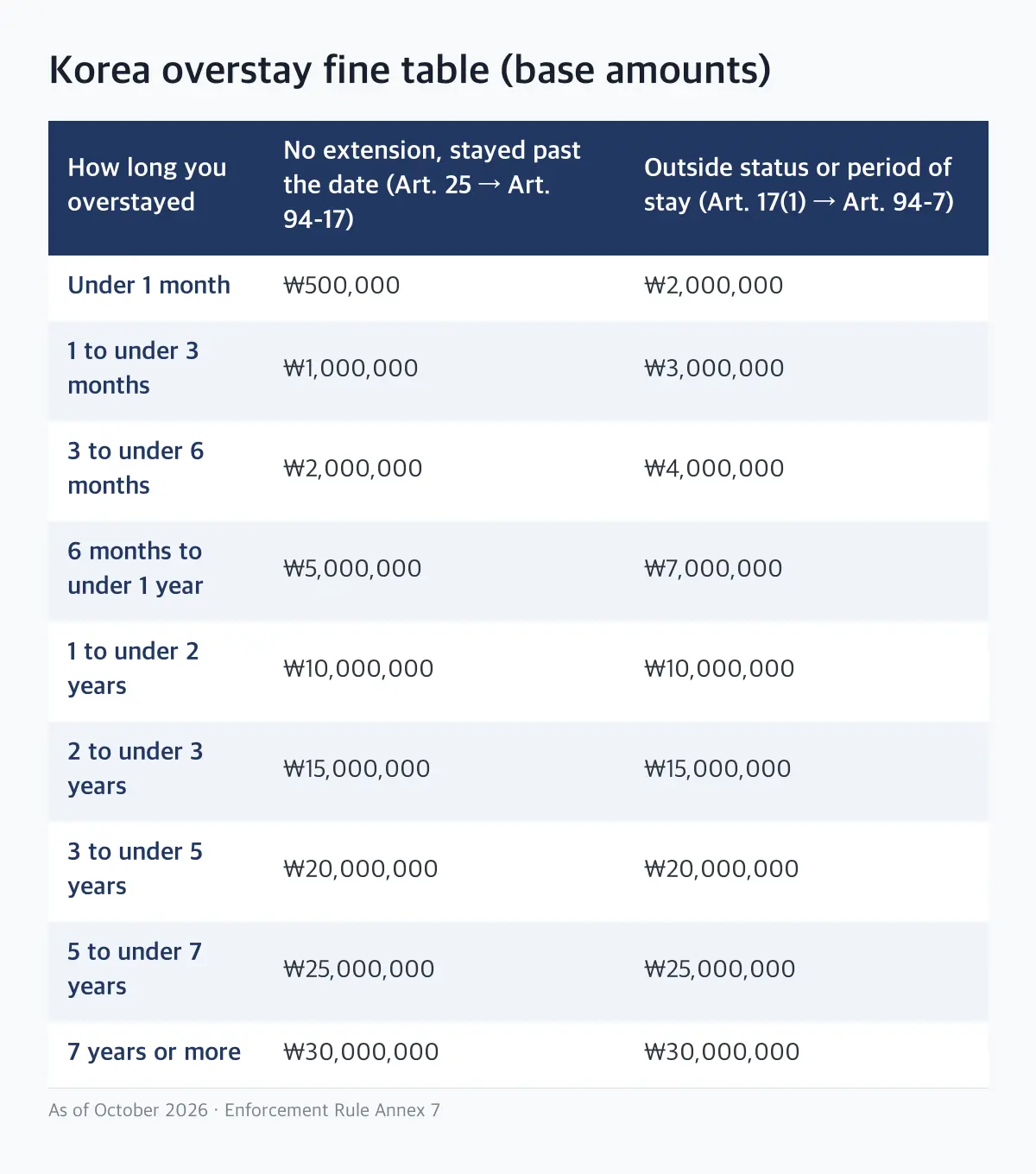
Immigration does not usually send overstay cases straight to court. Under Article 102, the immigration office can issue a notice of disposition (통고처분) ordering you to pay a fine instead. The base amounts are fixed in Annex 7 of the Enforcement Rule (시행규칙 별표 7), last amended on January 23, 2026.
| How long you overstayed | No extension, stayed past the date (Art. 25 → Art. 94-17) | Outside status or period of stay (Art. 17(1) → Art. 94-7) |
|---|---|---|
| Under 1 month | ₩500,000 | ₩2,000,000 |
| 1 to under 3 months | ₩1,000,000 | ₩3,000,000 |
| 3 to under 6 months | ₩2,000,000 | ₩4,000,000 |
| 6 months to under 1 year | ₩5,000,000 | ₩7,000,000 |
| 1 to under 2 years | ₩10,000,000 | ₩10,000,000 |
| 2 to under 3 years | ₩15,000,000 | ₩15,000,000 |
| 3 to under 5 years | ₩20,000,000 | ₩20,000,000 |
| 5 to under 7 years | ₩25,000,000 | ₩25,000,000 |
| 7 years or more | ₩30,000,000 | ₩30,000,000 |
Which column applies depends on which article immigration finds you violated. The table gives the base amount only. The final number can move:
- Up or down by half: the office can cut or raise the base amount by up to one half, looking at your age and situation, why you overstayed, the result, your ability to pay, and how many times you have violated the law (Enforcement Rule Article 86(2)).
- A different amount or no fine: with Ministry of Justice approval, the office can set a different amount, and the Minister can waive the fine entirely based on similar factors (Enforcement Rule Article 86(3), Act Article 103(2)).
- Working without permission is fined separately. Annex 7 has its own line for working without a work-eligible status, starting at ₩2,000,000 for under a month.
Paying the fine: 15 days, and paying ends the case
Once you receive the notice, you have 15 days to pay (Article 105). A few rules matter here:
- If you do not pay in time, the office must file a criminal complaint, which can lead to prosecution. Paying before the complaint is filed stops it.
- If you pay the amount as notified, you cannot be punished again for the same case (Article 106).
- You can pay by credit or debit card through a designated payment agency (Article 102-2), and the office can accept a provisional payment (임시납부) on the spot (Article 102(2)).
- If a deportation order has been issued, the office does not file the criminal complaint for non-payment (Article 105(3)).
Departure recommendation, departure order or deportation
The fine settles the criminal side. Separately, immigration decides whether you can stay or must leave. There are three tools, from lightest to heaviest:
| Measure | When it is used | Deadline to leave | What follows |
|---|---|---|---|
| Departure recommendation (출국권고, Art. 67) | Minor violations of Article 17 or 20 | Up to 5 days | If ignored, a departure order |
| Departure order (출국명령, Art. 68) | You fall under a deportation ground but will leave at your own expense, or leaving is appropriate after a fine | Up to 30 days from the order (Enforcement Rule Art. 65) | Conditions can be attached, and a deposit of up to ₩20 million can be required |
| Deportation order (강제퇴거, Art. 46) | Deportation grounds, including overstaying | Removal by immigration; you can be held in a detention facility | Grounds for an entry ban of up to 5 years |
The key line in Article 68: if you do not leave by the deadline on a departure order, or you break its conditions, immigration must issue a deportation order without delay and can keep the deposit. A departure order is the better outcome, so keep the deadline.
If you receive a deportation order, you can file an objection within 7 days of receiving it, through the immigration office to the Minister of Justice (Article 60).
Re-entry bans: what the law actually says
This is where many online guides go wrong. Here is what the official texts show:
- Deportation: Article 11(1), item 6 lets the Minister of Justice ban the entry of anyone who left after a deportation order less than 5 years ago. This is the only fixed ban period written into the act for overstayers.
- Other cases: Article 11(1), item 8 lets the Minister ban anyone in a similar situation whose entry is not considered appropriate. The act and its decrees do not publish a table of ban lengths by overstay length. Detailed entry restrictions (입국규제) are decided by the Ministry of Justice.
- Voluntary departure: the Ministry of Justice runs a standing voluntary departure system. Since July 2020, people who leave voluntarily and pay their fine are exempted from the entry ban.
So if you see a chart claiming exact bans such as "1 to 3 years for 3 to 12 months," treat it as unofficial. When you apply for a new visa later, the consulate checks whether you are subject to an entry ban (Enforcement Rule Article 9-2), so the only reliable answer for your case comes from immigration or the 1345 Immigration Contact Center.
An old overstay also matters for long-term plans. For F-5 permanent residency, you are not eligible until 7 years have passed since you left on a deportation order, or 5 years since you left on a departure order (Enforcement Rule Article 18-4).
Voluntary departure in 2026: report 3 to 15 days before you fly
The Ministry of Justice ran temporary special voluntary departure programs in 2022, 2023, 2024 and 2025. The most recent one ran from December 1, 2025 to February 28, 2026. During those 90 days, people who reported and left had their fine waived and their entry restriction suspended, even without paying. That program has ended, and the Ministry had not announced a new one as of October 22, 2026.
The standing system still works. Since October 2019, you cannot simply show up at the airport on the day of your flight. You must report in advance:
- Book your flight. The report needs your flight details.
- File a voluntary departure report (자진출국 신고) 3 to 15 days before departure. The 3-day minimum excludes public holidays; the 15-day maximum includes them.
- Choose how to report. In person at the immigration office for your area, with the report form, your passport and your ticket. Or online on HiKorea, entering your personal details, address in Korea, departure date, airport and flight number.
- Pay the fine if one is issued. Under the standing system, paying is what gets you the entry ban exemption.
- Go to the airport on your flight date. Immigration officers at the airport check your criminal record and wanted status before you leave.
People who entered illegally, used a forged passport, committed crimes, or ignored a previous departure order were excluded from the 2025 program. The Ministry's press release describes these groups as deportation cases, so do not expect voluntary departure benefits if you fall into one of them.
Show this: 체류기간이 지났습니다. 자진출국 신고를 하고 싶어요.
Overstayed by a few days? What to do now
The fine table starts at under 1 month, so a few days late lands in the lowest bracket: ₩500,000 base for a missed extension. It is still an overstay, and the way you leave decides whether it follows you.
- Do not just go to the airport and hope. Same-day airport voluntary departure was abolished in 2019. Report first, online or at the immigration office.
- Call 1345 first if you are unsure. Ask which office handles your case, whether you should visit in person, and how to pay. Interpretation is available.
- If you want to stay in Korea, go to the immigration office in person and explain. Whether you can still get a new permit after an overstay is decided case by case; the fine is handled first.
- Keep every receipt. The notice, the payment receipt and the departure report are what you show if a consulate asks about the overstay later.
Sources
- Immigration Control Act (출입국관리법), Korea Law Information Center
- Enforcement Decree of the Immigration Control Act (출입국관리법 시행령)
- Enforcement Rule of the Immigration Control Act (출입국관리법 시행규칙)
- Enforcement Rule Annex 7: Fine standards (별표 7, amended Jan 23, 2026, PDF)
- Ministry of Justice: Management of illegal stayers and the voluntary departure system
- Ministry of Justice press release: 2025 Special Voluntary Departure Program (Nov 28, 2025, PDF)
- Korea Immigration Service (English): 2025 Special Voluntary Departure Program for Undocumented Foreign Residents
- Ministry of Justice: Online advance voluntary departure report on HiKorea (Mar 5, 2020)
- Easy to Find Practical Law: Visa extension and departure deadlines
- Korea.net: 90-day program allows those in Korea illegally to self-deport (Dec 1, 2025)
This guide is general information, not legal advice. Rules change, so confirm with HiKorea or the 1345 Immigration Contact Center before you apply.
Related guides
 Korea Visa Extension: HiKorea Up to 4 Months Early, Fee ₩60,000When and how to extend your period of stay in Korea: the 4-month window, HiKorea e-Application versus a visit…
 How to Change Visa Status in Korea: Get Permission First, Fee ₩100,000Who can switch status of stay inside Korea and who must leave first, the common switches (D-2 to D-10 or E-7,…
 Change of Address Korea (Foreigners): Report Within 15 Days, Free, Online on HiKoreaYou moved to a new place in Korea. Here is where to report your change of address, what to bring, how the HiKorea…