
Last updated: November 2, 2026
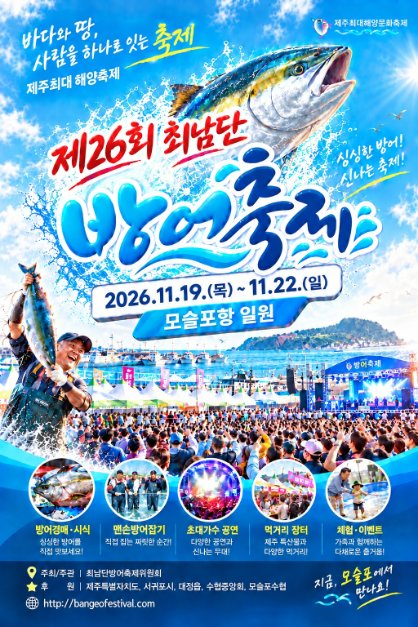
Key facts at a glance
| 2026 details | |
|---|---|
| Dates | Thu, Nov 19 – Sun, Nov 22, 2026 |
| Venue | Moseulpo Port (모슬포항), Daejeong-eup, Seogwipo |
| Listed hours | 10:00 a.m.–5:00 p.m., with some stage events running later |
| Entry | Free (some activities charge a fee) |
| Best single day | Sat, Nov 21, for the most events |
| Organizer | Choenamdan Bangeo Festival Committee |
| Phone | +82-64-794-8032 (Korean) |
The dates and program above come from the Korea Tourism Organization's festival listing, updated on October 30, 2026, and the festival's own website and 2026 poster. VisitKorea's English page still shows the 2024 dates and 9 a.m.–9 p.m. hours, so ignore those. The festival website is in Korean only.
What is bangeo, and why Moseulpo?
Bangeo (방어) is yellowtail, the same fatty fish many sushi menus call hamachi or buri. In Korea, it is a winter fish. Visit Jeju says it tastes best from November to February, when the flesh turns rich and firm.
Moseulpo is the main harbor of southwest Jeju and Korea's southernmost fishing base. Its boats work the rough water around Marado and Gapado, two small islands offshore, where yellowtail gather from October to February. Visit Jeju calls this area the country's largest yellowtail producer, with the highest market value. The festival has celebrated that catch since 2001.
The most common way to eat it is bangeo-hoe (방어회), which means sliced raw yellowtail. Think of it as sashimi, served in thick slices.
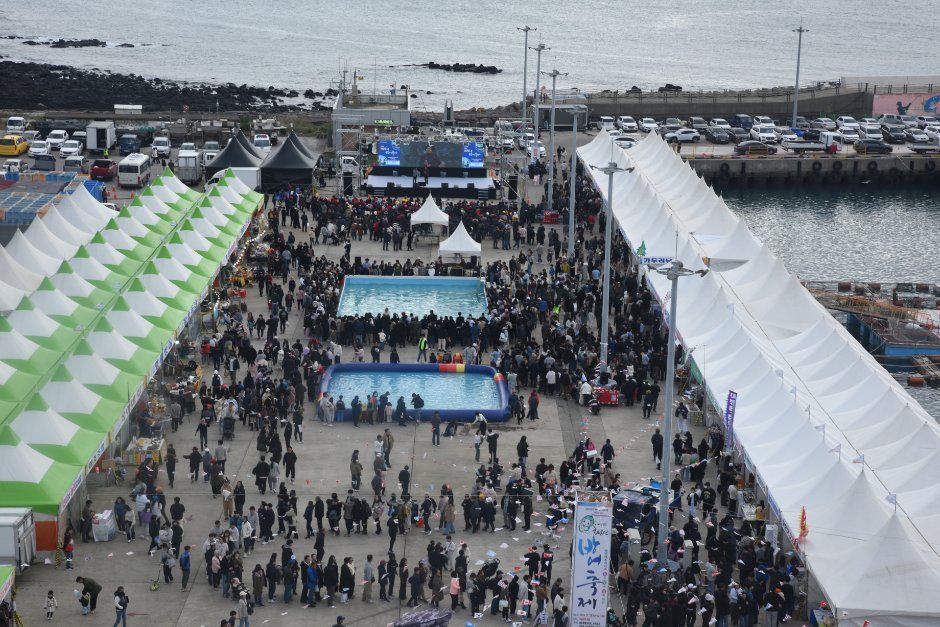
Day-by-day program
Times follow the festival's provisional timetable, which is built on last year's, so stage times can shift.
| Day | Main events |
|---|---|
| Thu, Nov 19 | Parade at 3 p.m., opening ceremony at 5 p.m., evening show from 6 p.m. |
| Fri, Nov 20 | Yellowtail song contest heats, kids' fish catching and free tastings begin |
| Sat, Nov 21 | Giant yellowtail filleting show at 11 a.m., eating contest at noon, haenyeo (해녀, Jeju women divers) song contest at 2 p.m. |
| Sun, Nov 22 | Song contest final at 4:30 p.m., closing ceremony and fireworks in the evening |
The festival's own notices give the closing ceremony as both 7 p.m. and 8 p.m. Be at the port by 7 p.m. on Sunday so you do not miss the fireworks.
If you can only come once, choose Saturday. It has the filleting show, the eating contest and the haenyeo events in one day. Friday is the better pick if you mainly want the free tasting and a little more room.
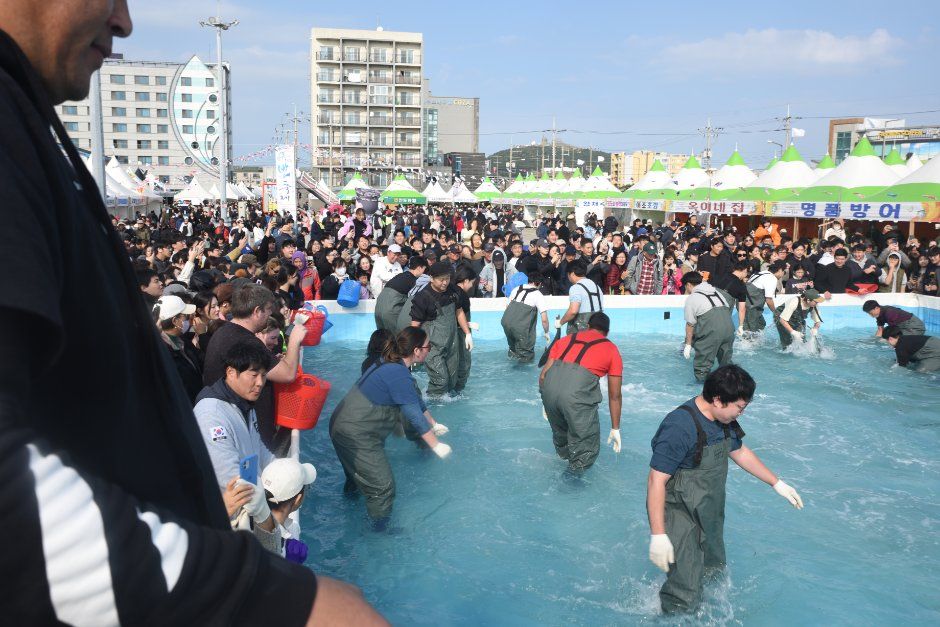
Activities and what they cost
The 2026 listing confirms all the activities below. The fees and hours are from 2025, so budget for those amounts.
| Activity | Fee (2025) | Hours (2025) |
|---|---|---|
| Bare-hand yellowtail catching | ₩20,000 | Thu–Sun, 11 a.m.–5 p.m. |
| Kids' bare-hand catching | Free, first come | Fri–Sun, noon–3 p.m. |
| Net-pen yellowtail fishing | ₩20,000 | Thu–Sun, 11 a.m.–5 p.m. |
| Yellowtail auction | Free to join, you pay your winning bid | Fri–Sun, 11 a.m.–5 p.m. |
| Free yellowtail tasting | Free | Fri–Sun, 11 a.m.–4 p.m. |
No booking is needed. You sign up on-site on the day. Arrive before noon for the kids' session, because it fills in order of arrival.
For bare-hand catching, you wade into a shallow pool and grab a live fish. Past festival photos show adults in chest waders, but bring a change of clothes and a towel anyway.
Show this: 방어 맨손잡기 신청하고 싶어요. 어디서 접수해요?
What to order: Korean words to look for
Menus and stall signs are mostly in Korean, so these words will help.
| Korean | Meaning |
|---|---|
| Bangeo-hoe (방어회) | Sliced raw yellowtail |
| Daebangeo (대방어) | Large yellowtail, usually the fattiest and most prized |
| Baekkopsal (배꼽살) | Fatty belly cut, the favorite part |
| Bangeo meori-gui (방어머리구이) | Grilled yellowtail head |
| Bangeo malgeun-tang (방어맑은탕) | Clear yellowtail soup, not spicy |
| Bushiri (부시리) | A similar fish at its best in summer, also sold as kkot-bangeo (꽃방어) |
| Muryo sisik (무료 시식) | Free tasting |
In Jeju, people often wrap a slice of raw yellowtail in aged kimchi. You can also dip it in sesame oil and wrap it in dried seaweed. "Large" has no legal definition here: Moseulpo sellers start at 4 kg, while others use 8 kg, so ask if size matters to you.
Show this: 방어회 작은 접시 하나 주세요. 몇 명이 먹을 수 있어요?
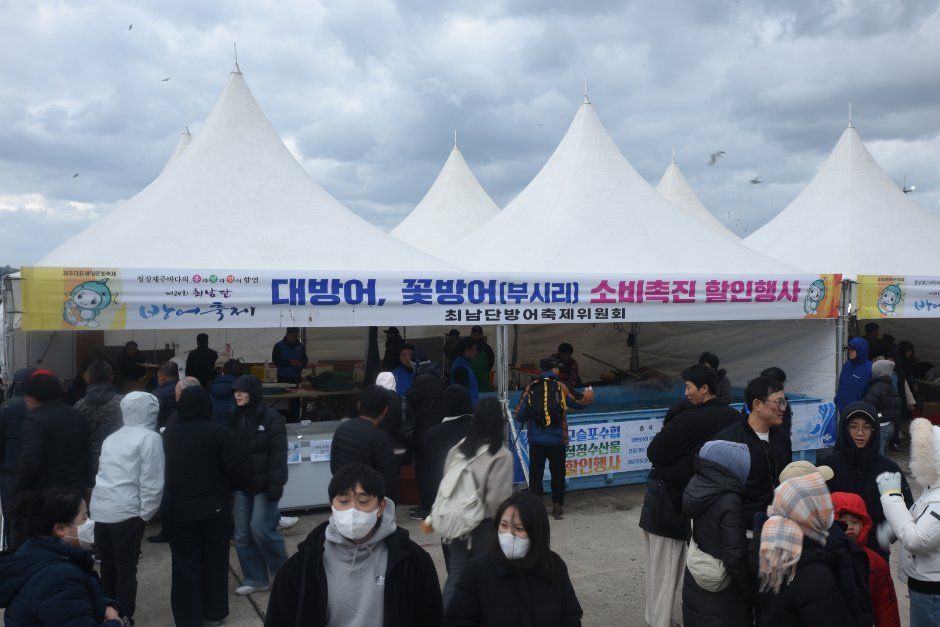
How much does yellowtail cost?
Prices change with the catch, so use these as a guide:
- Festival plate: In 2022, a plate normally priced at ₩15,000 sold for ₩10,000 at the festival, according to Seoul Shinmun.
- Recent trend: The average auction price for an extra-large Moseulpo yellowtail rose from about ₩110,000 in late 2024 to about ₩208,000 in late 2025. Expect festival plates to cost more than the 2022 price.
- Restaurants: Korea JoongAng Daily put the smallest serving for two at about ₩70,000 in December 2025.
As a rough budget, allow ₩20,000 per person for a shared plate at a stall, and more for a restaurant on the festival street. The 2026 listing includes a discount yellowtail sale, so start at the festival tents.
Carry some cash as well. Foreign cards can fail at small vendors, and a temporary stall is a poor place to find that out.
How to get there from Jeju Airport and Seogwipo
| From | Route | Time | Cost |
|---|---|---|---|
| Jeju Airport | Express bus 151 to Hamo Sports Park (하모체육공원), then walk about 300 m | About 1 hr 15 min | ₩2,000–3,000 by card |
| Seogwipo | Express bus 181 to Donggwang Transfer Station (동광환승정류장), then 151 | About 1 hr 25 min–1 hr 40 min | About ₩4,150–5,100 |
| Jeju Airport by car | About 40 km; search for Moseulpo Port parking (모슬포항 주차장) in your map app | About 1 hr 10 min | Rental and fuel |
| Seogwipo by taxi | About 33 km | About 35 min | About ₩33,000–40,000 |
Three things catch visitors out:
- Buses do not take cash. Jeju stopped accepting cash on all regular buses on October 1, 2024. Buy a T-money card at a convenience store before you go to the stop, and load at least ₩10,000.
- Tap off when you leave. Express fares start at ₩2,000 and rise with distance, up to ₩3,000. The extra charge is taken when you get off.
- Bus 151 shows Unjin Port as its end point. That is the ferry port for Marado, about 1.5 km past the festival. Get off earlier, at Hamo Sports Park. Older guides also mention bus 152, which was scrapped in August 2024.
Show this: 모슬포항 방어축제에 가요. 하모체육공원에서 내려야 해요. 도착하면 알려 주세요.
Sunday night is the hard one. The fireworks end well after dark, and the ride back is over an hour. Stay overnight near Moseulpo or arrange a taxi back if you want to see them. If you are based in Seogwipo, Saturday is the easier day.
Saturday traffic and the five-day market
Driving on Saturday, November 21, will be slow. The Daejeong Five-Day Market (대정오일시장) opens on dates ending in 1 and 6, so it falls on the same day as the festival's busiest program. When the two overlapped in 2022, Seoul Shinmun reported that drivers spent 30 to 40 minutes finding a parking space.
The bus is the easier choice on Saturday. If you do drive, aim to arrive before the 11 a.m. filleting show.
The market is about 1 km from the port, so it is an easy add-on. The festival draws big crowds too. Visit Jeju puts the yearly attendance at around 200,000.
What to wear in late November
Wind matters more than temperature here. Korea Meteorological Administration normals for nearby Gosan in late November are a daytime high of 14.6°C (58°F) and a morning low of 8.9°C (48°F), with an average wind of 7.8 m/s (17 mph). That is more than three times the wind in Seogwipo city.
Bring a windproof jacket and something for your neck. You will spend hours standing on an open pier, and it feels colder after sunset.
What else to do near Moseulpo
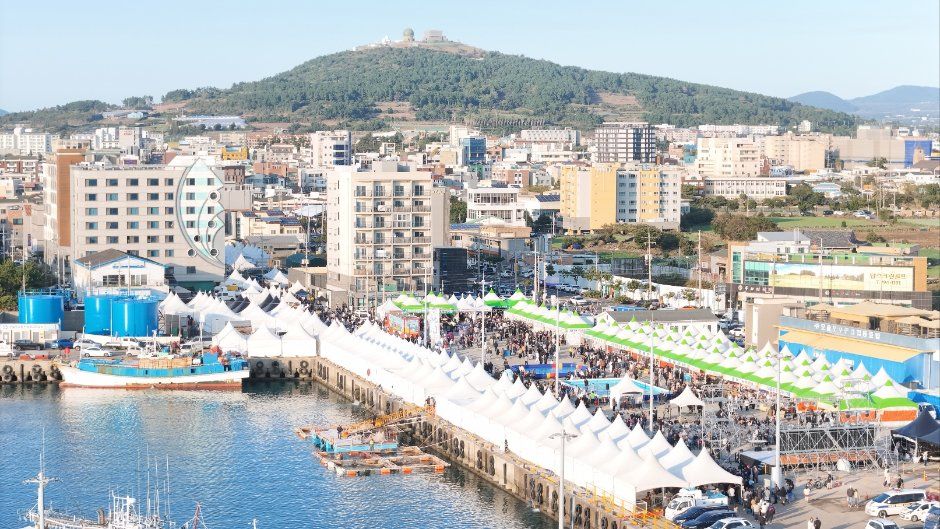
Moseulpo Port is the end of Jeju Olle Route 10 and the start of Route 11. The streets between the old post office site and the port form Bangeo Festival Street (방어축제의거리), where shops sell fish year-round.
| Nearby stop | Distance from the port | Note |
|---|---|---|
| Unjin Port (운진항) | About 1.5 km | Ferries to Marado (30 min) and Gapado (10 min) |
| Alddreu Airfield (알뜨르비행장) | About 4 km | Outdoor site with old hangars |
| Songaksan coastal path (송악산 둘레길) | About 5 km | Loop of about 2.8 km |
| Sanbangsan (산방산) | About 7 km | Adult entry ₩1,000 |
| Yongmeori Coast (용머리해안) | About 7 km | Adult entry ₩2,000; closes for tides and waves |
Ferries stop in strong wind, and November is windy, so keep your Marado plan flexible. You need ID to board. A rental car makes these stops much easier to combine than the bus does.
Need help in English?
The organizer's phone line is in Korean. The Korea Travel Helpline at 1330 can interpret and answer questions in English, which helps if you want to ask about parking or a schedule change.
Sources
- Bangeo Festival, official site (Korean)
- Bangeo Festival, VisitKorea
- Moseulpo Port, Visit Jeju
- Bangeo Festival Street, Visit Jeju
- Daejeong-eup winter walk, Visit Jeju
- Festival guide and 2025 fees, jeju.com
- Jeju bus fares, jeju.com
- Jeju cashless bus report, Wikitree
- 2022 festival report, Seoul Shinmun
- Yellowtail feature, Korea JoongAng Daily
- Seogwipo to Moseulpo routes, Rome2Rio
Related guides
 Jeju Olle Walking Festival 2026: Nov 5–7, Walk-Up Entry ₩35,000 CashThe 2026 Jeju Olle Walking Festival runs November 5–7 on Routes 19 and 20 in northeast Jeju. Online sign-up is…
 T-Money Card Korea: ₩3,000 at Convenience Stores, Top Up With CashWhere to buy a T-money card in Korea, what it costs, how to load it with cash, how transfer discounts work, and how…
 Things to Do in Sokcho: Fish Market, Abai Village Ferry and BeachA practical Sokcho guide for foreigners: the main sights and what they cost, what to eat, a one-day plan that fits…