
Last updated: October 12, 2026
Sokcho at a glance
| Place | What you do | Cost |
|---|---|---|
| Seoraksan National Park | Hike, cable car, autumn leaves | Trails free; cable car 16,000 won |
| Sokcho Tourist & Fish Market | Street food, raw fish center | Pay per dish |
| Abai Village and the Gaetbae ferry | North Korean refugee village, pull the ferry yourself | Ferry 500 won one way |
| Yeonggeumjeong | Pavilion on sea rocks, sunrise spot | Free |
| Sokcho Beach and Sokcho Eye | City beach, Ferris wheel | Beach free; wheel 12,000 won |
| Daepo Port | Fresh fish and fried snacks by the harbor | Pay per dish |
Prices are from the Korea Tourism Organization's listings and the operators' own pages, as of October 2026.
Seoraksan: the reason most people come
Seoraksan National Park starts at the edge of the city. From the Sokcho intercity bus terminal, city buses 7 and 7-1 go to the last stop, the Seoraksan parking lot at Sogongwon (소공원).
- Easy: the Seorak Cable Car to Gwongeumseong viewpoint, or the flat valley walk to Biseondae.
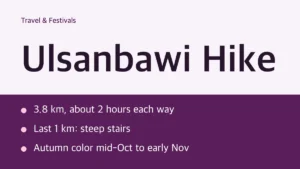
- Hard: the Ulsanbawi Rock hike, a half-day climb that ends in steep stairs.
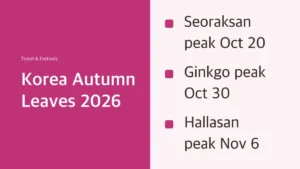
In autumn, the Korea Forest Service expects Seoraksan's color to peak around October 20, 2026. Weekend roads to the park are crowded until early November, so go early in the morning and leave the city sights for the afternoon.
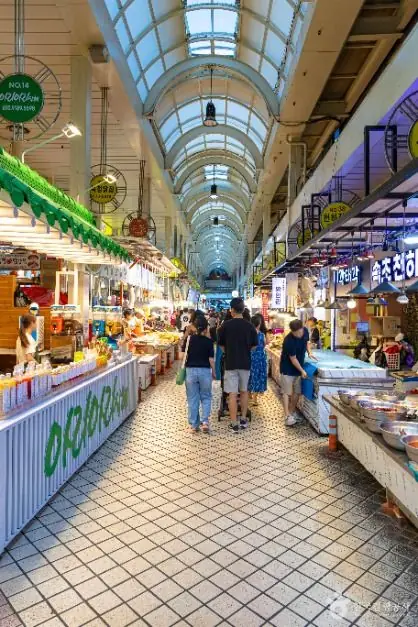
Sokcho Tourist & Fish Market: what to eat
The market (속초관광수산시장) is the city's food hall. It has a main building with a raw fish center in the basement and five covered alleys outside, including a sundae (Korean sausage) alley and a fish and salted seafood alley. Because the alleys are covered, it works on rainy days too.
What people line up for:
- Dakgangjeong (닭강정): crispy sweet-and-spicy fried chicken, sold in boxes to take away. A whole alley of shops sells it.
- Ojingeo sundae (오징어순대): squid stuffed with rice and vegetables, sliced and pan-fried.
- Abai sundae (아바이순대): a large North Korean-style sausage.
- Fried snacks: shrimp, squid and vegetable twigim from the street stalls.
The market is open about 8 a.m. to midnight, but each shop sets its own hours and days off. If you drive, spending 15,000 won or more gets you a 30-minute parking discount ticket (up to two).
Show this: 닭강정 작은 거 하나 주세요. (One small box of dakgangjeong, please.)
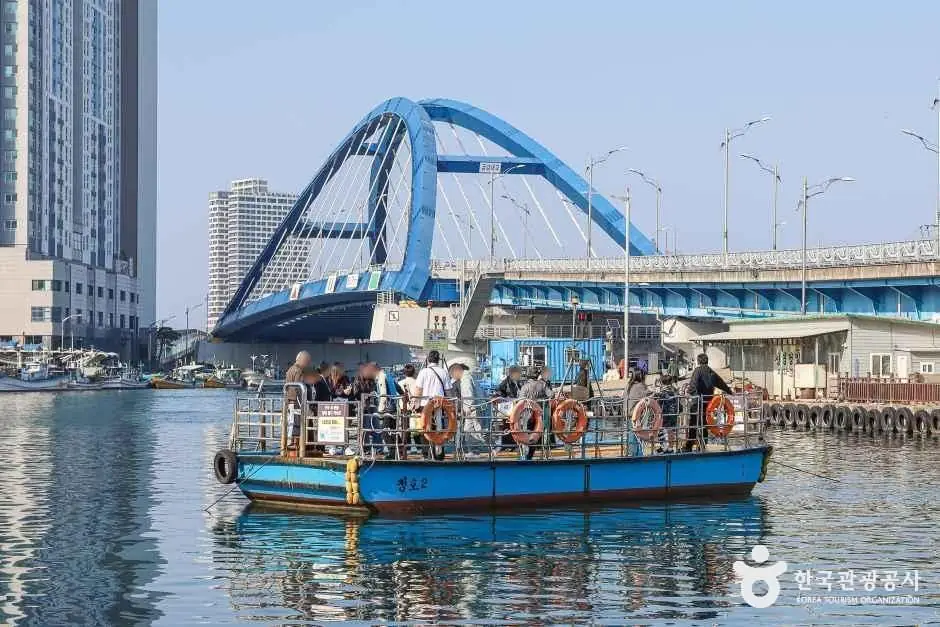
Abai Village and the Gaetbae ferry
Abai Village (아바이마을) was built by refugees from Hamgyeong Province in North Korea who came south in 1951. "Abai" means an older man in their dialect. It is the only village of its kind in Korea. A few old houses and murals about the lost hometowns remain, and the lanes near the water are full of North Korean-style restaurants serving Hamheung naengmyeon (cold noodles) and sundae soup.
The fun way in is the Gaetbae (갯배), a flat ferry with no engine. Passengers pull it across a 50 m channel by hooking onto a steel cable. The crossing takes only a few minutes.
| Gaetbae ferry | Details |
|---|---|
| Adult fare | 500 won one way |
| Child (elementary school) | 300 won |
| Hours, May to October | 5:00 a.m. to 11:00 p.m. |
| Hours, November to April | 5:30 a.m. to 10:30 p.m. |
The ferry can stop in bad weather. Abai Village itself is open all the time and free.
Yeonggeumjeong: sunrise on the rocks
Yeonggeumjeong (영금정) is a stretch of wide, flat sea rocks under the Sokcho lighthouse. The name comes from the old saying that the waves hitting the rocks sound like a geomungo, a Korean string instrument. A pavilion stands on the rocks at the end of a footbridge of about 50 m, and locals call it the sunrise pavilion. Entry is free.
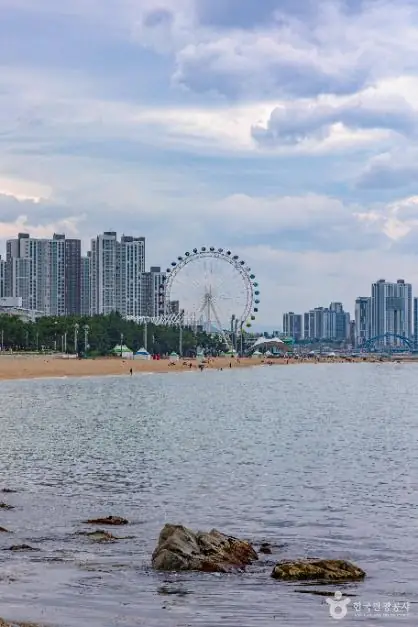
Sokcho Beach and the Sokcho Eye
Sokcho Beach (속초해수욕장) is the city beach, a walk from the express bus terminal. The water is shallow, and behind the sand there is a pine grove and a short walking path. Outside summer it is a photo stop, with a big frame, a compass and a "stairway to heaven" sculpture on the sand. The beach and its parking are free.
At the end of the beach turns the Sokcho Eye (속초아이대관람차), a Ferris wheel as tall as a 22-story building. You see the sea on one side and Seoraksan on the other.
| Sokcho Eye | Details |
|---|---|
| Adult ticket | 12,000 won |
| Child | 6,000 won |
| Senior | 9,000 won |
| Ride | about 15 minutes |
| Hours | 10 a.m. to 8 p.m., last ticket 7:30 p.m. |
No food is allowed inside except bottled water. It lights up at night, so sunset is a good time to ride.
Daepo Port
Daepo Port (대포항), at the south end of the city, is a working fishing harbor known for fresh fish such as flatfish and yellowtail, plus an alley of fried seafood stalls. It is a good stop if you come from the south or drive along the coast.
A one-day plan with Seoraksan
- 7–8 a.m.: bus 7 or 7-1 to Seoraksan; cable car or a morning hike.
- 1 p.m.: back in the city; lunch at the Tourist & Fish Market.
- 3 p.m.: walk to the Gaetbae dock, cross to Abai Village.
- 5 p.m.: Sokcho Beach and the Sokcho Eye at sunset.
- Evening: seafood dinner, or a box of dakgangjeong for the bus back.
Getting to Sokcho from Seoul
There is no direct train to Sokcho. Take a bus:
- Express bus: about 2 hours 30 minutes to Sokcho Express Bus Terminal, near Sokcho Beach.
- Intercity bus: about 2 hours 10 minutes to Sokcho Intercity Bus Terminal, near the market and the Seoraksan buses.
- Buses run about every 30 minutes. On autumn weekends, book a return seat early.
Show this: 속초 가는 버스 표 한 장 주세요. (One bus ticket to Sokcho, please.)
Sources
- Korea Tourism Organization: Sokcho Tourist & Fish Market (Korean)
- Korea Tourism Organization: Abai Village (Korean)
- Korea Tourism Organization: Abai Village Gaetbae ferry (Korean)
- Korea Tourism Organization: Sokcho Eye Ferris wheel (Korean)
- Seorak Cable Car: fares and directions (Korean)
Hours and prices can change by season. Check the official pages or call before you go.
Related guides
 Seoraksan Autumn Foliage 2026: Peak Oct 20, Valleys Late OctoberSeoraksan's 2026 foliage is forecast to peak around October 20, starting on the high ridges and reaching the valleys…
 Ulsanbawi Hike: 3.8 km and 2 Hours Each Way, Then Steep StairsHow long the Ulsanbawi Rock hike really takes, using the national park's own distances: an easy first hour to the…
 Korea Autumn Leaves Forecast 2026: Seoraksan Peaks Oct 20, Hallasan Nov 6The Korea Forest Service expects peak autumn color from Seoraksan on October 20 to Hallasan on November 6. Here are…