
Last updated: November 17, 2026
How do you order? By the serving, usually two or more
A Korean BBQ restaurant is called a gogi-jip (고깃집), literally "meat house". The menu lists each cut by the serving, written as il-inbun (1인분, one serving). You tell the server the cut and the number of servings.
- Start with 2 servings. This is a house rule at most grill restaurants, not a law. One grill, one set of side dishes and one charcoal fire cost the restaurant the same whether one or four people sit down.
- Order more as you go. Nobody expects the whole order at the start. Koreans usually begin with two or three servings and add one at a time.
- Pick one kind of restaurant. Most places specialize in pork or in beef, so the menu is short.
| Menu word | What it is |
|---|---|
| samgyeopsal (삼겹살) | Pork belly, the default first order |
| moksal (목살) | Pork neck, leaner than belly |
| galbi (갈비) | Ribs, pork or beef, often marinated |
| deungsim (등심) | Beef sirloin |
| Hanwoo (한우) | Korean native beef, the most expensive option |
Show this: 삼겹살 2인분 주세요.
Can you eat Korean BBQ alone?
Yes, if you order for two. A Korea Times columnist described being turned away from the dinner menu as a single diner and solving it by ordering two servings by himself. That is still the practical answer today: a solo diner who orders the 2-serving minimum is a normal customer.
Two things make it easier. Go outside the dinner rush, when a table for four is not needed for a group. And ask at the door before you sit down, so nobody has to explain the rule after you are seated.
Show this: 혼자인데 2인분 주문하면 먹을 수 있나요?
Who grills the meat?
It depends on the restaurant, and you will know within a minute of the meat arriving.
| What happens | What you do |
|---|---|
| A server puts the meat on the grill and stays, or keeps coming back to turn it | Leave the tongs alone. Wait until the server says you can eat |
| A server drops off the plate, tongs and scissors and walks away | You grill it yourselves |
The Korea Tourism Organization notes that some places have staff grill the meat for you and tell you when it is ready. This is common at beef restaurants and at places with thick cuts.
When you grill it yourselves:
- Tongs are for raw meat. Lay the pieces on the hot grill with the tongs. Use your chopsticks only for cooked meat.
- Flip thick pork once or twice. Wait until the bottom is brown before you turn it.
- Cut with the scissors. Hold a strip with the tongs and snip it into bite-size pieces on the grill. Scissors are a normal kitchen tool in Korea, not a sign that something is wrong.
- Cook pork all the way through. Thin beef cooks in seconds and many people eat it slightly pink. Pork should have no pink left.
- Move cooked pieces to the edge of the grill, where the heat is lower, so they stay warm without burning.
In a group, one person usually takes the tongs for the table. In a Korean group it is often the youngest person, and the oldest person takes the first bite. As a visitor, offering to grill is polite, and handing the tongs to someone more skilled is also fine. If soju is on the table, the pouring rules are their own subject.
If you have never done it, ask. Staff help first-timers all the time.
Show this: 처음이라서 그런데, 고기 좀 구워 주실 수 있나요?
When should you ask for a new grill?
Ask when the grill plate is black with burnt bits, and when you switch from plain meat to marinated meat. Marinades contain sugar and char fast. A burnt grill makes the next batch taste bitter.
Changing the grill is free and expected. Many servers swap it without being asked. If yours does not, press the call bell or say yeogiyo (여기요), which means "over here".
Show this: 불판 좀 갈아 주세요.
How do you make a ssam (lettuce wrap)?
A ssam (쌈) is one piece of meat wrapped in a leaf. The Korea Tourism Organization describes it as meat on lettuce or perilla leaves with ssamjang (쌈장), a paste of red chili and soybean paste, eaten in one bite.
- Put a lettuce leaf flat on your palm. Add a perilla leaf (깻잎) on top if you like its minty taste.
- Add one piece of meat.
- Add a small dab of ssamjang.
- Add what you like: grilled garlic, kimchi, green onion salad, a little rice.
- Fold it into a ball and eat it whole.
Keep the wrap small enough for one mouthful. Biting a ssam in half makes it fall apart. Nothing is off limits as a filling, so build each wrap differently.
Plain meat is also dipped in sesame oil with salt. You do not have to wrap every piece.
Are side dish and lettuce refills free?
Yes. The side dishes (banchan, 반찬), the lettuce basket, garlic and sauces come with the meat order. The Korea Tourism Organization states that requests for extra water or side dishes do not add to the bill, and that more restaurants now have a self-service bar where you refill them on your own. Look for a sign that says self (셀프).
Take what you will finish. Asking for a third basket of lettuce is fine. Leaving a full one is not.
Show this: 상추랑 반찬 좀 더 주세요.
What do you order after the meat?
Koreans treat the meat as the first half of the meal. The second half is a small starch or soup dish, ordered when the meat is almost gone. These are paid extras, listed in a section of the menu called siksa (식사, meal).
| Add-on | What it is |
|---|---|
| gonggi-bap (공깃밥) | A bowl of steamed rice |
| doenjang-jjigae (된장찌개) | Soybean paste stew, shared in the middle of the table |
| naengmyeon (냉면) | Cold buckwheat noodles, in icy broth or spicy sauce |
| bokkeum-bap (볶음밥) | Rice fried on the grill with the leftover meat and kimchi |
One stew for the table and one rice or noodle dish per person is plenty.
Show this: 공깃밥 하나랑 된장찌개 하나 주세요.
How much does Korean BBQ cost? Read the 100 g price
The price next to "1 serving" tells you little until you see the weight. A serving is whatever the restaurant decides. A 2024 Chosun Biz check of 20 pork belly restaurants in Seoul's Jongno district found 160 g at 11 places, 150 g at 7 and 200 g at only 2. Some restaurants serve 120 to 130 g.
Korean law gives you a way to compare. Under the Food Sanitation Act enforcement rules, restaurants must show meat prices per 100 g. If they also show a per-serving price, the serving weight has to be printed with it. The government's own example reads: sirloin 100 g ₩22,000 (1 serving 150 g ₩33,000). The weight is the raw weight before grilling.
The Korea Consumer Agency tracks pork belly prices on its price portal and converts every restaurant's serving to 200 g, because servings run from about 100 g to 250 g.
| Where and when | Pork belly, 200 g | Same price per 100 g |
|---|---|---|
| National average, September 2026 | ₩17,906 | about ₩8,950 |
| Seoul, June 2026 | ₩21,321 | about ₩10,660 |
So a 150 g serving at the Seoul average works out to about ₩16,000. The Segye Ilbo ran the numbers for a full dinner: two people sharing four 200 g servings in Seoul pay ₩85,284 for the meat alone, before rice, stew or drinks. Menu prices already include VAT.
Beef costs far more. The same Chosun Biz report cited a well-known Hanwoo rib restaurant in Suwon charging ₩102,000 for one 250 g serving.
What does the origin label on the menu mean?
Every restaurant in Korea must show where its meat comes from. The rule covers six meats: beef, pork, chicken, duck, lamb and goat. Each menu item is marked as domestic or with the country it was imported from, in letters at least as large as the menu text. Rice and cabbage kimchi are labeled too.
| Meaning | On the menu |
|---|---|
| Domestic, raised in Korea | guknaesan (국내산) |
| Korean native beef | Hanwoo (한우) |
| From the United States | miguksan (미국산) |
| From Australia | hojusan (호주산) |
A false origin label can bring up to 7 years in prison or a fine of up to ₩100 million. Leaving the label off brings a fine of up to ₩10 million. So the label is reliable, and it explains most of the price gap between two beef restaurants: Hanwoo costs far more than imported beef.
What should you wear to Korean BBQ?
Wear something washable. The Korea Tourism Organization points out that most tables have a vent that pulls up the smoke, but the smell of grilled meat still clings to wool coats and long hair by the end of the meal.
Restaurants plan for this. Many hand out aprons, and many have seats with a lid that opens for storing coats and bags, or large plastic bags for the same purpose. Use them. If nobody offers an apron, ask.
Show this: 앞치마 있어요?
How do you pay?
There is no bill at the table and no tipping in Korea. When you finish, walk to the counter by the door and pay there. Staff ring up the table as one total, so tell the cashier before the first card goes in if you want to split it.
A few last manners before you stand up:
- Leave the tongs and scissors on the table, not on the grill.
- Do not order extra meat you cannot finish. Add one serving at a time near the end.
Show this: 계산할게요.
Sources
- Korea Tourism Organization: About Korean Food (ssam, grill restaurants, free side dishes)
- Korea Tourism Organization: Grilled Pork Belly (Samgyeopsal)
- Easy to Find Practical Law: Restaurant price display rules, Food Sanitation Act enforcement rules
- Korea.kr policy news: Final price and per-100 g meat pricing on menus (2013)
- Geumcheon-gu Public Health Center: Restaurant origin labeling
- Financial News: Korea Consumer Agency dining prices, September 2026
- Segye Ilbo: Seoul pork belly price, June 2026
- Chosun Biz via Daum: Serving sizes at Seoul pork belly restaurants (2024)
- The Korea Times: Enjoy Korean BBQ! (2015)
Prices and serving sizes differ by restaurant, so this guide reflects sources as of November 2026.
Related guides
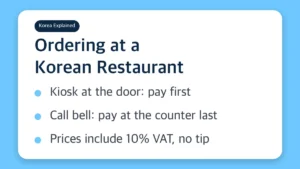 How to Order at a Korean Restaurant: Press the Bell, Pay at the CounterMost Korean restaurants take your order through a kiosk, a table tablet or a call bell, and you pay at the counter…
 Korean Drinking Etiquette: Two Hands, Turn Away, Never Self-PourThe pouring, toasting and seating rules at a Korean table, how to turn down a drink at a hoesik or year-end party…
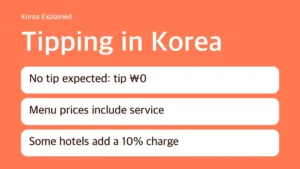 Tipping in Korea: No Tip Expected, Even at Luxury HotelsYou do not need to tip in Korea. Why menu prices already include service, what the 10% hotel charge means, and what…