
Last updated: November 15, 2026
These rules come from Confucian manners that go back to the Joseon Dynasty. Korea.net, the government's official site, traces them to Sohak (소학, "Lesser Learning"), a Joseon rulebook for daily life. Koreans don't expect a foreigner to know every detail, but following the basics at a work dinner gets noticed. The Korea Herald notes that the stricter manners apply mainly to formal business dinners, and you can relax with close colleagues.
The 7 core rules of Korean drinking etiquette
| Rule | What to do | Why |
|---|---|---|
| 1. Two hands | Pour and receive with both hands when the other person is older or senior | Shows respect. Korea.net: people who speak formally to each other use two hands |
| 2. Turn away | Turn your head to the side and cover the glass with your hand as you drink in front of a senior | A Joseon manner still followed today |
| 3. No self-pouring | Don't fill your own glass. Pour for someone else and they will pour back | Self-pouring is called jajak (자작) and is traditionally discouraged |
| 4. Glass lower | When you clink, keep the rim of your glass below the senior's | Shows respect during the toast |
| 5. No topping up | Don't add drink to a glass that still has some in it | Called cheomjan (첨잔). Koreans reserve it for ancestral rites |
| 6. Not to the brim | Fill the glass short of the top | A full-to-the-brim pour can feel like a challenge to drink it all |
| 7. Ask first | Watch the one or two people next to you, wait a bit, ask, then pour | Pouncing on an empty glass can read as pushing someone to drink |
When one hand is fine
You don't need two hands with everyone. Korea.net, citing the National Research Institute of Cultural Heritage, says one hand is acceptable when the age gap is less than five years. The two-hand rule is for people you address formally and for anyone clearly older or above you at work.
How to pour and receive
- Pouring for a senior: hold the bottle in your right hand and support it with your left. The Joseon version described in Korea.net was holding the bottle with the right hand and holding back the right sleeve with the left, so it doesn't touch the food.
- Receiving from a senior: lift your glass a little and hold it with both hands while they pour. Say thank you.
- Drinking: wait until everyone has a drink and the toast is made. Then turn your head to the side, away from the senior, and drink.
The common word for the toast is geonbae (건배), "cheers."
Where to sit and how to start
The Korea Herald's guide to business drinking covers two things that happen before the first glass:
- The best seat is the one farthest from the entrance, against the wall. It is called sangseok (상석) and goes to the most senior person. In a row of three or more, the most senior person sits in the middle. The seat nearest the door goes to the most junior person.
- Don't sit down before your seniors. Hang back and let a Korean colleague point people to their seats.
- Don't open with business talk. Chat about other things first. Work topics come up later.
Somaek and the first glass
Somaek (소맥) is soju (소주) mixed with beer. It is the standard drink at a hoesik and at group toasts. Korea.net quotes a traditional liquor expert who points out it is a modern habit, not an old one. It started with industrialization and cheap alcohol. If the boss asks someone to mix somaek for the table, that person pours for everyone. Otherwise, the Herald says a junior should not take it upon themselves to fill every senior's glass without asking.
The first toast is where the pressure to drink is strongest. Older crowds may expect you to drain the first glass in one go, which Koreans call one-shot (원샷).
You don't have to. The Korea Herald says it is good manners to drink at least a little, or just touch the glass to your lips at the first toast. This is also the traditional answer. Korea.net says that even under Joseon rules, someone who did not drink should sip the cup and put it back on the table.
How to decline a drink politely
Here is the order that works at most tables, based on the Korea Herald's guide:
- Let them pour. Accept the glass with two hands. Refusing the pour itself is the awkward part.
- Touch it to your lips and set it down. Your glass stays full, so nobody tops it up (rule 5).
- Give one clear reason if someone pushes. Health and driving are the reasons the Herald lists as accepted.
- Join toasts with a soft drink. You still clink and turn your head.
Show this: 죄송하지만 오늘은 술을 못 마셔요. (Sorry, I can't drink today.)
Show this: 약을 먹고 있어서 한 잔만 받을게요. (I'm on medication, so I'll just take one glass.)
Show this: 운전해야 해서 음료수로 할게요. (I have to drive, so I'll have a soft drink.)
Show this: 저는 술을 안 마셔요. 사이다로 건배할게요. (I don't drink. I'll toast with a lemon-lime soda.)
Show this: 천천히 마실게요. (I'll drink slowly.)
Penalty drinks are fading too. Beolju (벌주), the "penalty drink" that losers of drinking games had to down, is now widely seen as outdated among students, the Korea Herald reported in August 2025.
Hoesik: the company dinner
A hoesik (회식) is a meal with your team after work, usually with alcohol. The Korea Herald calls it "an extension of work": the mood loosens, but the office hierarchy stays. A traditional hoesik runs in rounds: dinner first (1차), then a bar (2차), then another bar or karaoke.
It is much smaller than it used to be:
| Source | What it found |
|---|---|
| Seoul survey, March 2023 (via Korea Herald, June 2026) | 64.4% said they had fewer hoesik since COVID-19 |
| Korea Disease Control and Prevention Agency, 2024 | 56% of people aged 19 to 29 don't drink or drink less than once a month, the highest since 2005 |
| Opensurvey, 2025 (via Korea JoongAng Daily) | People in their 20s and 30s drank 6.4 times a month, down from 7.04 in 2024 |
| Seoul Metro (via Korea Herald, June 2026) | Subway use after midnight fell 23.7% from 2019 to 2025, and 46% at Gangnam Station |
One office worker told the Korea Herald in April 2026 that hoesik used to last until 2 or 3 a.m., and now people feel they should head home at 11 p.m. or midnight.
What this means for you:
- Go to the first round if you can. It is where the team eats and talks. Later rounds are easier to skip.
- Leaving early is normal. Say goodbye to the most senior person before you go.
- You don't have to drink to attend. Forcing others to drink is considered a form of workplace abuse today, per the Korea Herald.
Show this: 내일 일찍 일이 있어서 먼저 들어가 보겠습니다. 즐거운 시간 보내세요. (I have an early start tomorrow, so I'll head out first. Enjoy the rest of the night.)
Who pays
At a hoesik, you don't pay. It is a work event, so expect the company or the most senior person to cover it. Don't fight over the check with your boss. With friends, splitting the bill is common, and the person who invites often pays. Tipping isn't expected in Korea, so the total on the bill is what you owe (see tipping in Korea).
Year-end parties in December
December is year-end party season. The parties are called songnyeonhoe (송년회) and are the biggest hoesik of the year. A job platform survey shows how mixed feelings are.
Incruit surveyed 888 office workers from November 27 to December 5, 2025, as reported by the Korea Herald:
| Question | Result |
|---|---|
| Will your workplace hold a year-end party? | 69.7% yes |
| Of those, can you choose whether to attend? | 69.8% yes |
| Are year-end office dinners necessary? | 41.2% said no |
| Preferred format, people in their 20s | 36% during work hours, 32.4% lunch, 31.6% dinner |
| Preferred format, people in their 50s | 60.2% dinner |
| Just a meal, no drinking | 38.8% of people in their 20s |
| Dinner and drinks | 47.2% of people in their 50s |
The gap is generational. Managers in their 50s often still expect dinner and drinks, while younger staff prefer lunch or an event during work hours. If your team's party is an evening dinner, everything above applies, and the same polite refusals work.
Drinking age
The legal age to drink in Korea is counted by birth year: you can drink from January 1 of the year you turn 19. Bars and convenience stores can ask for ID. For the full rules, see drinking age in Korea.
Drunk driving: the 0.03% limit
Korea's limit is a blood alcohol level of 0.03%, under Article 44 of the Road Traffic Act (도로교통법). The Korean National Police Agency said in 2019 that people usually reach 0.03% about an hour after one glass of soju, though it varies by person.
The rule covers cars, motorcycles and e-scooters, and also bicycles. Article 44 bans riding a bicycle after drinking, and an electric kick scooter counts as a motorized bicycle under the same law.
| Blood alcohol | Criminal penalty (Road Traffic Act, Article 148-2) | License |
|---|---|---|
| 0.03% to under 0.08% | Up to 1 year in prison or up to ₩5 million | Suspended |
| 0.08% to under 0.2% | 1 to 2 years in prison or ₩5 to 10 million | Revoked |
| 0.2% or more | 2 to 5 years in prison or ₩10 to 20 million | Revoked |
| Refusing the breath test | 1 to 5 years in prison or ₩5 to 20 million | Revoked |
Repeat offenders face heavier ranges. The license thresholds (suspension from 0.03%, revocation from 0.08%) took effect on June 25, 2019, per the Korea Times.
Watch the morning after. In May 2019, nearly 10% of drivers caught between 0.03% and 0.05% were stopped between 6 a.m. and 10 a.m., after drinking the night before, the police said. The police advice: take public transportation the morning after a heavy night.
If you drove to a hoesik, leave the car, take a taxi, or call a designated-driver service, called daeri unjeon (대리운전). The driver comes to you and drives your car home.
Show this: 대리운전 불러 주실 수 있어요? (Could you call a designated driver for me?)
Drinking in public
Korean law has no nationwide ban on drinking outdoors. Instead, under the National Health Promotion Act (국민건강증진법), a city or district can name places where many people gather as alcohol-free zones (금주구역) and must post signs. Drinking inside one can bring a fine of up to ₩100,000. Look for the sign in parks and near children's facilities.
FAQ
What do Koreans say before drinking?
Geonbae (건배), which means "cheers." At company dinners, the senior person often gives a short toast first, and everyone drinks together after it.
Is it rude to refuse a drink in Korea?
Refusing the pour is awkward, but not drinking it is fine. Accept the glass, touch it to your lips and set it down. If someone keeps pushing, a health or driving reason ends the conversation.
Do I have to go to the second round?
No. The first round is the main event. Say goodbye to the most senior person and leave.
Sources
- [Korea.net: Alcohol in Korean Life [8], sul and manners (National Research Institute of Cultural Heritage, 2014)](https://www.korea.net/NewsFocus/Culture/view?articleId=117340)
- Korea.net: 4 experts discuss Korean booze culture (2022)
- Korea Herald: How about a drink? What alcohol means to business in Korea (October 2025)
- Korea Herald: Politeness without pressure, Gen Z drinking norms (August 2025)
- Korea Herald: Incruit year-end party survey (December 2025)
- Korea Herald: Seoul survey on hoesik and binge drinking (June 2026)
- Korea Herald: KDCA data on heavy drinking (April 2026)
- Korea Times: Drinking no longer default for Korea's Gen Z (April 2026)
- Korea Times: Why more young Koreans are avoiding company dinners (August 2026)
- Korea JoongAng Daily: Why has drinking fallen below the pandemic level? (2026)
- Korea Times: Korean National Police Agency on the 0.03% rule (June 2019)
- Road Traffic Act (도로교통법), Articles 2, 44, 93 and 148-2, Korean Law Information Center (in Korean)
- National Health Promotion Act (국민건강증진법), Articles 8-4 and 34, Korean Law Information Center (in Korean)
Customs differ by company, generation and region, so follow what the people at your table do. This guide reflects sources as of November 2026 and is general information, not legal advice.
Related guides
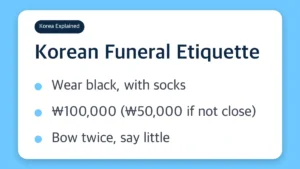 Korean Funeral Etiquette: Wear Black, Give ₩100,000, Bow TwiceWhat to wear, how much condolence money to give, how to write the envelope, and the exact order at a Korean funeral…
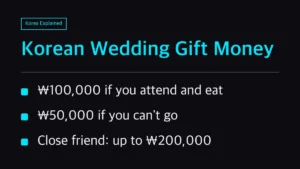 Korean Wedding Gift Money Is ₩100,000 to Attend, ₩50,000 to SkipHow much to give at a Korean wedding, with amounts by relationship, what bank data and surveys show, how to fill out…
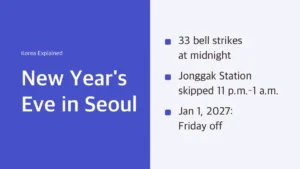 New Year's Eve in Seoul: Bosingak Bell at Midnight, Jan 1 Is OffWhat actually happens on New Year's Eve in Seoul: the 33 midnight bell strikes at Bosingak, which subway stations to…