
Last updated: November 18, 2026
The three routes at a glance
Korea's Nationality Act (국적법) has three kinds of naturalization (귀화). The route decides how long you must live here, whether you need F-5 first, and whether you can keep your old passport.
| Route | Who it is for | Years living in Korea | F-5 needed? | Keep old nationality? |
|---|---|---|---|---|
| General (일반귀화, Article 5) | Anyone else | 5 consecutive years | Yes | No, renounce within 1 year |
| Simplified, family ties (간이귀화, Article 6(1)) | A parent who was Korean, born in Korea to a parent born in Korea, adopted by a Korean as an adult | 3 consecutive years | No | No, renounce within 1 year |
| Simplified, marriage (Article 6(2)) | Spouse of a Korean citizen | 2 years married in Korea, or married 3 years with 1 year in Korea | No | Can sign the pledge instead |
| Special, parent (특별귀화, Article 7) | A parent who is a Korean citizen now | No minimum, just an address in Korea | No | No, renounce within 1 year |
| Special, merit or talent (Article 7) | Great service to Korea, or top ability in science, economy, culture or sport | No minimum | No | Can sign the pledge instead |
Every route still checks good conduct, basic knowledge of Korean language and customs, and national security. The general and simplified routes also check that you are an adult and can support yourself.
General naturalization: the full list
To get general naturalization you must meet all seven requirements in Article 5:
- 5 or more consecutive years with an address in Korea
- A status that lets you live in Korea permanently, which means F-5
- Adult under the Civil Act (19 or older)
- Good conduct, such as obeying the law
- Ability to support yourself through your own assets or skills, or a family member you live with
- Basic knowledge as a Korean national, such as Korean language and understanding of Korean customs
- The Minister of Justice finds that naturalizing you does not harm national security, public order or public welfare
The F-5 rule since 2018
The F-5 requirement was added by an amendment made on December 19, 2017 that took effect one year later. It applies to applications filed after that, so since December 2018 a general applicant must already hold permanent residence. You cannot file until you have F-5. The simplified and special routes skip both the 5-year rule and the F-5 rule.
If you are not there yet, our F-5 permanent residence guide covers the 5-year visa list and the 2x GNI income test, and the F-2-7 points visa is a common step before it.
How the years are counted
The clock starts on the day you entered lawfully and finished alien registration. Time spent abroad can break the chain. Under the Enforcement Rule (Article 5), these trips still count as continuous:
- You left with a re-entry permit before your stay expired and came back within the permit period
- You left briefly because your stay could not be extended and returned with a new visa within 1 month
- Other cases the Minister of Justice accepts as equivalent
How much income or assets you need
The law only says you must be able to support yourself. The Enforcement Rule lists the papers that prove it. You need one of these:
| Route | Option A | Option B | Option C |
|---|---|---|---|
| General | Income certificate from the tax office at or above last year's GNI per capita | ₩60 million in savings, deposits or securities | Property worth ₩60 million, or a lease deposit of ₩60 million |
| Simplified (marriage, family ties) | ₩30 million in savings, deposits or securities | Property or lease deposit of ₩30 million | Certificate of employment or proof of a job offer |
The GNI figure is the Bank of Korea number for the year before you apply. For 2025, the Bank of Korea put GNI per capita at ₩52,416,000 (March 10, 2026). A family member you live with can supply the proof instead of you, and the Ministry can accept other documents it judges equivalent.
Good conduct: records that block you
The Enforcement Rule (Article 5-2) lists records that count against you unless the Ministry decides otherwise after weighing the details:
| Record | Blocked until |
|---|---|
| Sentenced to imprisonment (금고) or heavier | 10 years after the sentence ends |
| Suspended sentence | 7 years after the suspension period ends |
| Fine | 5 years after you paid it |
| Suspended indictment or suspended sentencing | 2 years after the decision |
| Deportation order | 10 years after you left |
| Departure order | 5 years after you left |
| Unpaid national tax, customs or local tax | Until you pay |
Even with one of these records, the Ministry can still find your conduct acceptable after looking at how it happened, how serious it was, what you have contributed to Korea and humanitarian reasons. Check your own record against this table before you pay the fee.
The test and interview, or KIIP
Applicants are checked in two steps: the comprehensive assessment (종합평가), a written test also called KINAT (한국이민귀화적격시험), and an interview.
- You must sit the written test within 1 year of applying, or the application fails.
- The pass mark is 60 out of 100.
- The interview checks your Korean, your attitude as a citizen and your belief in the free democratic order.
Who skips the written test
- Minors
- People aged 60 or older
- Special naturalization applicants for merit or talent
- People who completed KIIP (사회통합프로그램)
- People who scored 60 or more on the comprehensive assessment within the last 3 years
Who skips the interview
- Applicants under 15
- KIIP graduates who also scored 60 or more on the comprehensive assessment
- Spouses of people who recovered Korean nationality, if they are 60 or older
The government's Easy Law guide for marriage immigrants (October 2026) adds that a spouse applying for simplified naturalization who is still in a normal marriage is exempt from the interview.
The KIIP route
Completing KIIP is the most common way around the test. The Ministry's 2024 fee notice splits Level 5 into a 70-hour basic course (for F-5) and a 30-hour advanced course for naturalization. Under that notice the basic course costs ₩70,000 and the advanced course ₩30,000. Our KIIP program guide explains levels 0 to 4, the pre-assessment and how to sign up on Socinet.
What the interview day looks like
Immigration offices post interview lists each month. The Busan Immigration Office's November 2026 notice is typical:
- The date you are given cannot be changed.
- Missing it, even by being late, counts as a fail. You get a new date within 6 months.
- You have 2 chances in total.
- Results come by text message.
- Passing the interview is not the final answer. A last check for law violations follows before the decision.
Study materials, including sample interview questions and the national anthem (애국가), are on HiKorea and the Ministry's KakaoTalk channel (국적종합정보).
Marriage naturalization in more detail
Your marriage must be legally registered. A partner you live with without registering counts as general naturalization, which means 5 years and F-5.
You can still use the marriage route without the full 2 or 3 years in two cases, as long as you then complete the remaining period and the Ministry accepts it:
- Your Korean spouse died or went missing, or the marriage broke down for reasons that were not your fault.
- You are raising, or must raise, a minor child born from the marriage.
Most spouses come in on the F-6 marriage visa, which our F-6 visa guide covers. A spouse who naturalizes through the 2-year or 3-year rule can sign the pledge below and keep their original passport.
Special naturalization
Korean parent: If your father or mother is a Korean citizen now, you can apply with any length of stay, as long as you have an address in Korea. People adopted as adults are excluded.
Merit: This covers independence or national merit awardees and their families, and people who contributed to national security, society, the economy, education or culture.
Outstanding talent: For people with very high ability in science, the economy, culture, sport and similar fields. You need a recommendation (for example from a central government agency, an embassy, a provincial governor or a four-year university president) or international recognition, and the Nationality Review Committee decides.
Two 2026 changes help this group:
- On February 12, 2026 the Ministry of Justice widened the list of who can recommend candidates and stepped up recruitment of talented ethnic Koreans.
- The K-STAR track (from February 2026) lets international master's and PhD students at 32 Korean universities get F-2 on the university president's recommendation, then apply for F-5 or special naturalization after 3 years on F-2.
Merit and talent applicants do not pay the fee and skip the written test.
Fee and how to apply
| Item | Detail |
|---|---|
| Naturalization fee | ₩300,000 per person, paid with a government revenue stamp |
| Children applying with you | No separate fee |
| Exempt | Special naturalization for merit or talent; humanitarian cases the Ministry accepts |
| Where | Your local immigration office (출입국·외국인청) |
| Who files | You in person if you are 15 or older; a legal guardian for younger children |
Documents include the application form, proof that you are a foreigner, your income or asset proof, and, for marriage applicants, your Korean spouse's family relation certificate. Anything in a foreign language needs a Korean translation with the translator's name and contact details. The full list per route is on HiKorea under Citizenship/Naturalization.
Show this: 귀화 허가 신청하러 왔어요.
Bringing your children
Your minor children can apply at the same time by marking it on your form. They become Korean the moment you do (수반취득). If you are divorced, you must show in writing that you have custody or parental authority.
The steps
- File the application and pay the fee.
- Immigration checks your documents, background and criminal record, and may visit your home.
- Take the written test within 1 year, unless exempt.
- Attend the interview, unless exempt.
- Final review and decision by the Minister of Justice.
- Take the citizenship oath and receive your certificate. You become Korean at this moment.
- Within 1 year, renounce your old nationality or sign the pledge.
How long it takes
Plan for at least a year. The best guide is nationality restoration, which the same Nationality Division at the Ministry of Justice handles: the ministry said in August 2026 that approval took 13 months on average and ran a 3-month push to cut that to 9 months. The written test deadline is 1 year after filing, and the interview has two chances up to 6 months apart, so the steps alone take many months.
Demand is high. In 2025, 18,623 people applied and 11,344 became Korean citizens, the most since the pandemic. 56.5% of new citizens were from China and 23.4% from Vietnam.
Renounce or pledge: the dual citizenship rule
Once you become Korean, you have 1 year to deal with your old nationality.
| Who | What you must do within 1 year |
|---|---|
| General naturalization | Renounce, and submit the foreign renunciation certificate |
| Simplified, family ties (Korean parent who was Korean, born in Korea, adult adoptee) | Renounce |
| Special, Korean parent | Renounce |
| Marriage, 2-year or 3-year rule | Renounce or sign the foreign nationality non-exercise pledge (외국국적불행사서약) |
| Special, merit or outstanding talent | Renounce or sign the pledge |
| Anyone whose country makes renouncing impossible | Sign the pledge, with proof |
Note that marriage applicants who used the death, disappearance or child-raising exception are not on the pledge list.
If you miss the deadline
If you do neither within 1 year, you lose Korean nationality when the year ends. You can get it back by renouncing your foreign nationality within the following year and reporting it (fee ₩20,000). Until you finish, your treatment as a Korean for entry, residence registration and passports can be limited.
The renunciation confirmation and the pledge confirmation each cost ₩2,000, or nothing if you request them online through Government24.
Living as a dual citizen after the pledge
The pledge lets you keep both passports, but inside Korea you are treated only as a Korean. The Ministry can order you to choose one nationality within 6 months if you:
- Repeatedly enter or leave Korea on your foreign passport
- Register as a foreigner or report residence as an overseas Korean to use your foreign nationality
- Use a foreign passport to claim rights as a foreigner from government offices, public institutions or schools without good reason
If you ignore the order, you lose Korean nationality. You must also give up the foreign one if you take a job that foreign nationals cannot hold.
Military service for naturalized men
Naturalized men become subject to military service like any Korean man. The Military Manpower Administration lets a person who became Korean by naturalization apply to be placed in wartime labor service (전시근로역), which releases you from active duty, supplementary service and reserve forces.
You apply at a regional MMA office or online with a copy of your naturalization permit, the official gazette notice or a nationality acquisition certificate. Our Korean military service guide explains the wider system and the deadlines for dual nationals born Korean.
FAQ
Can I get Korean citizenship without marriage? Yes. The general route is open to anyone with 5 years and F-5, and the special route covers people with a Korean parent, merit or outstanding talent.
Can I get Korean citizenship by investment? There is no investment route in the Nationality Act. The only routes are the general, simplified and special ones above.
Is it hard to get Korean citizenship? In 2025, 11,344 people became citizens while 18,623 applied, about 6 in 10. The main hurdles are the income proof, a clean record and the test or KIIP.
Sources
- Nationality Act, English translation (Articles 5, 6, 7, 10, 24; Act No. 15249 addenda)
- Easy Law: types of naturalization (Korean, as of October 15, 2026)
- Easy Law: naturalization procedure, fee, test and interview (Korean)
- Easy Law: renouncing foreign nationality and the non-exercise pledge (Korean)
- Easy Law: choosing a nationality as a dual citizen (Korean)
- Easy Law: marriage immigrants, income proof and good conduct rules (Korean)
- Ministry of Justice: KIIP (English)
- Ministry of Justice: KIIP fee notice (September 2024)
- Busan Immigration Office: November 2026 naturalization interviews (Korean)
- Ministry of Justice: nationality restoration fast-processing period (August 12, 2026, Korean)
- Ministry of Justice: more recommenders for special naturalization (February 12, 2026, via Korea.kr)
- Korea.kr: 2026 Ministry of Justice changes for foreigners, K-STAR track (Korean)
- Military Manpower Administration: wartime labor service for naturalized citizens (Korean)
- Asia News Network / Korea Herald: 2025 naturalization numbers (February 5, 2026)
- Newsis: 2025 GNI per capita ₩52,416,000 (March 10, 2026, Korean)
This guide is general information, not legal advice. Rules change, so confirm with HiKorea or the 1345 Immigration Contact Center before you apply.
Related guides
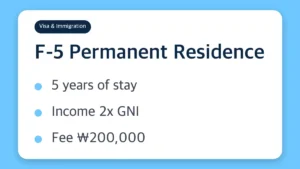 F-5 Permanent Residence Korea Requirements: 5 Years, 2x GNIWhat the general F-5-1 permanent residence visa asks for in 2026: which visas count toward 5 years, the 2x GNI…
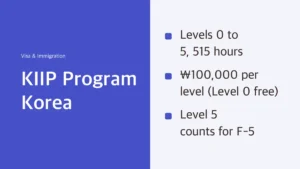 KIIP Program Korea: ₩100,000 per Level, and Level 5 Counts for F-5What Korea's Immigration and Integration Program (KIIP) is, how the six levels and the pre-assessment work, what…
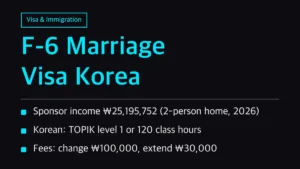 F-6 Visa Korea Requirements: Sponsor Needs ₩25,195,752 in 2026The 2026 F-6 marriage visa rules from the HiKorea manuals: the sponsor income table by household size, the…