
Last updated: October 20, 2026
Who has to serve
The Constitution gives all citizens a duty of national defense. The Military Service Act turns that into conscription for men. Article 3 says every male of the Republic of Korea must serve. Women can serve only if they volunteer.
| Who | Duty? |
|---|---|
| Korean men (including dual nationals) | Yes |
| Korean women | No, volunteering only |
| Foreign nationals with no Korean citizenship | No |
| Naturalized Korean men | Yes, but can apply to be moved to wartime labor service |
| Korean men who live abroad long term (overseas Koreans) | Duty stays, but can be deferred to 37 while living abroad |
So a foreign student, an E-7 worker or a tourist never gets a draft notice. The rules start to matter when you hold Korean citizenship, even if you also hold another passport.
Service length by branch
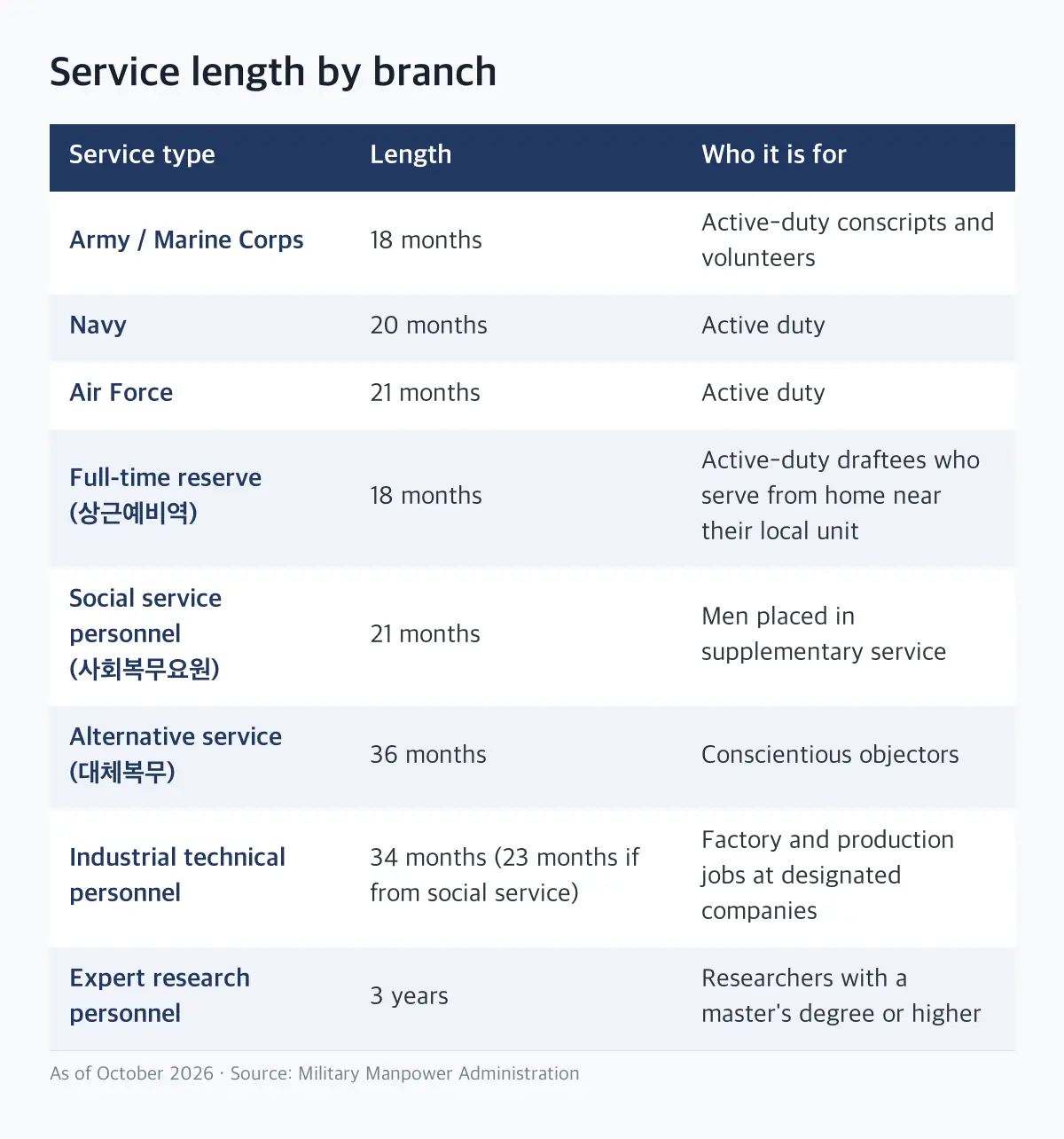
The Military Manpower Administration (병무청), or MMA, lists these terms on its overview page:
| Service type | Length | Who it is for |
|---|---|---|
| Army / Marine Corps | 18 months | Active-duty conscripts and volunteers |
| Navy | 20 months | Active duty |
| Air Force | 21 months | Active duty |
| Full-time reserve (상근예비역) | 18 months | Active-duty draftees who serve from home near their local unit |
| Social service personnel (사회복무요원) | 21 months | Men placed in supplementary service |
| Alternative service (대체복무) | 36 months | Conscientious objectors |
| Industrial technical personnel | 34 months (23 months if from social service) | Factory and production jobs at designated companies |
| Expert research personnel | 3 years | Researchers with a master's degree or higher |
After service, men stay in the reserve forces for 8 years.
The Army term includes 5 weeks of basic training. It became 18 months for men who enlisted from June 2, 2020. Before that, it was 21 months.
You may read "two years" in the law itself. That is not a mistake. Article 18 of the Military Service Act sets the Army term at two years, the Navy at two years and two months, and the Air Force at two years and three months. Article 19 lets the Minister of National Defense shorten these by up to six months, and the shorter terms in the table are what men actually serve.
How a man gets placed
- Age 18: He is put on the register as "preliminary military service" (병역준비역).
- Age 19 or so: He takes the draft physical exam and gets a physical grade.
- Placement: The grade, plus his education and age, decides where he goes.
| Physical grade | Result |
|---|---|
| Grades 1 to 3 | Active duty (some go to supplementary service, based on education and supply) |
| Grade 4 | Supplementary service, usually social service |
| Grade 5 | Wartime labor service, no peacetime duty |
| Grade 6 | Exempt from military service |
| Grade 7 | Re-examined within 2 years |
Korea counts military ages by year of birth. "From 18 years of age" means from January 1 of the year a man turns 18, not his birthday.
What social service is
Social service personnel work at government agencies, local governments, public bodies and welfare facilities. Typical jobs are social welfare, health care, education and culture, environment and safety, and office support.
- Length: 21 months.
- Daily life: They commute from home and work under the head of the agency. Live-in service happens only when commuting is not practical.
- Pay: Roughly the same as an active-duty soldier's pay, plus travel costs for the job.
- Training: Up to 30 days of military training, counted as part of the 21 months.
Exemptions and other paths
A healthy man rarely avoids service. The main ways out of active duty are medical, family or special-talent reasons.
- Medical: Grade 6 means exemption. Grade 5 means wartime labor service only.
- Family hardship: A man who is the sole provider for his family can apply to be moved out of active duty.
- Conscientious objection: Since alternative service started, objectors serve 36 months instead of carrying weapons.
- Art and sports personnel (예술·체육요원): Athletes with an Olympic medal (top 3) or Asian Games gold, and winners of designated arts competitions, serve in their field instead of in a unit. The term is 2 years and 10 months, including basic military training, and they must also do volunteer work in their field.
- Postponement: Students and others can delay enlistment, but most delays have an age limit.
How long can a man wait? The duty to take the exam or enlist ends in the year he turns 36. The whole military service duty ends in the year he turns 40. Men who left Korea without permission or evaded service face later limits.
Why K-pop idols enlist
Pop singers and actors are Korean men like any other. There is no exemption for pop music.
- The art and sports personnel route covers Olympic and Asian Games results and designated arts competitions. Popular music is not on the list.
- A December 22, 2020 amendment lets the MMA postpone enlistment for "outstanding persons" in sports and popular culture who raised the nation's prestige. A delay is not an exemption, and the MMA can cancel it if the person harms that standing.
- The MMA keeps a separate military record for registered pop culture artists, athletes, high earners and public officials. It tracks them from 18 until their service ends. They get the same physical grades and placements as everyone else.
That is why even top idols enlist, and why the service of celebrities, including social service placements, still gets close public attention.
Rules for dual nationals and overseas Koreans
This is the part that surprises families abroad. If a child is born to a Korean parent in a country like the United States, he can be a Korean citizen from birth, even without a Korean passport. The MMA notes that skipping the family register report does not erase Korean citizenship.
| Situation | What the rules say |
|---|---|
| Male dual national who wants to give up Korean citizenship | Report renunciation by the end of March in the year he turns 18 (3 months after entering preliminary service) |
| Missed that deadline | Finish or be exempted from service, or apply to the Minister of Justice for special permission |
| Born abroad while parents stayed there with no plan to settle (for example, birth tourism) | Cannot renounce until service is completed or exempted |
| Lives abroad and meets residence conditions | Can defer service to age 37 with an overseas emigration permit |
| Dual national who keeps both | Must choose a nationality by 22, and can keep both by pledging not to use the foreign one in Korea |
The 2022 exception. In 2020 the Constitutional Court ruled the strict renunciation rule did not conform to the Constitution. On September 15, 2022, the Nationality Act added Article 14-2. A man who missed the March deadline can now apply for permission to renounce if he meets every condition below.
- He was born abroad and has lived mainly abroad since birth, or he moved abroad before age 6 and has lived there since.
- His parents were not staying abroad temporarily when he was born.
- He has a good reason for missing the 3-month window.
- He applies through the Korean consulate for his area. The Minister weighs factors such as how often he entered Korea and whether he used rights only citizens have.
The age-37 deferral for overseas residents. A dual national living abroad can delay service to 37 if he meets one of these:
- He has lived abroad 3 years or more with a parent who holds foreign permanent residency or citizenship.
- He has lived abroad 5 years or more with his parents since before 24.
- He has lived abroad 10 years or more.
He must get an overseas travel permit for the "overseas emigration" reason through a Korean consulate, between age 24 and January 15 of the year he turns 25.
Overseas travel permits after age 25
Any Korean man 25 or older who has not served yet needs an MMA overseas travel permit for every trip abroad. The same goes for men serving as social service personnel or in similar roles.
- Apply online on the MMA website, at a regional MMA office, or at the MMA center at Incheon Airport.
- If you cannot come back in time, ask for an extension at least 15 days before the permit runs out.
- If you left Korea before 25, get your extension by January 15 of the year you turn 25.
Staying abroad without a valid permit is a crime. The MMA lists these penalties:
- Up to 3 years in prison (1 to 5 years if the aim was to dodge service).
- Limits on jobs and business licenses until 40.
- Military duty that runs until 37.
- Personal details published online, and an exit ban on return.
Since May 3, 2026, the MMA refers a man to investigators if he has not returned 15 days after his permit ends without a good reason, such as illness or a cancelled flight. It used to be 30 days.
Show this: 국외여행허가 대상인지 확인하고 싶어요.
F-4 visa and renouncing citizenship
Men who give up Korean nationality to skip service pay a price later. Under Article 5 of the Overseas Koreans Act, a man who renounced or lost Korean nationality without serving, or without being exempted, cannot get the F-4 overseas Korean visa until January 1 of the year he turns 41. This rule has applied to men who first renounced on or after May 1, 2018.
Before that age, he can still visit Korea on other visas. But the long-stay F-4 route is closed.
Permanent residents abroad can also choose to serve. Under an MMA volunteer program, they pick their own exam and enlistment dates, and the government pays for one round trip a year to their country of residence during service.
Where to check your own case
Rules on nationality and service are personal and change often. The MMA call center is 1588-9090 (+82-1588-9090 from abroad). Nationality questions go to the 1345 Immigration Contact Center or HiKorea.
Show this: 병무청 콜센터 1588-9090에서 병역 의무를 확인하고 싶어요.
Sources
- Military Manpower Administration — Military Service Process (English)
- Military Manpower Administration — Categories of Military Service (English)
- Military Manpower Administration — Military Service Information for Conscription Candidates Overseas (English)
- Military Manpower Administration — Military Service Overview (Korean)
- Military Manpower Administration — Social Service Personnel (Korean)
- Military Manpower Administration — Art and Sports Personnel (Korean)
- Military Manpower Administration — Dual Nationality and Military Service (Korean)
- Military Manpower Administration — Overseas Travel Permit (Korean)
- Military Manpower Administration — Penalties for Not Returning (Korean)
- Military Service Act (English, KLRI)
- Nationality Act (English, KLRI)
- Act on the Immigration and Legal Status of Overseas Koreans (English, KLRI)
This guide is general information, not legal advice. Rules change, so confirm with HiKorea or the 1345 Immigration Contact Center before you apply. For military service questions, contact the Military Manpower Administration.
Related guides
 F-4 Visa Korea 2026: Who Qualifies and What ChangedSince February 12, 2026, one F-4 standard applies to overseas Koreans from every country, and new H-2 visas have…
 Korean Age vs International Age: What Changed in 2023Korean age made everyone one or two years older. Since June 28, 2023, official Korea counts age the international…
 Suneung Day 2026 in Korea: Nov 19, Offices Open Late, Flights PauseKorea's college entrance exam (수능) falls on Thursday, November 19, 2026. Here is what that day means if you live in…