
Last updated: November 18, 2026
What the E-9 visa is
E-9 is the status for non-professional workers in factories, farms, fishing boats, construction sites and some service jobs. The government, not a private agency, runs the whole route. Korea signs an agreement (MOU) with each sending country, and the Ministry of Employment and Labor issues an employment permit (고용허가) to a Korean company that could not hire enough local workers.
Two things make E-9 different from most work visas:
- You do not find the job yourself. You join a job seeker roster in your home country, and an employer picks you from it.
- You cannot switch to E-9 inside Korea. The Ministry of Government Legislation's guide says E-9 must be obtained in your home country through EPS before entry, so changing from a tourist, student or other status to E-9 is, as a rule, not allowed.
E-9 jobs are in manufacturing, construction, agriculture and livestock, fisheries, forestry, mining and services, in the fields the Foreign Workforce Policy Committee designates.
Who can apply: the 17 sending countries
The Foreign Workforce Policy Committee said on August 14, 2026 that these 17 countries currently send E-9 workers:
| Region | Countries |
|---|---|
| Southeast Asia | Philippines, Vietnam, Thailand, Indonesia, Cambodia, Myanmar, Laos, Timor-Leste |
| South Asia | Sri Lanka, Pakistan, Bangladesh, Nepal |
| Central Asia | Uzbekistan, Kyrgyzstan, Tajikistan |
| East Asia | Mongolia, China |
At the same meeting the committee named Kazakhstan the 18th sending country. Workers from Kazakhstan are expected to start arriving from 2028, after Korea and Kazakhstan sign the EPS MOU and set up a local EPS center. India is not on the list, so Indian nationals cannot get an E-9 visa through EPS.
EPS-TOPIK: the first gate
HRD Korea (한국산업인력공단) runs the EPS-TOPIK test in each sending country. Its eligibility rules are:
- Age 18 to 39
- No history of deportation from Korea
- No reason that bars you from entering Korea
- Not more than 5 years in Korea on E-9, on E-10, or on the two combined
The test has 40 questions in 50 minutes: listening and reading, 25 minutes each. It is a relative test. You need at least the lowest score set for your industry, and then candidates are picked in score order up to the number each country expects to send. Test dates are announced per country on the EPS-TOPIK website, not on a single global calendar.
This is a different test from the regular TOPIK that students and E-7-4 applicants take. For that test, see our TOPIK test dates guide.
From test to job: the six steps
The Act on the Employment of Foreign Workers (외국인근로자의 고용 등에 관한 법률) sets this order:
- Pass EPS-TOPIK in your home country.
- Register on the job seeker roster through your country's sending agency.
- An employer chooses you and you sign a standard labor contract.
- Get the E-9 visa at the Korean embassy in your country.
- Enter Korea and finish employment training.
- Start work at the workplace named in the contract.
After you arrive, register as a foreigner and get your Residence Card (외국인등록증).
How many people get in depends on the yearly quota. For 2026 the quota is 80,000 workers: 50,000 for manufacturing, 10,000 for agriculture and livestock, the rest for other industries, plus 10,000 that can go to any industry when demand changes.
How long you can stay
| Period | Length | Who applies |
|---|---|---|
| First employment period | 3 years from entry (Article 18) | Automatic |
| Re-employment extension | Up to 1 year 10 months, once (Article 18-2) | Your employer asks the Ministry of Employment and Labor before your 3 years end |
| Total for one entry | 4 years 10 months |
If your employer files for re-employment and the conditions are met, the job center issues a confirmation within 7 days. You still have to apply for a visa extension at immigration before your current period of stay ends. A longer employment period does not extend your visa on its own.
The law also lets the committee add up to 1 more year when an epidemic or natural disaster makes it hard for workers to enter or leave Korea, as happened during COVID-19. That is a special measure, not the normal rule.
Changing workplaces
E-9 workers are expected to stay at the workplace in their first contract. You can apply to the job center to move only for one of these reasons (Article 25):
- The employer ends the contract for a lawful reason or refuses to renew it.
- Business suspension or closure, cancelled employment permit, unpaid wages, broken dormitory conditions, unfair treatment, or other reasons that are not your fault.
- An injury means you cannot keep doing this job but can work somewhere else.
Limits and deadlines:
| Rule | Detail |
|---|---|
| Number of moves | Up to 3 in the first 3 years, up to 2 during the 1 year 10 month extension |
| Moves that do not count | Moves caused by the employer's fault (closure, unpaid wages, unfair treatment and similar) |
| Deadline to apply | Within 1 month after your contract ends, or you must leave Korea |
| Industry | You cannot move to a different industry |
The 1-month clock starts later if work injury, illness, pregnancy or childbirth stops you from applying.
There is a second step people miss. After the job center approves the move, you also need permission to change workplace (근무처 변경 허가) from the immigration office for your area, on HiKorea or by visit. Starting at a new company without it can lead to deportation, or up to 1 year in prison or a fine of up to ₩10 million.
Show this: 사업장 변경 신청을 하고 싶어요. 근로계약이 끝났어요.
Insurance you pay and insurance you collect
E-9 workers join the four regular social insurances like Koreans (health, employment, industrial accident, and National Pension only if your country gives Koreans the same coverage). EPS adds four insurances of its own:
| Insurance | Who pays | What it does |
|---|---|---|
| Departure guarantee insurance (출국만기보험) | Employer, 8.3% of your monthly ordinary wage every month | Your severance pay, paid when you leave after 1 year or more |
| Return cost insurance (귀국비용보험) | You, ₩400,000 to ₩600,000 depending on country, within 3 months | Covers your flight home |
| Wage guarantee insurance (보증보험) | Employer | Pays up to ₩4 million if wages go unpaid |
| Accident insurance (상해보험) | You | Death or disability not caused by work |
Claiming departure guarantee insurance
- You qualify after 1 year of continuous work. Under 1 year, the money goes back to the employer.
- It is paid within 14 days after you leave Korea, or within 14 days of your claim if you claim after leaving or because you changed status (for example to E-7-4).
- Claim it within 3 years. Unclaimed money moves to HRD Korea.
- If the insurance payout is smaller than your legal severance pay, your employer must pay you the difference.
- Check your expected amount with Samsung Fire & Marine at 1600-0266.
Our severance pay guide shows how the legal amount is calculated, and the National Pension refund guide covers pension money if your country qualifies.
Report your departure to the job center up to 1 month before you fly (출국예정신고), with your plane ticket, passport and Residence Card. The job center uses this report when your departure guarantee and return cost insurance are paid out.
Wages and working hours
You are paid at least the minimum wage, which is ₩10,320 an hour in 2026, at least once a month on a fixed payday. Working hours are the same as for Koreans: 8 hours a day, 40 hours a week, with up to 12 hours of overtime a week. Our minimum wage guide has the 2027 rate.
For unpaid wages or problems at work, call the Counseling Center for Foreign Workers at 1577-0071.
Coming back after your 4 years 10 months
| Route | When you can work again | Main conditions |
|---|---|---|
| Re-entry special case (재입국 취업 특례, formerly the "sincere worker" program) | 1 month after you leave | Your employer applies for your re-entry permit before you leave; you finished the extended period; you did not change workplace (or only for allowed reasons); new contract of 1 year or more |
| Special EPS-TOPIK | 6 months after you leave | You left voluntarily before your stay ended after re-employment, and you pass the special test |
| Normal rule | 6 months after you leave | Start again through EPS-TOPIK and the roster |
The re-entry special case is allowed once. You skip the employment training, and the 3-year plus 1 year 10 month limits apply again from your new entry. If you changed workplace for a reason the law counts against the limit, you can still qualify if you worked 4 years 10 months in the same industry you started in and have at least 1 year left on the contract with the employer asking for you.
Do not stay past your permitted date. Overstaying can mean deportation, and up to 3 years in prison or a fine of up to ₩30 million. See overstay penalties.
Moving to E-7-4 later
The E-7-4 skilled worker visa is how E-9 workers stay longer and bring family. You switch inside Korea, without leaving. The main conditions are:
- 4 years or more on E-9, E-10 or H-2 within the last 10 years
- A recommendation from your current employer and a contract of 2 years or more at ₩26 million a year or more
- 200 of 300 points, with at least 50 each for income and Korean
In October 2026 the Ministry of Justice said it will simplify E-7-4 extension paperwork (from 12 or more documents to 7 or fewer), give more points for long service with one employer, and set out an official path from E-9 to E-7-4, then F-2 and F-5.
By September 2026, 52,648 people held E-7-4 status. In a June 2026 survey of E-9 workers, 53.5% said getting the Korean-language score was the hardest part, so start studying early. Full details are in our E-7-4 visa guide.
When you switch, you can claim your departure guarantee insurance as a change of status.
FAQ
Can Indian or Nigerian nationals get an E-9 visa? No. Only nationals of the 17 sending countries can take EPS-TOPIK and join the roster.
Can I bring my family on E-9? E-9 does not come with a dependent visa for your spouse or children. In the June 2026 survey, 34.6% of workers who wanted E-7-4 said bringing family was their reason.
Sources
- Ministry of Employment and Labor: 2026 E-9 quota of 80,000 (December 22, 2025)
- Foreign Workforce Policy Committee: Kazakhstan named 18th sending country (August 14, 2026, via Seoul Shinmun)
- HRD Korea: What is EPS-TOPIK
- HRD Korea: Special EPS-TOPIK
- Ministry of Employment and Labor: International Cooperation and EPS
- Easy to Find, Practical Law: Employment of Foreign Workers (English)
- Easy Law: changing workplace (Korean)
- Easy Law: re-employment extension (Korean)
- Easy Law: re-entry employment (Korean)
- Easy Law: returning home and insurance claims (Korean)
- HRD Korea: EPS insurances
- HRD Korea: departure guarantee insurance (Korean)
- Enforcement Decree of the Act on the Employment of Foreign Workers, Article 21 (departure guarantee insurance)
- Ministry of Justice: E-7-4 system improvements (October 22, 2026)
- Ministry of Justice: E-7-4 changes from June 2026
This guide is general information, not legal advice. Rules change, so confirm with HiKorea or the 1345 Immigration Contact Center before you apply.
Related guides
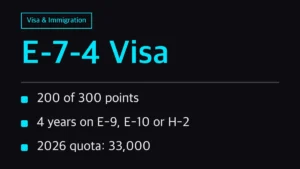 E-7-4 Visa Korea: 200 of 300 Points, 4 Years on E-9 to QualifyHow an E-9 or E-10 worker moves to the E-7-4 skilled worker visa: the 4-year rule, the 300-point table, the…
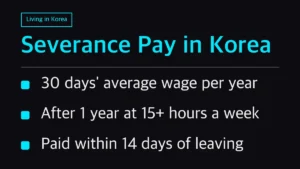 How Much Is Severance Pay in Korea? 30 Days' Average Wage a YearHow much severance pay you are owed in Korea, with a full worked example, the ordinary-wage floor that raises the…
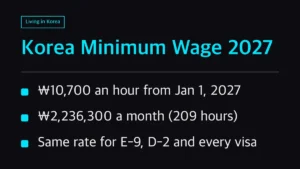 Korea Minimum Wage 2027: ₩10,700 an Hour, ₩2,236,300 a MonthThe 2027 hourly rate, the monthly, daily and yearly figures, how weekly holiday pay and probation pay work, what…