
Last updated: October 20, 2026
The Ministry of Justice published these rules in its "Easy Guide to Work for Foreign-Nationality Koreans" (February 2026) on HiKorea. This post follows that manual.
What changed on February 12, 2026
Before this date, ethnic Koreans from China and the CIS countries (former Soviet states) had a separate visa, the H-2 (방문취업) Work and Visit visa. Other overseas Koreans used F-4.
From February 12, 2026:
- The two tracks merge into F-4.
- Embassies issue F-4 visas to Chinese and CIS ethnic Koreans too.
- New H-2 visas are no longer issued.
- People who already hold an H-2 visa get up to 3 years of stay when they register as foreigners. They can extend within the allowed range if they meet the requirements.
Who qualifies for the F-4 visa
There are two main groups:
| Group | Code | In plain terms |
|---|---|---|
| Held Korean nationality at birth, then took foreign citizenship | F-4-41 | You were a Korean national (this includes people who left before the Korean government was founded) |
| Direct descendant of that person, with foreign citizenship | F-4-42 | Your parent or grandparent was a Korean national |
Men who left Korean nationality after May 1, 2018 cannot get F-4 status until December 31 of the year they turn 40, unless they finished military service or received an exemption.
Who cannot get F-4 status
The manual lists these limits:
- A sentence for a "specific violent crime" under Korean law.
- A prison term for a serious social crime (drugs, voice phishing, or three or more drunk-driving cases).
- Another prison sentence or suspended sentence, until 5 years pass after it ends or becomes final.
- Court fines totaling KRW 7 million or more, until 3 years pass after you pay the fine that crossed that line.
- Immigration Act penalty fines totaling KRW 7 million or more, until 3 years pass after you pay in full.
If you do 100 hours or more of volunteer work over 6 months or longer, confirmed by the Korea Volunteer Center (☏1365), the immigration fine waiting period can drop to 1 year. Volunteer time counts for up to 6 hours a day.
A foreign criminal record can also block approval. Check the document rules for overseas criminal records in the manual.
Documents you need
For both groups:
- Korean ability proof (see the next section).
- Overseas criminal record certificate. If you have no past record, the manual allows a one-time delay in submitting it.
- Documents showing you are an overseas Korean, such as a Korean family register, a Chinese household register (호구부) or a birth certificate.
F-4-41 also needs: proof you were a Korean national (family relations record, old family register or similar) and proof of when and why you took foreign citizenship.
F-4-42 also needs: proof your parent or grandparent was a Korean national, passports showing their foreign citizenship, and proof of the family link (such as a birth certificate).
If you apply in Korea to change your visa status, you also submit the Overseas Korean Integrated Application form, your passport, one standard photo, proof of address, a tuberculosis test certificate, an Early Adaptation Program certificate and the fee.
Korean ability proof: it sets your stay length
The manual accepts any one of these:
- Social Integration Program (KIIP) pre-assessment score of 21 or higher
- KIIP education certificate, stage 1 or higher
- TOPIK level 1 or higher
- Sejong Institute certificate, beginner 1B or higher
- Ministry of Education Korean Education Center course certificate, level 2 or higher
Pre-assessment and TOPIK scores must be within 2 years of the result date.
You are exempt if you once held Korean nationality, are 60 or older, or graduated from a Korean elementary school or higher. Children 13 or younger are exempt too.
| Situation | Stay granted |
|---|---|
| Embassy visa, Korean proof submitted (or exempt) | 2-year multiple-entry visa |
| Embassy visa, no Korean proof | 1-year multiple-entry visa |
| In Korea, proof submitted (or exempt) | Up to 3 years |
| In Korea, no proof | 1 year (2 years if you enrolled in KIIP) |
Early Adaptation Program
To change to F-4 inside Korea, or to get your residence report card, you must finish the Early Adaptation Program first. These people are exempt:
- Students or graduates of a Korean elementary, middle or high school
- Children aged 6 or younger, and people 65 or older
- People who stayed 3 years or more in Korea on a long-term visa
- People who already completed the program
- People in or past KIIP stage 1
- People with severe disabilities
After you arrive
- Report your address within 90 days. If you plan to stay 90 days or more, go to the immigration office for your area within 90 days of arrival. Bring the integrated application, passport and copy, a photo, proof of address, the Early Adaptation certificate and the fee.
- Extend before your stay ends. Apply for an extension with your application, the fee, Korean ability proof and address proof such as a lease. The maximum stay is 3 years, and law violations can limit approval.
Show this: 재외동포 거소신고하러 왔어요. (I came to report my address as an overseas Korean.)
Work rules
F-4 holders can work freely, with three exceptions. You cannot take jobs that are:
- Simple labor
- Gambling or other activity against public morals and order
- Restricted by the Ministry of Justice to protect public interest or the job market
The Ministry of Justice sets the restricted jobs in a notice (Notice 2026-35). If a job needs a license under Korean law, you must hold it.
Former H-2 holders who moved to F-4 can ask for permission for activities outside status to keep working at the same workplace they registered under H-2. You need an employment contract, business registration and public proof of simple-labor work, such as health insurance records.
Moving on to permanent residence
The manual says F-5 permanent residence is open to F-4 holders who have stayed 2 years or more and meet income or asset rules. Income is judged against Korea's gross national income per person, so check the current figure before you apply.
Sources
- HiKorea: Foreign Resident Stay Guide, September 2026 (notice page with HWP attachments, includes the Easy Guide to Work for Foreign-Nationality Koreans, February 2026)
- Korea Immigration Service: Immigration Contact Center (1345)
Questions about your own case: call 1345 inside Korea, or +82-1345 from abroad. English is available.
This guide is general information, not legal advice. Rules change, so confirm with HiKorea or the 1345 Immigration Contact Center before you apply.
Related guides
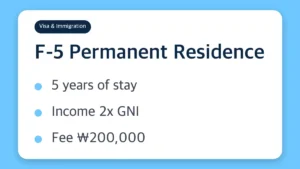 F-5 Permanent Residence Korea Requirements: 5 Years, 2x GNIWhat the general F-5-1 permanent residence visa asks for in 2026: which visas count toward 5 years, the 2x GNI…
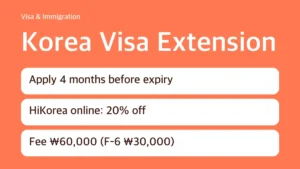 Korea Visa Extension: HiKorea Up to 4 Months Early, Fee ₩60,000When and how to extend your period of stay in Korea: the 4-month window, HiKorea e-Application versus a visit…
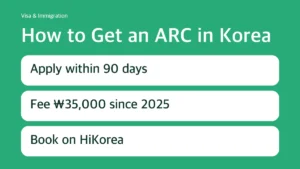 How to Get ARC in Korea (Residence Card): Book Within 90 Days, Pay ₩35,000Staying in Korea longer than 90 days? You need a Residence Card, still called an ARC. Here are the documents, the…