
Last updated: October 20, 2026
What identity verification actually checks
Korean sites and apps rarely trust an email address alone. When you sign up, pay or log in to a bank or government service, they ask you to prove you are a real, named person. This step is called bon-in-in-jeung (본인인증).
In practice you type your name, date of birth and mobile number, choose your carrier, and then confirm a code sent by text message or a push in an app such as PASS. The check passes only when the details you type match the person the number is registered to. That is why the Toss guide for foreigners says the number "must be registered in your own name."
You will hit this step when you:
- sign up for shopping malls, delivery apps and membership programs
- register a card or pay with a simple payment app
- log in to banking apps and public sites such as Hometax with a certificate
- book or pay inside apps that only accept verified users
Which method works for you
| Your situation | Phone verification (PASS or text) | Other options that can work |
|---|---|---|
| Tourist with a passport only | No (tourist SIM is not supported for bank or government checks) | Naver passport verification for Naver Map bookings, orders and payments |
| Resident with a line in your own name | Yes, if your name matches your Residence Card | Certificates, Mobile Residence Card |
| Phone registered to an employer, partner or landlord | No, the number is not yours | Move the line into your own name |
| Prepaid SIM bought at a convenience store or airport | Often no, it may not be in your name | Open a line directly with a carrier |
| Corporate (business) phone | SK Telecom PASS only after real-user registration | Ask the carrier store or 114 |
Option 1: Phone verification with PASS or a text message
PASS is the identity app run by the three carriers. Each carrier has its own version (PASS by SKT, PASS by KT and PASS by U+).
What the carriers' own app pages say:
- SK Telecom: you can sign up and use PASS only on a phone in your own name. Budget carrier (알뜰폰, MVNO) customers can use it too. Corporate phones work only after the actual user is registered at a store or through 114. Under 14 needs a guardian's consent.
- KT: PASS by KT is for KT mobile and KT MVNO customers, and it states that foreigners who can complete mobile phone identity verification can use it.
If you do not want the app, most sites also offer a plain text-message code. It runs on the same carrier record, so the own-name rule is the same.
Option 2: Certificates (joint, financial or private)
Many logins, especially banks, Hometax and Government24 (정부24), let you choose a certificate instead of a phone check.
| Certificate | What it is | What you need first |
|---|---|---|
| Joint certificate (공동인증서) | The older bank-issued certificate | A Korean bank account. Hana Bank's Hana EZ app issues one to foreign residents in 16 languages |
| Private certificate (Kakao, Naver, Toss) | A certificate inside a popular app, used under "simple authentication" (간편인증) | A Korean number in your own name and a bank account in your name |
Getting a private certificate usually runs through a phone check first. For example, the KakaoTalk certificate asks for mobile phone authentication and then confirms a 1 won deposit into your bank account. So a certificate is not a way around the own-name phone; it is something you add once you have one.
Option 3: Mobile Residence Card
Since January 10, 2025, registered foreigners can carry their Residence Card (외국인등록증) on their phone through the government app Korea Mobile ID (대한민국 모바일 신분증). It has the same legal effect as the physical card.
- Who: registered foreigners aged 14 or older with a smartphone in their own name (permanent residence cards and domestic residence report cards are included)
- How: tap a chip (IC) Residence Card on your phone, or scan a QR code
- Phones that cannot be used: the app's own notice says corporate-name phones and anonymous prepaid phones (무기명 선불폰) are not supported for now
- Banks: since March 21, 2025, six banks accept it for opening accounts and other banking: Shinhan, Hana, iM Bank, Busan, Jeonbuk and Jeju in branches, and Jeonbuk for non-face-to-face (online) banking
Option 4: Residence card checks at banks
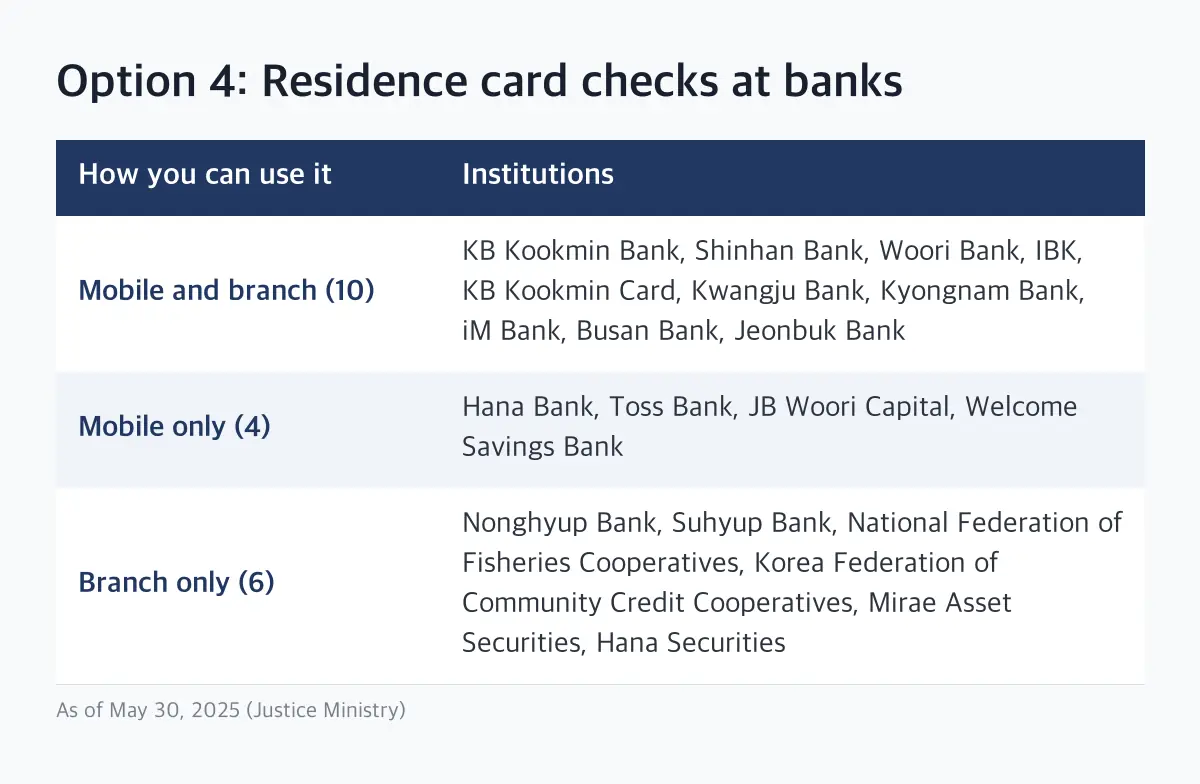
Banks have their own route too. The Justice Ministry's residence card verification service lets a financial company check your card against immigration records without a branch visit. As of May 30, 2025, 20 institutions had adopted it:
| How you can use it | Institutions |
|---|---|
| Mobile and branch (10) | KB Kookmin Bank, Shinhan Bank, Woori Bank, IBK, KB Kookmin Card, Kwangju Bank, Kyongnam Bank, iM Bank, Busan Bank, Jeonbuk Bank |
| Mobile only (4) | Hana Bank, Toss Bank, JB Woori Capital, Welcome Savings Bank |
| Branch only (6) | Nonghyup Bank, Suhyup Bank, National Federation of Fisheries Cooperatives, Korea Federation of Community Credit Cooperatives, Mirae Asset Securities, Hana Securities |
This helps with banking, but it does not replace phone verification on shopping or delivery apps.
What about i-PIN and credit card checks?
i-PIN: The government's public i-PIN stopped new issuance and renewals in July 2018. Private i-PINs from NICE, SCI and Korea Credit Bureau continued. We could not find a current official rule on whether foreigners can get one, and most sites now lean on phone verification, so do not plan around it.
Card checks: Some sites offer a card-based check. The Toss guide warns that cards issued outside Korea often fail at the identity verification step, and that Toss Pay and Kakao Pay take only domestic cards. Its advice is a Korean debit card linked to a Korean bank account. To apply, you need your Residence Card, passport and a Korean number in your name.
If you are a tourist
A tourist SIM or eSIM is built for travel, not for identity checks. LG U+ answers this directly in its FAQ: with a data + voice plan you can receive text codes for restaurant and taxi reservation apps, but identity verification for banking or government services is not supported. With a data-only plan, text verification is not available at all.
What does work without a Korean number:
- Naver passport verification: since June 4, 2026, foreigners with a passport issued overseas can verify on a smartphone and use Naver Map reservations, orders and payments, with no Korean phone number and no call to customer support. Naver says it will extend this to more services.
- Guest checkout: some shopping sites let you buy without signing up, though delivery apps and memberships still ask for a Korean number, according to Toss.
Why verification fails, and how to fix it
| Problem | Why it fails | Fix |
|---|---|---|
| Tourist SIM | The carrier does not support bank or government verification on it | Use Naver passport verification, or get a regular line once you live here |
| Phone in someone else's name | The check matches your name to the number's owner | Open or transfer a line in your own name. KT notes that using service under another person's name is prohibited in Korea |
| Prepaid SIM from a store or airport | It is often not registered in your name | Sign up directly with a carrier |
| Name mismatch | The carrier's record differs from the English name on your Residence Card | Ask the store to re-enter your name exactly as printed |
| Corporate phone | SK Telecom requires real-user registration | Register at a store or through 114 |
| Card from abroad | Domestic payment apps reject it | Get a Korean debit card |
Show this: 본인인증이 안 돼요. 가입자 이름을 외국인등록증 영문 이름과 똑같이 바꿔 주세요.
Show this: 제 명의로 휴대폰을 개통하고 싶어요. 외국인등록증 이름 그대로 등록해 주세요.
New rules for opening a line in 2026
Getting the own-name line itself is now stricter. In July 2026, carriers and budget carriers began requiring new subscribers and number transfers to verify with facial recognition, a mobile ID or a same-day resident registration document.
For foreigners, Residence Cards were not yet supported by the facial recognition system at launch, and passport-based facial checks were expected next year. Until then, foreign nationals are limited to one mobile line per person and must explain any additional line. The Ministry of Science and ICT also said it would tighten registration requirements for lines in foreigners' names, so ask the store what they need before you go.
KT's own conditions for foreigners are also worth knowing: at least 90 days must be left on your visa to subscribe, and a passport-only prepaid line runs for 90 days from activation, while one activated with a Residence Card runs until the card expires.
FAQ
Can a foreigner get a Korean phone number? Yes. KT allows one prepaid and one postpaid line per person, and a prepaid line can be opened with a standard passport. Postpaid lines need your Certificate of Alien Registration, and monthly charges are paid from a Korean bank account or Korean credit card.
Do I need a Korean phone number in Korea as a tourist? Not for most travel. Naver passport verification covers Naver Map bookings and payments, and a tourist SIM with voice can receive restaurant and taxi app codes. You only need an own-name line for banking, government sites and most delivery apps.
Sources
- LG U+ Korea SIM FAQ: identity verification with a tourist SIM
- KT Shop: What You'll Need (foreign subscribers)
- PASS by SKT (App Store)
- PASS by KT (App Store)
- Korea Mobile ID app (Ministry of the Interior and Safety, App Store)
- Financial Services Commission: Mobile Residence Card at six banks
- Korea Immigration Service: Mobile Residence Card issuance
- The Korea Herald: 20 financial institutions adopt ID verification for foreign customers
- Toss: The Complete Guide to Online Payments in Korea
- The Asia Business Daily: Naver passport authentication for foreigners
- The Herald Business: Facial recognition for mobile phone registration
- Asia News Network: New phone sign-ups face tougher ID checks
- Korea JoongAng Daily: Hana EZ app certificates for foreigners
- JobPloy: Registering a KakaoTalk certificate
- Aju Business Daily: Public i-PIN issuance ends (Korean)
This guide is general information, not legal advice. Rules change, so confirm with your carrier, your bank or the 1345 Immigration Contact Center before you rely on one method.
Related guides
 Korean SIM Card: Tourist eSIM From ₩6,500, Real Line With Passport or ARCWhere to get a Korean SIM card or eSIM, what it costs, and what you need to show. Tourist prices from the carriers'…
 Open Bank Account in Korea Foreigner Guide: Passport Works at a Branch, ₩1,000,000 Daily LimitCan a foreigner open a bank account in Korea without a Residence Card? Yes, at a branch with a passport and proof of…
 Mobile Residence Card Korea: Free QR Code or Tap Your Chip CardThe mobile Residence Card puts your Korean ID on your phone. If you are 14 or older with a phone in your own name,…