
Last updated: October 20, 2026
What is still left in 2026
Three TOPIK tests are still ahead this year, but you can no longer register for any of them in Korea. The official schedule shows all three as closed.
| Test | Registration in Korea | Test date | Results (15:00 KST) | Status |
|---|---|---|---|---|
| 109th TOPIK PBT | Sep 1–7, 2026 | Sun, Nov 15, 2026 | Tue, Dec 22, 2026 | Closed |
| 16th TOPIK IBT | Sep 15–21, 2026 | Sat, Nov 28, 2026 | Fri, Dec 18, 2026 | Closed |
| 110th TOPIK PBT | Dec 8–14, 2026 | Sun, Jan 10, 2027 | Thu, Feb 4, 2027 | Not open yet |
The 108th paper test took place on October 18, 2026 (October 17 in some overseas regions). Its results come out on December 10, 2026.
If you missed the September windows, the 110th test is your next chance. Put December 8, 2026 in your calendar now. Test sites can fill up and close early, and the 109th notice said there was no extra registration period after the window.
Full 2026 TOPIK schedule in Korea
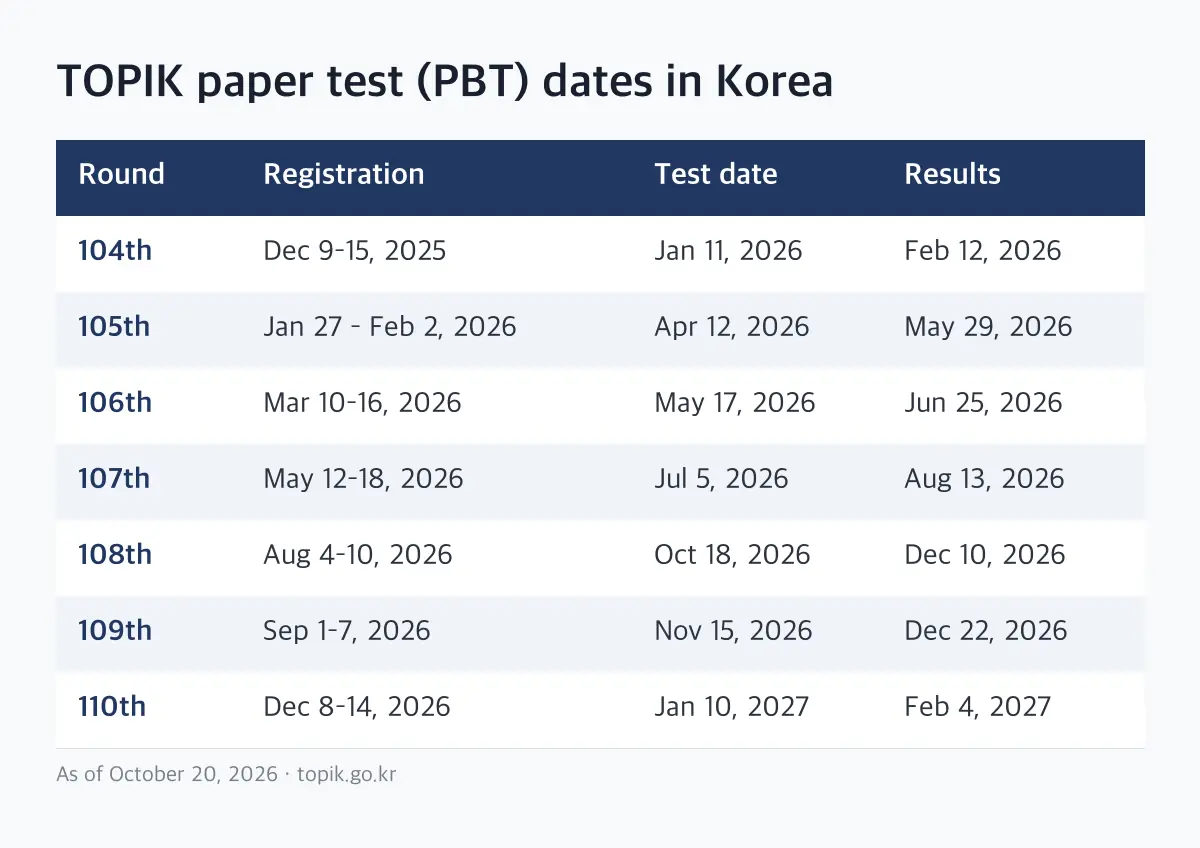
These are the dates for testing inside Korea, from the official TOPIK schedule and the 2026 test plan from the Ministry of Education.
Paper-based test (PBT)
| Round | Registration | Test date | Results |
|---|---|---|---|
| 104th | Dec 9–15, 2025 | Jan 11, 2026 | Feb 12, 2026 |
| 105th | Jan 27 – Feb 2, 2026 | Apr 12, 2026 | May 29, 2026 |
| 106th | Mar 10–16, 2026 | May 17, 2026 | Jun 25, 2026 |
| 107th | May 12–18, 2026 | Jul 5, 2026 | Aug 13, 2026 |
| 108th | Aug 4–10, 2026 | Oct 18, 2026 | Dec 10, 2026 |
| 109th | Sep 1–7, 2026 | Nov 15, 2026 | Dec 22, 2026 |
| 110th | Dec 8–14, 2026 | Jan 10, 2027 | Feb 4, 2027 |
The 2026 plan listed August 4–10 for the 108th round. The live schedule page now shows August 4–12, because TOPIK opened extra registration in Korea that month.
Internet-based test (IBT) and Speaking test
| Test | Registration | Test date | Results |
|---|---|---|---|
| 11th IBT | Dec 16–22, 2025 | Feb 28, 2026 | Mar 20, 2026 |
| 12th IBT + 10th Speaking | Jan 13–19, 2026 | Mar 21, 2026 | IBT Apr 10 / Speaking Apr 13 |
| 13th IBT + 11th Speaking | Apr 7–13, 2026 | Jun 13, 2026 | IBT Jul 3 / Speaking Jul 6 |
| 14th IBT | Jul 7–13, 2026 | Sep 12, 2026 | Oct 2, 2026 |
| 15th IBT + 12th Speaking | Aug 18–24, 2026 | Oct 24, 2026 | IBT Nov 13 / Speaking Nov 16 |
| 16th IBT | Sep 15–21, 2026 | Nov 28, 2026 | Dec 18, 2026 |
The IBT is taken on a computer at a test center. TOPIK says it has the same legal effect and the same level system as the paper test.
When the 2027 schedule comes out
As of October 20, 2026, the full 2027 TOPIK plan has not been posted. Only the 110th paper test (January 10, 2027) appears on the official schedule so far.
For reference, the 2026 plan was dated October 10, 2025 and posted on the TOPIK site on October 31, 2025. If 2027 follows the same pattern, expect the full list around the end of October or in November 2026. We will update this page when it appears.
Testing outside Korea
The dates above are for Korea. Abroad, the rules are different:
- You do not register on the Korea site. You register through the local test agency in your country, often a Korean Cultural Center, an embassy office or a partner university.
- Registration windows abroad are set locally and are often earlier than in Korea.
- Fees abroad are set by each country.
- Some rounds are not held everywhere. For the 110th test, the official schedule lists a date for Korea and Asia (January 10) but no date in the column for the Americas, Europe, Africa and Oceania.
Check your local agency's notice on topik.go.kr before you plan around a date.
How to register in Korea
Registration happens online on the TOPIK registration site during the window only. Based on the 109th round notice:
- Log in with your TOPIK account (one person, one account).
- Choose the test and the level (TOPIK I or TOPIK II).
- Enter your English name, date of birth and gender exactly as on your ID.
- Pick a test site. You can sign up for both TOPIK I and TOPIK II, but only at the same site.
- Upload a photo and pay.
Points that trip people up:
- Windows PC only. Mac OS and mobile phones are not supported.
- Korean payment only. Overseas transfers and cards issued abroad are not accepted. Use a Korean card or a virtual bank account.
- Hours: new registrations are accepted from 10:00 to 16:00 each day of the window.
- Regional days: for the 109th round, Seoul and some provinces opened on day 1, Gyeonggi, Incheon, Busan and other areas on day 2, and from day 3 every region could take the remaining seats.
- Photo: 413 × 531 pixels, taken within the last 6 months. A photo that does not match you on test day can mean you are not allowed to sit the test.
- Name match: if your English name on the admission ticket does not fully match your ID, you cannot take the test.
On test day, a valid passport or Residence Card (외국인등록증) works as ID. If immigration is holding your card for a visa application, the 2026 plan says you can bring the receipt for that application instead, as long as it shows your name, date of birth and photo.
Refunds
For the 109th paper test, refunds worked like this:
| When you cancel | Refund |
|---|---|
| Before 10:00 on the last day of registration | 100% |
| From then until one week later | 50% |
| After that, until 13:00 the day before the test | 40% |
TOPIK fees in Korea
| Test | Fee |
|---|---|
| TOPIK I (PBT) | ₩40,000 |
| TOPIK II (PBT) | ₩55,000 |
| TOPIK I (IBT) | ₩70,000 |
| TOPIK II (IBT) | ₩95,000 |
| TOPIK Speaking | ₩80,000 |
These are the Korea fees in the Ministry of Education's 2026 plan. Fees abroad differ by country.
TOPIK levels and passing scores
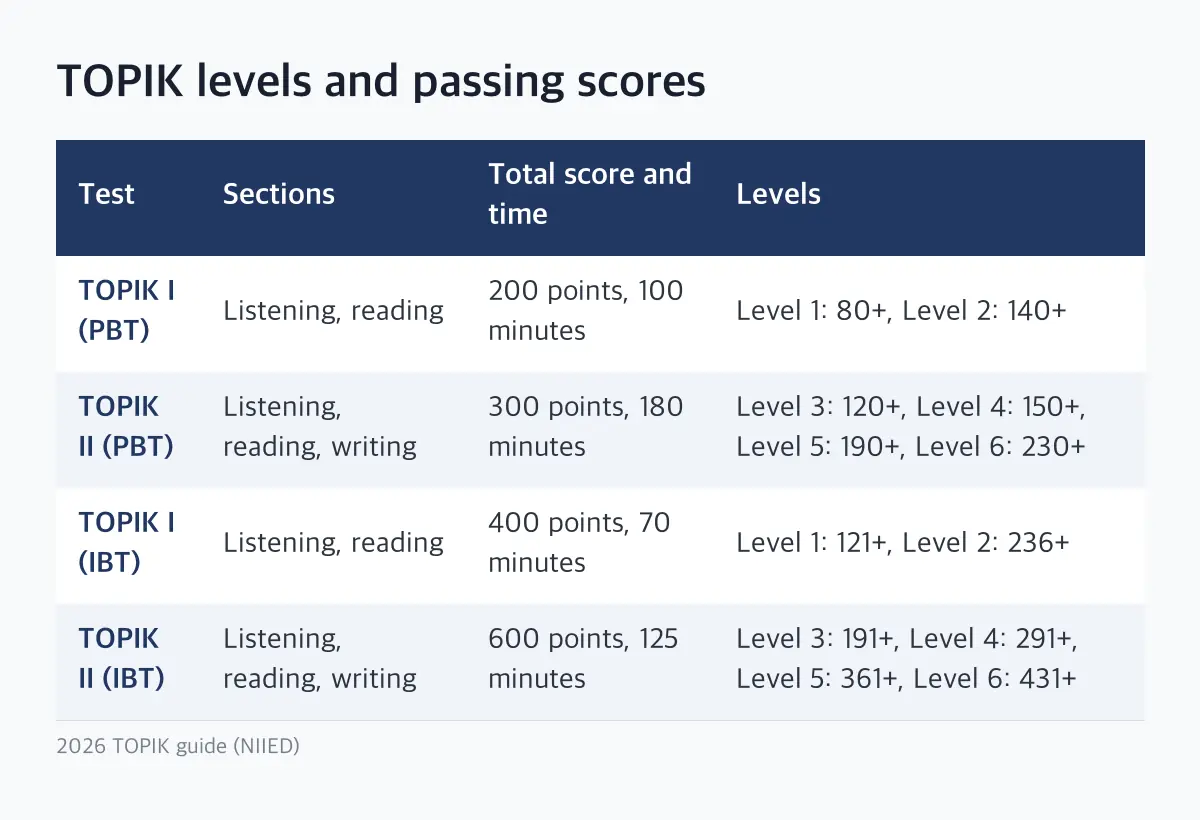
TOPIK has no single pass mark. Your total score decides your level, from Level 1 to Level 6.
| Test | Sections | Total score and time | Levels |
|---|---|---|---|
| TOPIK I (PBT) | Listening, reading | 200 points, 100 minutes | Level 1: 80+, Level 2: 140+ |
| TOPIK II (PBT) | Listening, reading, writing | 300 points, 180 minutes | Level 3: 120+, Level 4: 150+, Level 5: 190+, Level 6: 230+ |
| TOPIK I (IBT) | Listening, reading | 400 points, 70 minutes | Level 1: 121+, Level 2: 236+ |
| TOPIK II (IBT) | Listening, reading, writing | 600 points, 125 minutes | Level 3: 191+, Level 4: 291+, Level 5: 361+, Level 6: 431+ |
TOPIK I covers beginner levels (1–2). TOPIK II covers intermediate and advanced levels (3–6). If a visa rule asks for Level 3 or higher, you need TOPIK II.
The TOPIK Speaking test is separate and has its own 200-point scale.
There is also a free TOPIK Basic test for learners below TOPIK I. It has 40 questions, but TOPIK says its scores have no legal effect, so it will not help a visa application.
How long TOPIK scores are valid
A TOPIK score is valid for 2 years from the results date. After that, you cannot look up the score or print a certificate.
HiKorea's 2026 immigration manual says the same thing from the visa side: immigration accepts a TOPIK score only until the expiry date printed on the certificate. KIIP works differently. Completed KIIP levels and the KIIP mid-term and final tests are accepted with no expiry date, while the KIIP pre-test score lasts 2 years.
So if you need TOPIK for a visa, time your test so the score is still valid on the day you apply. If your application could slip by months, KIIP may be the safer long-term proof.
Which visas use TOPIK levels
Here is what the September 2026 HiKorea manuals say. Most of these rules accept KIIP as an alternative.
| Visa or permit | How TOPIK is used | KIIP alternative |
|---|---|---|
| F-2-7 points-based residence | Korean ability points: Level 5+ = 20, Level 4 = 15, Level 3 = 10, Level 2 = 5, Level 1 = 3 | Same points for the matching KIIP level |
| D-10 job seeker | Korean ability points: Level 5+ = 20, Level 4 = 15, Level 3 = 10, Level 2 = 5 | Matching KIIP level or pre-test score |
| D-10 part-time work | Level 4 or higher | KIIP Level 4 or higher (manufacturing jobs: KIIP only) |
| E-7-4 skilled worker | Minimum Level 2 | KIIP Level 2, or pre-test 41+ |
| F-5 general permanent residence | No longer accepted (only for applications filed by March 31, 2019) | KIIP Level 5, or 60+ on the comprehensive test |
A few more details:
- F-2-7: In the F-2-7 points table, Korean ability sits in the "basic knowledge" section and is worth up to 20 points. HiKorea checks TOPIK or your KIIP level on Socinet.
- D-10: graduates of a Korean university within 3 years of graduating can qualify on the "strong Korean" route with a valid TOPIK Level 4 score or KIIP mid-term pass. A TOPIK Level 6 score also matters on the "promising talent" route for overseas university graduates aged 29 or under who majored in Korean studies.
- E-7-4: the manual lets workers who meet every other requirement defer the Korean requirement until their first extension, but only for applications through December 31, 2026.
- F-5: a TOPIK score alone no longer meets the basic knowledge requirement. One exception in the manual: F-5-1 applicants who are E-5 medical residents at a Korean hospital can use TOPIK Level 5 or higher.
Show this: 한국어능력시험(TOPIK) 성적증명서를 제출하려고 왔어요.
Common questions
How long is the TOPIK exam?
The paper TOPIK I takes 100 minutes and TOPIK II takes 180 minutes. On computer, TOPIK I takes 70 minutes and TOPIK II takes 125 minutes, with no break.
Can I take TOPIK online from home?
Not the official test. The IBT is on a computer, but at a test center. Only the free TOPIK Basic can be taken at home, and it has no legal effect.
Does TOPIK expire?
Yes. Scores are valid for 2 years from the results date, and immigration accepts them only until that date.
Sources
- TOPIK official test schedule (NIIED)
- TOPIK test overview and score validity (NIIED)
- 2026 TOPIK test plan, Ministry of Education notice
- 2026 TOPIK guide: sections, scores and levels
- 109th TOPIK registration notice (Korea)
- 16th TOPIK IBT registration notice
- TOPIK Basic notice
- HiKorea: integrated visa and stay manuals (September 2026)
This guide is general information, not legal advice. Rules change, so confirm with HiKorea or the 1345 Immigration Contact Center before you apply.
Related guides
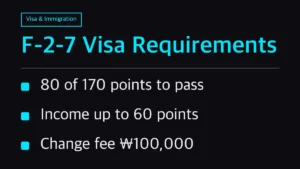 F-2-7 Visa Requirements: Score 80 of 170 Points to QualifyWho can apply for Korea's F-2-7 points-based residence visa, the full points table, three worked score examples, how…
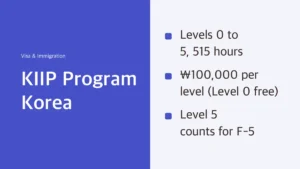 KIIP Program Korea: ₩100,000 per Level, and Level 5 Counts for F-5What Korea's Immigration and Integration Program (KIIP) is, how the six levels and the pre-assessment work, what…
 D-10 Visa Korea: Score 60 of 190 Points, Stay Up to 3 YearsWho qualifies for the D-10 job seeker visa, how the 190-point test works, how long each score lets you stay, the…