
Last updated: October 14, 2026
What the F-3 visa is
F-3 is Korea's dependent family status (동반, "accompanying"). Your status follows your sponsor: your spouse or parent holds the main visa, and you stay in Korea because of their stay.
The official name of the activity is simply "dependent family." That means the F-3 itself covers living with your family member in Korea. It does not cover a job. Children can go to school, and anyone on F-3 can study at an elementary, middle, high school or university without a separate permit, as long as it does not replace the main purpose of the stay.
Who can sponsor an F-3 family member
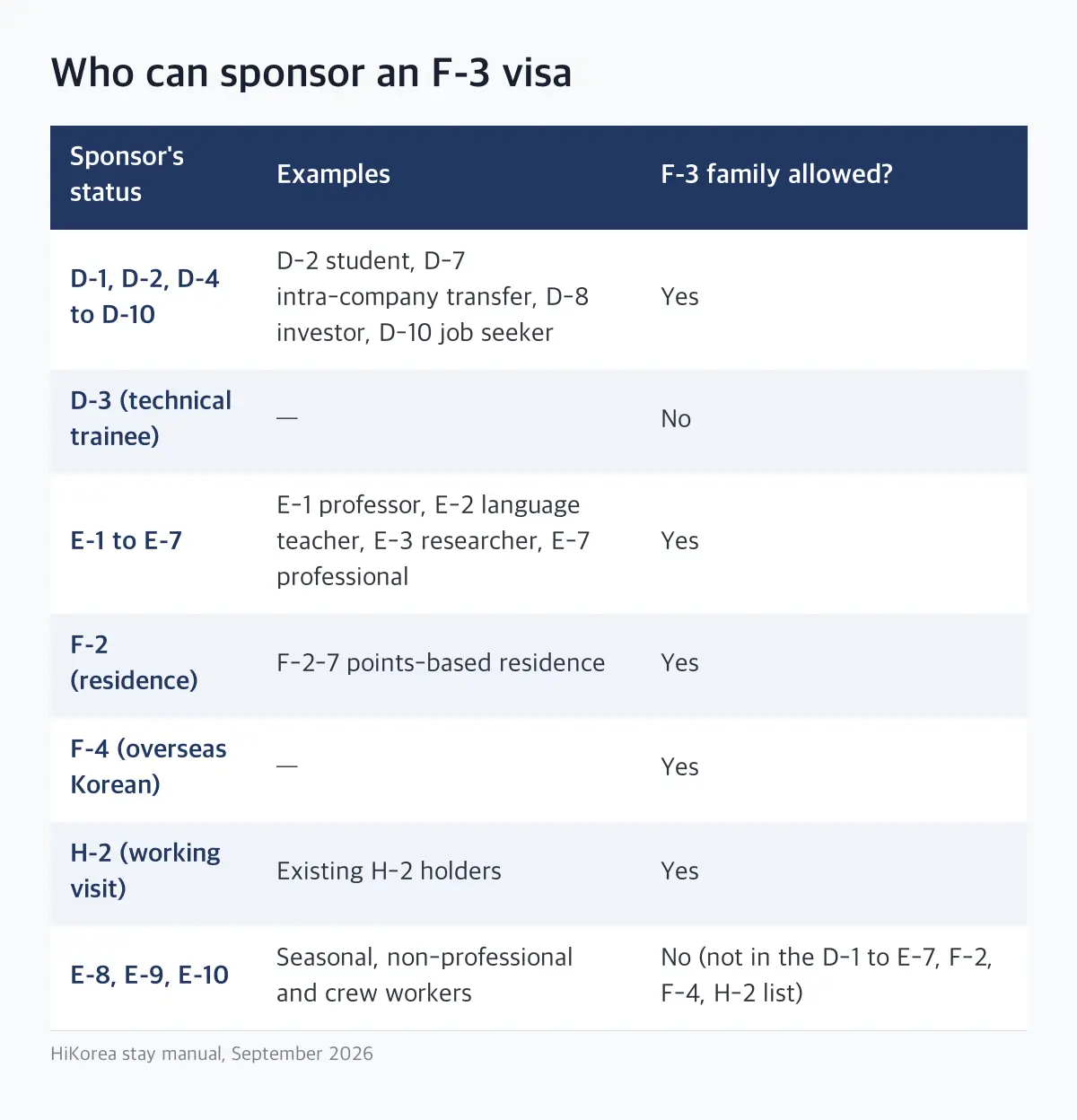
The September 2026 HiKorea stay manual lists the sponsor statuses. Your sponsor must hold one of these:
| Sponsor's status | Examples | F-3 family allowed? |
|---|---|---|
| D-1, D-2, D-4 to D-10 | D-2 student, D-7 intra-company transfer, D-8 investor, D-10 job seeker | Yes |
| D-3 (technical trainee) | — | No |
| E-1 to E-7 | E-1 professor, E-2 language teacher, E-3 researcher, E-7 professional | Yes |
| F-2 (residence) | F-2-7 points-based residence | Yes |
| F-4 (overseas Korean) | — | Yes |
| H-2 (working visit) | Existing H-2 holders | Yes |
| E-8, E-9, E-10 | Seasonal, non-professional and crew workers | No (not in the D-1 to E-7, F-2, F-4, H-2 list) |
Two notes on this list:
- H-2 is closing to new applicants. From February 12, 2026, Korea merged H-2 into F-4 and stopped issuing new H-2 visas. If your sponsor already holds H-2, F-3 is still listed for their spouse and minor children.
- Some online guides say H-2 holders cannot bring family on F-3. The 2026 manual says otherwise. It has a separate section for F-3 family of F-4 and H-2 holders.
Who counts as family
- Spouse: a legal spouse. You prove it with an official marriage certificate.
- Child: an unmarried minor child. Under Korea's Civil Act, a person becomes an adult at 19, so "minor" means under 19.
Parents of the sponsor are not F-3. For example, the parents of an F-4 holder fall under F-1 (visiting family) instead.
Two ways to apply from abroad
Most families get the F-3 visa before they fly. There are two routes.
| Route | Who files | When it fits |
|---|---|---|
| Visa at a Korean consulate (재외공관) | Your family member, at the consulate covering where they live | The usual route. The consulate can issue a single-entry F-3 visa for a stay of up to 1 year. |
| Certificate of Confirmation of Visa Issuance (사증발급인정서) | Filed in Korea, then the family uses it at the consulate | As a rule, only when the family member applies together with the main visa holder |
If your sponsor holds E-1, E-3, E-4, E-5, an E-7 with a GOLD CARD tech-field recommendation, or E-7-T, the spouse and minor children can also use Korea's e-visa (전자사증), which skips the consulate visit.
F-4 and H-2 families have their own short checklist. For F-4 holders' spouse and minor children, the visa manual lists a multiple-entry F-3 visa valid for 1 year.
Documents the consulate asks for
These are the documents for a consulate F-3 visa in the September 2026 visa manual. The consulate can add or drop items after reviewing your case.
| Document | Notes |
|---|---|
| Visa application form, passport, 1 standard photo, fee | Form No. 17 |
| Proof of family relationship | Spouse: original marriage certificate. Child: original birth certificate, or another official parent-child record |
| Proof of the sponsor's ability to support you | For example, the sponsor's certificate of employment and tax payment certificate |
| Letter of guarantee (신원보증서) | Usually signed by the sponsor |
| Proof of where you will live in Korea | A lease or similar |
| TB test certificate | Only if your country is covered by Korea's TB screening rules |
Rules for foreign documents. Every official document from your home country needs all of these:
- A translator's confirmation attached to the translation.
- An apostille, if your country is in the Apostille Convention.
- Korean consular legalization, if your country is not in the convention.
Who can skip some documents. The support proof is waived when the sponsor holds E-1, E-3, E-4, E-5, F-4 or H-2. The support proof and the housing proof are both waived for E-1, E-3, E-4, E-5, F-4, H-2, E-7-T, E-7-S1, and D-8 investors who put in $500,000 or more.
What if the sponsor has no tax record yet? The manual allows other financial documents instead of a tax payment certificate, for example when the sponsor is on some D statuses or is applying at the same time as the family.
The 2026 manual does not print a fixed income amount for F-3. Some websites publish household income tables. Before you apply, ask your consulate which income proof and which amount it will check, because the consulate decides your visa.
Can you switch to F-3 inside Korea?
Usually not. If your spouse or child is already in Korea as a tourist, the normal path is to go home and get the F-3 visa at a consulate.
The 2026 stay manual allows a change of status to F-3 inside Korea only for humanitarian reasons that came up after entry: pregnancy, childbirth, child-rearing or illness. It applies to:
- People who entered visa-free (B-1), on transit (B-2), or on a short-term visa.
- Foreigners already staying legally long-term in Korea.
If you qualify, you file a change of status at your immigration office. The fee is ₩100,000. Bring:
- Application form, passport, 1 standard photo, fee.
- Proof of family relationship (apostilled or legalized, as above).
- Proof of funds for your stay.
- Proof of where you live.
- Letter of guarantee.
- A written reason for the change, with evidence such as a medical certificate.
- The sponsor's Residence Card.
For families of F-4 and H-2 holders, the manual says the same thing in short form: a visa from abroad is the rule, and an in-Korea change is allowed only in limited cases.
Show this: 동반(F-3) 자격으로 체류자격 변경 신청하려고 왔어요.
After you arrive: register and pay these fees
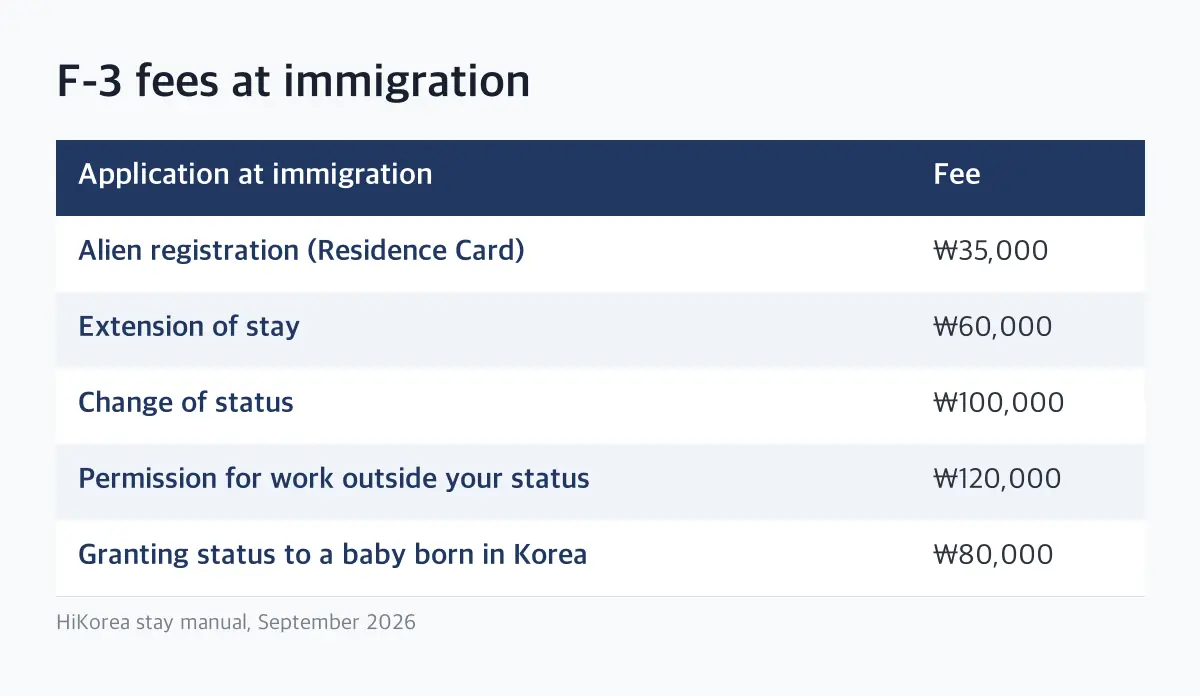
If your family will stay 90 days or more, each person registers within 90 days of entry and gets a Residence Card (외국인등록증).
| Application at immigration | Fee |
|---|---|
| Alien registration (Residence Card) | ₩35,000 |
| Extension of stay | ₩60,000 |
| Change of status | ₩100,000 |
| Permission for work outside your status | ₩120,000 |
| Granting status to a baby born in Korea | ₩80,000 |
Fees are review fees. Immigration does not refund them once your application is accepted.
For the F-3 registration, bring the application form, passport, 1 photo, the fee and proof of where you live. A family relationship document is needed only when you also need a further permit, and at that point a plain copy is enough.
Show this: 동반(F-3) 자격으로 외국인등록하러 왔어요.
How long you can stay on F-3
Your F-3 period follows your sponsor's. Immigration extends an F-3 within the sponsor's period of stay, so you cannot be permitted past the date your sponsor's own permission ends. For family of a D-10 job seeker, for example, the manual caps the F-3 at the D-10 holder's stay.
Your passport also limits it. As a rule, Korea grants a period of stay only within your passport's validity, so renew a passport that is running out before you apply.
To extend, bring the application form, passport, Residence Card, the fee (₩60,000), proof of where you live, and your spouse's or parent's Residence Card.
You do not need a re-entry permit if you leave Korea and come back within 1 year, as long as your stay has not run out.
Can F-3 visa holders work in Korea?
Not by default. You need permission for activities outside your status (체류자격외활동허가) before you start. Which jobs you can get depends on your sponsor.
| Your sponsor | What the F-3 spouse can do | How long |
|---|---|---|
| E-1 to E-5, E-6 (not E-6-2), E-7 including E-7-4 | Professional jobs in the E-1 to E-7 fields, and farming, forestry or livestock work | Up to 1 year at a time, within your stay |
| Adult spouse of F-2, F-4 or H-2 | Same as above | Up to 1 year at a time |
| Any F-3 holder | Foreign language instructor (E-2), foreign school teacher (E-7), or language proofreader at a government body or public agency (E-7) | Per permit |
| Adult spouse of D-2-3 (master's), D-2-4 (PhD), E-1, E-3, E-4, E-5 | Almost any job, under a pilot program | Your period of stay |
Farming, forestry and livestock work needs extra papers: a standard labor contract, the employer's business registration, a copy of the employer's ID, and proof of Korean: TOPIK level 2 or higher, or a pass at Social Integration Program level 2 or above.
For an E-7 job, the employer and the job still have to meet the normal E-7 rules.
The pilot for spouses of top talent (to March 29, 2027)
From March 30, 2026 to March 29, 2027, adult spouses of D-2-3 and D-2-4 graduate students and of E-1, E-3, E-4 and E-5 holders can get one blanket permit. After that, you sign a job and report it, instead of asking permission for each job.
- Get the blanket permit once (application, passport and a copy, Residence Card, fee). You can apply in person, or online from April 22, 2026.
- Sign your labor contract and start work.
- Report the start and the end of each job within 15 days, online only. If you skip a report, immigration can cancel the permit.
Some jobs stay off-limits even under the pilot: gambling businesses, hostess bars and other adult entertainment venues, private one-on-one tutoring, and businesses that minors are banned from.
Show this: 배우자 체류자격외활동허가 신청하러 왔어요.
A baby born in Korea
A child born in Korea to foreign parents has no status at birth. Apply for a status (체류자격 부여) within 90 days of the birth. The fee is ₩80,000.
Bring the application form, the baby's passport, 1 photo, the fee, your Residence Card, a letter of guarantee, and the Korean birth certificate.
Children in school: report it
Every registered foreign child aged 6 to 18 must report whether they attend elementary, middle or high school. Report within 15 days of starting school or moving up a level, and again each time you apply for a permit such as an extension. Bring a certificate of enrollment, or mark "not in school" on the form.
When F-3 ends: turning 19, a new job, or the sponsor leaving
- A child turns 19. They are no longer a minor child, so they need their own status, for example D-2 if they start at a university.
- The spouse gets a full-time job. A work permit is tied to F-3. To work on your own visa, apply for a change of status to the job's status, such as E-7.
- The sponsor leaves or loses status. Your F-3 depends on your sponsor's stay, so their departure or a new status affects yours. Ask immigration before the sponsor's status changes.
FAQ
What is the F-3 visa in Korea?
It is the dependent family status (동반) for the spouse and unmarried minor children of foreigners on D-1 to E-7 (not D-3), F-2, F-4 or H-2. It lets you live with them in Korea but not work without a permit.
Can I apply for F-3 at the airport or as a tourist?
No. Get the visa from a Korean consulate first. A tourist in Korea can switch to F-3 only for humanitarian reasons such as pregnancy, childbirth, child-rearing or illness.
Sources
- HiKorea: Stay and Visa Issuance Guidance Manuals, September 2026 (notice page with HWP attachments)
- Korea Immigration Service: Immigration Contact Center (1345)
- Civil Act, Article 4 (age of majority), Korea Legislation Research Institute English translation
Questions about your own case: call 1345 inside Korea, or +82-1345 from abroad. English is available.
This guide is general information, not legal advice. Rules change, so confirm with HiKorea or the 1345 Immigration Contact Center before you apply.
Related guides
 E-7 Visa Korea: 94 Jobs, a ₩31.12M Salary Floor, an Eligible EmployerWho qualifies for Korea's E-7 work visa in 2026: the 94 approved job codes, the degree and experience rules, the…
 Korea Visa Extension: HiKorea Up to 4 Months Early, Fee ₩60,000When and how to extend your period of stay in Korea: the 4-month window, HiKorea e-Application versus a visit…
 How to Get ARC in Korea (Residence Card): Book Within 90 Days, Pay ₩35,000Staying in Korea longer than 90 days? You need a Residence Card, still called an ARC. Here are the documents, the…