
Your employer also has to qualify. As a rule, it needs at least 5 Korean employees, must keep E-7 hires in protected jobs within 20% of its Korean staff, and must have no unpaid national or local taxes.
Last updated: October 13, 2026
What the E-7 visa is
E-7 is called Special Activities status (특정활동). The legal definition is short: work under a contract with a public or private organization in Korea, in an activity the Minister of Justice specially designates. In practice, "designated activity" means a list of approved occupations, each with a code taken from the Korean Standard Classification of Occupations.
The HiKorea immigration manuals updated in September 2026 split E-7 into four main subtypes:
| Subtype | What it covers | Number of job codes |
|---|---|---|
| E-7-1 | Managers and professionals (전문인력) | 67 |
| E-7-2 | Office and service workers (준전문인력) | 10 |
| E-7-3 | Skilled trades (일반기능인력) | 14 |
| E-7-4 | Skilled workers, points-based (숙련기능인력) | 3 |
That adds up to 94 job codes, the count the September 2026 stay manual gives as of August 2026. There are also special tracks outside the list: E-7-S for high earners and high-tech workers, E-7-Y for young people raised in Korea, and E-7-T for top-tier talent in advanced industries.
One grant of stay can be up to 3 years. It can be up to 5 years for talent recommended by a ministry and for some special zones.
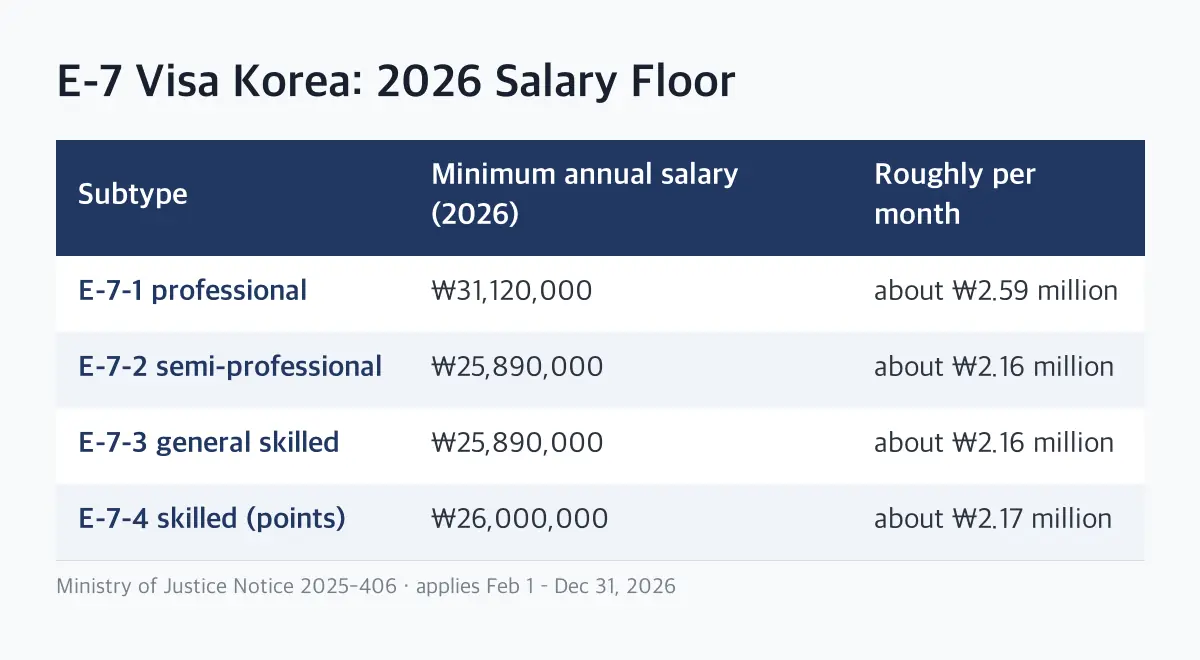
2026 salary requirement by subtype
The Ministry of Justice sets the E-7 wage floor every year. The current figures come from Ministry of Justice Notice No. 2025-406, dated December 29, 2025.
| Subtype | Minimum annual salary (2026) | Roughly per month |
|---|---|---|
| E-7-1 professional | ₩31,120,000 | about ₩2.59 million |
| E-7-2 semi-professional | ₩25,890,000 | about ₩2.16 million |
| E-7-3 general skilled | ₩25,890,000 | about ₩2.16 million |
| E-7-4 skilled (points) | ₩26,000,000 | about ₩2.17 million |
The monthly column is simply the annual figure divided by 12. Immigration checks the annual total in your contract, not the monthly number.
How the salary test works, according to the September 2026 visa manual:
- The amount that counts is the total annual pay in your employment contract (연봉).
- The contract must state the monthly pay and the working hours, per day and per month. Both the hourly and the monthly rate must also meet the minimum wage.
- A salary below the standard is, in principle, refused.
- Immigration uses the figure announced for the date you apply.
- Some job codes have their own wage rule set by the ministry, and that rule applies instead.
The manual also keeps a special rule for small and medium companies, venture companies, and mid-sized companies outside the Seoul area. For a worker with no more than 3 years of E-7 work in Korea, a job that uses the "80% of the previous year's per-capita GNI" rule can use 70% instead, for up to 3 years. When that special figure and the yearly notice differ, the one more favorable to the applicant applies.
The 2026 notice covers applications from February 1 to December 31, 2026. A new notice is published each year, so if you apply in 2027, look for the 2027 figures first.
Degree and experience rules
For most E-7 jobs, you must meet one of these:
| Route | What you need |
|---|---|
| Master's degree | A master's or higher in a field related to the job |
| Bachelor's plus experience | A related bachelor's degree and at least 1 year of work in the field |
| Experience only | At least 5 years of work in a related field |
Experience normally counts only after you earned the degree or license. In high-tech fields such as IT, bio, and nano, internships before graduation can count.
The manual lists several exceptions that lower or remove these requirements when the employer shows it needs you:
- Korean university graduates: with a bachelor's degree or higher from a Korean college or university, you can work in any approved job, whatever your major, and the 1-year experience rule is waived. Associate degree graduates get the waiver for jobs related to their major. Online universities such as cyber universities are excluded.
- World top universities: graduates of a Times top 200 or QS top 500 university do not need the 1 year of experience.
- Global 500 companies: at least 1 year in a professional job at one of the world's 500 largest companies can replace the normal education and experience rule.
- Young graduates, 29 or younger: graduates of a Times or QS top 200 university, or Korean studies majors with TOPIK level 6, skip the degree and experience match. STEM graduates of a QS top 1,000 university in Vietnam, China, Thailand, Japan, India, Indonesia, Malaysia, Singapore, or the Philippines skip the experience rule if they have TOPIK level 2 or higher.
- High earners: if your total annual pay is at least 3 times Korea's per-capita GNI for the previous year, degree and experience rules are waived for any job. This is the E-7-S1 track, though it still excludes office clerk and simple labor jobs.
- Ministry-recommended talent: pay of at least 1.5 times per-capita GNI plus a ministry recommendation waives both rules, for the 67 professional jobs only.
The 94 job codes: common examples
Each approved occupation has a code, and your contract and application must match one of them. The visa manual's full list, as of September 2026, includes these well-known ones:
- E-7-1 professionals: system software developer (2222), application software developer (2223), web developer (2224), data expert (2231), information security expert (2233), mechanical engineer (2351), electrical engineer (2341), nurse (2430), university lecturer (2512), overseas sales (2842), technical sales (2843), translator or interpreter (2914), designer (295).
- E-7-2 semi-professionals: airline transport clerk (32222), hotel receptionist (3612), medical coordinator (S3612), customer service clerk (3620), tour interpreter guide (44213), casino dealer (44291), cook and chef (451), care worker (42210).
- E-7-3 general skilled: shipbuilding welder (7406), ship electrician (76212), ship painter (78369), aircraft mechanic (7521), auto parts manufacturer (S85411), halal butcher (7103).
- E-7-4 skilled (points): root industry skilled worker (S740), agriculture, livestock and fishery skilled worker (S610), and manufacturing or construction skilled worker (S700).
Several codes have extra rules of their own, such as a recommendation letter from the ministry in charge, a guarantee letter, or a cap per company. Ask your employer which code it plans to use, then check that code's details with the immigration office before you sign.
What your employer must have
The employer is the inviting party, so its situation can sink an application even when you qualify. The 2026 manuals set these general conditions:
| Condition | Rule in the 2026 manuals |
|---|---|
| Company size | A company with fewer than 5 Korean employees that mainly sells in Korea is, in principle, not allowed to invite. Employees count only if listed on the employment insurance roll for at least 3 months at minimum wage or more |
| Foreigner ratio | For protected jobs, E-7 workers are allowed only within 20% of the Korean staff. A company already over 20% is, in principle, refused new invitations, status changes, and workplace changes |
| Taxes | No unpaid national or local taxes |
| Business record | Small startups and venture firms hiring for the 67 professional jobs can be allowed for up to 5 years after founding even without sales |
Because of the 3-month insurance record, a brand-new company generally has to wait at least 3 months after opening before it applies.
The 20% rule does not cover every job. For professional jobs, the manual says the general protection rules apply only in exceptions, such as mechanical engineers, drafters, travel product developers, overseas sales staff, and translators, plus jobs listed as protected. With a recommendation from KOTRA or the Korea International Trade Association, the cap can rise to 50% for advanced industries, or 70% for strong exporters working in rare languages.
Documents for the application
When you are abroad, your employer applies for a Confirmation of Visa Issuance (사증발급인정서) at the immigration office covering the company's address. Talent recommended by a ministry can also apply online through the Korea Visa Portal. With the confirmation, you apply for the visa at a Korean embassy or consulate.
Common documents, per the September 2026 visa manual:
| From you | From the employer |
|---|---|
| Application form (Form 21), passport copy, one standard photo | Business registration (사업자등록증) or similar |
| Copy of the employment contract | National and local tax payment certificates |
| Proof of qualifications: degree, career certificates, résumé, licenses | A letter explaining why it needs to hire you, and a plan for using you |
| Korean or English translations of foreign documents | Recommendation letter from the ministry in charge, for codes that require one |
| Apostille or consular confirmation on key documents | Guarantee letter (신원보증서), only for certain codes |
The immigration office can ask for more or fewer documents. Companies certified as model taxpayers or similar good-practice employers can skip some company documents.
Switching to E-7 inside Korea
You can change to E-7 without leaving Korea if you are a registered foreign resident in D-1, D-2, D-4, D-5 to D-10, or E-1 to E-6 status (except E-6-2 performers at hotels and entertainment venues), or the F-3 spouse of one. The usual path is D-2 student to D-10 job seeker to E-7.
Some statuses cannot switch to E-7 inside Korea: short-term B and C statuses, D-3, E-8, E-9, E-10, and G-1. The one exception is the E-7-4 points track for long-term E-9, E-10, and H-2 workers, explained below.
To apply, book a HiKorea visit reservation and bring the integrated application form, your passport and Residence Card, a photo, the fee, the company's documents, your career certificates, and the employer's tax certificates. The fee for a change of status is ₩100,000.
Show this: 특정활동(E-7) 자격으로 체류자격 변경하려고 왔어요.
E-7-4: the points route from E-9, E-10 or H-2
E-7-4 is only a change of status inside Korea. You cannot get a new E-7-4 visa from abroad. The selection quota is 35,000 people, and applications are open all year, online through HiKorea e-application.
Basic requirements, all required:
- At least 4 years in E-9, E-10, or H-2 status in the last 10 years, and legally working at your current workplace now.
- A contract with your current employer for at least 2 more years, at ₩26,000,000 a year or more (₩25,000,000 in farming, livestock, fishing, and coastal shipping).
- A recommendation from the company where you have worked for at least 1 year.
- At least 200 of 300 points, with at least 50 points each in average income and Korean language.
For the income item, your average income over the last 2 years must be at least ₩25,000,000 (₩24,000,000 in farming and fishing). For Korean, you need TOPIK level 2, completion of level 2 of the Social Integration Program, or 41 points or more on its pre-assessment.
The online system assigns application days by the last digit of your birth year: 1 or 6 on Monday, 2 or 7 on Tuesday, 3 or 8 on Wednesday, 4 or 9 on Thursday, and 5 or 0 on Friday. Each grant of stay is up to 2 years.
After you get E-7: extension and job changes
Extending your stay. Bring the application form, passport and Residence Card, the fee, your contract, and an income certificate (소득금액증명), which is required. Also bring the company's business registration, proof of where you live, and the employer's tax certificates. The extension fee is ₩60,000. Immigration checks your actual income at this stage, and the manual makes the income certificate mandatory for both extensions and workplace changes.
Changing or adding an employer. Most E-7 holders only need to report the new workplace within 15 days after the change, with no fee. A list of jobs needs permission before the move instead, including mechanical engineers, drafters, designers, cooks, hotel receptionists, shipbuilding welders, and all three E-7-4 codes. If you quit or are fired for your own fault, you need the former employer's consent to use the report system.
FAQ
Is there an age limit for the E-7 visa?
The general E-7 rules in the 2026 manuals set no age limit. Two special exemptions, the one for young graduates of top world universities and the one for Asian STEM graduates, apply only to people aged 29 or younger.
How long does E-7 processing take?
Neither the 2026 manuals nor the wage notice publish a standard processing time. Ask the immigration office handling your employer's application, or call the 1345 Immigration Contact Center (+82-1345 from abroad).
Can I switch from E-9 to E-7?
E-9 is on the list of statuses that cannot change to the regular E-7 subtypes inside Korea. Your route is E-7-4, which needs 4 years in E-9, E-10, or H-2 status within 10 years and 200 points.
Sources
- Ministry of Justice: 2026 E-7 wage requirement notice (Korean)
- Ministry of Justice Notice No. 2025-406, PDF (Korean)
- HiKorea: integrated guide manuals by status of stay, September 2026 (Korean)
- Enforcement Rule of the Immigration Control Act, Article 72: fees (Korean)
- Easy to Find Practical Law: extension and change of status of stay
This guide is general information, not legal advice. Rules change, so confirm with HiKorea or the 1345 Immigration Contact Center before you apply.
Related guides
 How to Change Visa Status in Korea: Get Permission First, Fee ₩100,000Who can switch status of stay inside Korea and who must leave first, the common switches (D-2 to D-10 or E-7,…
 Korea Visa Extension: HiKorea Up to 4 Months Early, Fee ₩60,000When and how to extend your period of stay in Korea: the 4-month window, HiKorea e-Application versus a visit…
 How to Get ARC in Korea (Residence Card): Book Within 90 Days, Pay ₩35,000Staying in Korea longer than 90 days? You need a Residence Card, still called an ARC. Here are the documents, the…