
Last updated: October 17, 2026
What F-5-1 is
F-5 is the permanent resident status (영주). It has more than 25 sub-types, and F-5-1 is the "general" one for adults who have lived in Korea for 5 years or more. Other routes, such as marriage to a Korean or 3 years on a points-based visa, follow different rules and are covered near the end.
Everything below comes from the HiKorea stay manual of September 2026, the latest version immigration has posted. Many private guides still repeat older rules, so check them against the numbers here.
Which visas count toward the 5 years
Only time on these statuses counts. An adult (by Korean civil law) must have stayed on one of them for 5 years or more.
| Counts | Does not count |
|---|---|
| D-7 (intra-company transferee) through E-7 (specially designated activities), which includes D-8, D-9, D-10 and E-1 to E-7 | Study (D-2) and language study (D-4) years |
| F-2 (residence), including F-2-7 | Work visas outside that range, such as E-9 |
Time on different qualifying statuses adds together as long as you never left Korea for good between them. You also need to be doing the economic activity your visa allows when you apply.
Some visas have an extra test:
- D-8 (business investment): average yearly sales of ₩1 billion or more over the last 2 years.
- D-9 (trade management): average yearly exports of ₩500 million or sales of ₩1 billion or more over the last 2 years.
- D-10 (job seeking) and E-7: a bachelor's degree or higher. D-10 holders also need a signed work contract that meets the E-1 to E-7 rules.
How the 5 years are counted
Short trips abroad do not break the clock if both rules hold in every 365-day period counted back from your application date:
- each trip is 90 days or less, and
- all days abroad add up to 180 days or less.
If one year fails, the continuous period restarts from that point. For example, if only one of the five years fails the test, you count only 3 continuous years and must stay 2 more years. Leaving Korea for good, or switching to a status that does not count, also breaks the chain.
Income or assets: the 2x GNI test
You must meet one of these two tests. You cannot add income and assets together.
| Test | General F-5-1 standard |
|---|---|
| Income | At least 2 times last year's GNI per capita |
| Net assets | At least 1.5 times last year's average household net assets, after debts |
For E-5 doctors finishing a residency at a Korean hospital, the income test is 1 times GNI.
What the income number is for 2026. The Bank of Korea announced a 2025 GNI per capita of ₩52,416,000 in March 2026, so 2 times is about ₩104.83 million. In June 2026 the Bank raised its dollar figure for 2025 from $36,855 to $36,963. I could not confirm a revised won figure, so the exact benchmark immigration uses may be slightly higher. Ask your immigration office for the number before you apply.
How the income is judged:
- Whose income counts: yours plus family who live with you at the same address and share expenses, meaning a spouse (not a common-law partner), minor children, and your own parents (not your spouse's parents).
- Your own share: your own income or assets must still be at least 50% of the benchmark, unless you are raising minor children.
- Which year: the full calendar year before your application date. Applying on January 1 or December 31 of 2026 both use 2025. If the tax office has not issued the 2025 income certificate yet, immigration uses the year before.
- Only taxed income counts. Income that should have been taxed but was not is ignored, and so are homes and other assets themselves. Rent you earn and pay tax on can count as business income.
- Assets must be held for at least 6 months before you apply and stay at that value until approval. Savings, funds, stocks, insurance and rental deposits count. Real estate counts at its official or bank-quoted value.
Immigration also checks whether you have hurt state finances. Unpaid national tax, local tax, customs duty, health insurance premiums or fines can fail the application. Income from work your visa does not allow, or from nightlife and gambling businesses, does not count.
Basic knowledge requirement
You must show basic knowledge of Korean language and society. Any one of these is enough:
- Finishing the Korea Immigration and Integration Program (KIIP, 사회통합프로그램) Level 5.
- Scoring 60 out of 100 or higher on the Comprehensive Assessment for permanent residence or naturalization (영주용·귀화용 종합평가).
The old TOPIK Level 4 route only worked for applications filed by March 31, 2019, so a TOPIK score is no longer accepted.
You are exempt if you are under 15, are a minor aged 15 or over still in a regular school, hold a Korean doctoral degree, or already qualify for a permanent residence type that waives the test. For how to finish KIIP, see the KIIP guide linked from this page.
Good conduct rules
Immigration reviews your Korean record and, in most cases, your home-country record. The manual lists several things that block approval until time has passed:
- A prison sentence ended less than 5 years ago, or a suspended sentence was finalized less than 5 years ago.
- A fine was paid less than 3 years ago.
- Three or more Immigration Act violations in the last 5 years, not counting administrative fines.
- An Immigration Act penalty of ₩5 million or more in the last 3 years, or penalties adding up to ₩7 million or more.
- Deported less than 7 years ago, or ordered to leave less than 5 years ago.
If you broke Korean law in the last 10 years, you may have to take a 3-hour law-abiding citizen education course (준법시민교육) before approval. You are exempt if you finished the course before and have no new violation, or if you have one violation at most and it was a non-prosecution or a fine of ₩1 million or less. You also must not have worked in nightlife or similar entertainment services while building your stay.
Documents
Bring originals and send foreign documents with an apostille or Korean consular confirmation.
| Document | Notes |
|---|---|
| Integrated application form | With revenue stamp |
| Passport and Residence Card (외국인등록증) | If you have no card, add a passport-size photo taken in the last 6 months |
| Proof of address | A valid lease or full property register |
| Criminal record certificate (범죄경력증명서) | From your home country, plus any third country where you lived 1 year or more in the last 5 years. Issued within 6 months of the application, with a notarized translation |
| Guarantor letter (신원보증서) | Waived for some applicants |
| Income documents | Tax payment or no-arrears certificate, and Income Certificate (소득금액증명) from the tax office |
| Proof of basic knowledge | KIIP Level 5 certificate or Comprehensive Assessment pass |
| Applicant background form | Filled in by you |
The criminal record certificate is waived if you have lived in Korea legally and continuously for 10 years or more, if you were born in Korea or entered before age 14 and have not spent 6 months abroad in a row since age 14, or if your country cannot issue one for your age or residence. Extra papers apply to D-8, D-9, D-10 and E-7 holders, such as sales records or your degree and work contract.
Show this: 영주권 신청하러 왔어요.
Show this: 소득금액증명이랑 납세증명서 가져왔어요.
Fee and how to apply
The fee for a change of status to F-5 is ₩200,000, compared with ₩100,000 for other status changes. It is a review fee and is not refunded after the application is accepted. You apply in person at your immigration office, and you must be in Korea when you apply. If you leave after applying, your application can be rejected. For the general booking steps, see the guide to a change of status in Korea.
The manual does not state how long a decision takes, so ask your office.
Other F-5 routes
Several other types skip parts of the general test. The conditions are different, so read the specific rule before relying on them.
| Type | Who | Core condition |
|---|---|---|
| F-5-2 | Spouse of a Korean | Married and living together, with 2 years or more on F-6-1 |
| F-5-16 | Points-based residents | 3 years or more on F-2-7 and income of 2x GNI, see the F-2-7 guide |
| F-5-13 | Pension recipients | Age 60 or older with a pension from abroad |
| F-5-5 | High-amount investors | Investment of $500,000 or more and 5 or more Korean employees |
| F-5-9 | High-tech PhD holders | PhD in a listed field and employed by a Korean company |
Some private guides mention lower income standards for KIIP graduates or volunteers. I could not find those in the September 2026 manual for F-5-1, so confirm with immigration before you count on them.
Keeping F-5 after approval
Your permanent resident card is not for life if you leave. If you stay abroad past 2 years from the day you left without a re-entry permit, the status can be lost. Giving false information in your application can lead to cancellation under Article 89-2 of the Immigration Act. F-5 status is also the basic step before naturalization, which is a separate application.
Sources
- HiKorea: Foreign Resident Stay Guide Manual (September 2026)
- Bank of Korea 2025 national income, via Newsis (March 10, 2026)
- Korea Herald on the Bank of Korea June 2026 revision
- HiKorea
- Immigration Contact Center 1345
This guide is general information, not legal advice. Rules change, so confirm with HiKorea or the 1345 Immigration Contact Center before you apply.
Related guides
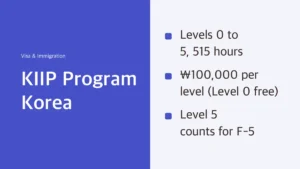 KIIP Program Korea: ₩100,000 per Level, and Level 5 Counts for F-5What Korea's Immigration and Integration Program (KIIP) is, how the six levels and the pre-assessment work, what…
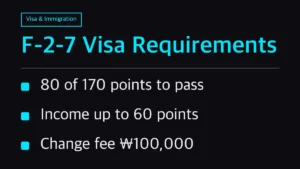 F-2-7 Visa Requirements: Score 80 of 170 Points to QualifyWho can apply for Korea's F-2-7 points-based residence visa, the full points table, three worked score examples, how…
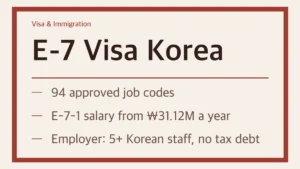 E-7 Visa Korea: 94 Jobs, a ₩31.12M Salary Floor, an Eligible EmployerWho qualifies for Korea's E-7 work visa in 2026: the 94 approved job codes, the degree and experience rules, the…