
Last updated: November 4, 2026
How does Korea's credit score work?
Korea switched from 10 credit grades to a points system on January 1, 2021, according to the Financial Services Commission (FSC). The old grades are gone, so a "grade 7" table you see online is out of date.
Two personal credit bureaus calculate the score:
| Bureau | Consumer site | Scale |
|---|---|---|
| NICE Information Service (NICE평가정보) | credit.co.kr (NICE지키미) | 1 to 1,000 |
| Korea Credit Bureau (KCB, 코리아크레딧뷰로) | allcredit.co.kr (올크레딧) | 1 to 1,000 |
The score is called a personal credit score (개인신용평점). A higher number means a lower chance of falling 90 days or more behind within a year, as KCB defines it.
Your two scores will differ, because the bureaus weight the same data differently. Banks and card companies also run their own internal scoring. KCB states that lenders treat its score as one reference point, not the final decision.
Do foreigners get a Korean credit score?
Yes, but only from Korean records. NICE's disclosure says it does not calculate a score when there is no credit information to evaluate, or for anyone under 18 or over 100. Nothing in it carves out foreigners, and nothing brings in data from abroad.
That is why most newcomers start with no score rather than a low one. NICE said in June 2026 that registered foreigners, about 1.6 million people, have long faced limits on financial services because they lack a Korean credit history.
You are not alone in this. FSC data reported by the Economist (Korea) counted 12.47 million thin filers (금융이력부족자) in August 2026, a quarter of everyone the bureaus evaluate.
Does my home-country credit score transfer?
No. A FICO score or a UK credit file does not feed into NICE or KCB.
One narrow exception is starting. In June 2026 NICE launched an app called Welko that, with your consent, passes a credit report from your home country to Korean banks and telecom companies. It covers Vietnamese E-9 workers first, with the Philippines, Indonesia, Thailand and Nepal planned. NICE describes this as sharing a report with lenders, not as converting it into your NICE score.
What goes into the score?
Both bureaus publish their weights. These are averages for ordinary customers. People with a past long-term default are weighted differently.
| Factor | NICE | KCB | What it means |
|---|---|---|---|
| Repayment history | 28.4% | 21% | Late payments, now and in the past |
| Debt level | 24.5% | 24% | How much you owe on loans and guarantees |
| Length of credit history | 12.3% | 9% | Time since you first opened credit |
| Type of credit | 27.5% | 38% | Card use patterns and the kind of loans you hold |
| Non-financial data | 7.3% | 8% | Bills you submit, such as phone and health insurance |
Sources: NICE's personal credit score disclosure and KCB's disclosure dated April 1, 2024.
For a newcomer, the last two rows matter most early on. Length of history starts at zero, and non-financial data is the one part you can add yourself on day one.
How do you check your credit score for free?
The Credit Information Use and Protection Act (신용정보법) gives every individual the right to see their credit score free of charge at regular intervals of no more than one year (Article 39). The law speaks of any credit data subject, not only citizens.
In practice:
- NICE: NICE's disclosure says your score and the information behind it can be viewed free 3 times a year, once every 4 months, at credit.co.kr. Customer center: 1588-2486.
- KCB: allcredit.co.kr offers the same free view under the same law.
- Apps: Toss shows both KCB and NICE scores for free, and Toss says anyone can manage their credit score in the app.
Korean financial sites confirm who you are before showing personal data, usually through a Korean phone number in your own name. If your line is under someone else's name, fix that first.
Does checking lower your score?
No. NICE states that inquiry records are not used in its scoring, and KCB says the same so that shopping for a loan is not punished. Toss notes the FSC removed the effect of inquiries in October 2011.
How do you build a credit score from nothing?
Start with the parts the bureaus say they reward.
| Step | Why it counts | Source |
|---|---|---|
| Use a check card (체크카드) steadily | NICE reflects check card use, and KCB counts steady check card use as a plus | NICE, KCB |
| Get a credit card and pay it in full | KCB says healthy card use scores better than no credit history at all | KCB |
| Submit non-financial payment records | Phone bills, health insurance, National Pension, utilities and apartment fees can earn extra points | NICE, KCB |
| Keep accounts open | NICE says cancelling a card has no effect on your score, and length of history only helps | NICE |
| Keep enough unused limit | KCB treats a constant lack of remaining limit as a risk | KCB |
Submitting non-financial data (비금융정보) is the fastest move for a foreign resident. You register it yourself on the bureau's site or through an app. KCB uses submitted payment records from the last 36 months.
If no card company will approve you yet, a deposit-backed card is the usual first step. In October 2026 the FSC designated Shinhan Card's deposit-based card and Woori Card's deposit-based card for foreign customers as innovative financial services, aimed at young people and foreigners with thin credit files. Paying such a card on time creates the Korean history that both bureaus score.
What lowers your credit score?
Late payment does the most damage. The Financial Supervisory Service says lenders report short-term arrears of 5 business days or more and ₩100,000 or more to the credit bureaus, which share them with other lenders. That can mean a suspended card, a refused loan or a higher rate.
How the bureaus treat a late payment:
| Situation | Effect |
|---|---|
| Under ₩100,000, or under 5 business days | Not used in scoring (NICE) |
| Only one late payment, under 30 days and under ₩300,000 | Not used in scoring (KCB, since late 2018) |
| Short-term arrears reported by a lender | Used for 3 years after you pay it off (NICE) |
| 90 days or more | Usually leaves a NICE score at 350 or below, and can count for up to 5 years after repayment |
| Unpaid taxes and fines | Used for 3 years after payment (NICE) |
Paying the debt does not restore your score at once. Both bureaus say it climbs back gradually over time.
Other things that pull a score down:
- Cash advances (현금서비스) and card loans. NICE and KCB both score frequent use as negative.
- Habitual installment plans. NICE rates heavy installment use worse than paying in one go.
- High-interest loans. KCB and NICE score loans by risk level, and Yonhap reported that borrowing from a savings bank or credit union hurts more than a bank loan of the same size.
- Guaranteeing someone else's loan. It counts as debt you might have to repay.
What does not lower it: holding several credit cards, reissuing a card or cancelling one. NICE says none of these affect your score.
Why does your credit score matter in Korea?
Banks and card companies use it to decide on approval, limits and interest rates. KCB says 250 institutions used its score at the end of 2023, including 24 banks and 19 card companies.
The clearest line is for credit cards. Korean regulations limit card issuance to people in the top 93% of scores or with a long-term default probability of 0.65% or less. KCB put that line at 621 points on its scale in its April 2024 disclosure, and the cutoff is reset every April 1. NICE uses its own scale, so its number is different.
Non-financial companies look too. Yonhap reported that companies check scores for decisions such as opening a credit account or allowing several phone lines.
For a sense of scale, NICE reported that 47.9% of the people it scores were at 900 or above at the end of 2025. A credit counselor at the Korea Inclusive Finance Agency told Yonhap that people just starting out sit around 700, and that 850 to 900 is roughly where bank credit loans become smooth.
FAQ
What is a good credit score in Korea?
A score of 850 to 900 or higher is generally treated as high credit, according to the counselor Yonhap quoted. For a credit card, the regulatory line on KCB's scale was 621 points as of its April 2024 disclosure.
Does Korea use a credit score or a credit grade?
A score. Grades were abolished on January 1, 2021. Some lenders still sort customers into internal grades, but the bureaus give a 1 to 1,000 score.
Sources
- Financial Services Commission: points-based personal credit scoring from January 1, 2021
- NICE: personal credit score weights (Korean)
- NICE: what each score factor means (Korean)
- NICE: credit information use and free viewing 3 times a year (Korean)
- KCB: personal credit evaluation system disclosure, April 1, 2024 (Korean PDF)
- Credit Information Use and Protection Act, Article 39 (English)
- NICE: Welko app links home-country credit reports, June 9, 2026 (Korean)
- KDI summary of the FSC's October 2026 innovative financial services, including deposit-based cards (Korean)
- Herald Business: Financial Supervisory Service on 5-business-day arrears (Korean)
- Yonhap via Daum: how credit scores are calculated (Korean, May 2026)
- The Economist Korea: 12.47 million thin filers (Korean, October 2026)
- Toss: credit inquiries do not affect your score
This guide is general information, not financial advice. Rules change, so confirm with your bank or the credit bureau before you rely on it.
Related guides
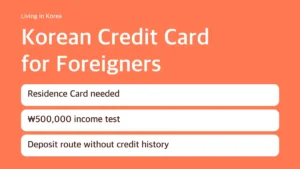 Can Foreigners Get a Korean Credit Card? Yes, With Income or a DepositForeign residents can get a Korean credit card through the standard income and credit review or through a…
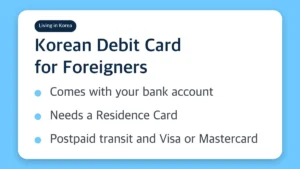 Korean Debit Card for Foreigners: You Need a Residence Card FirstForeign residents get a Korean debit card, called a check card, when they open a bank account with a Residence Card.…
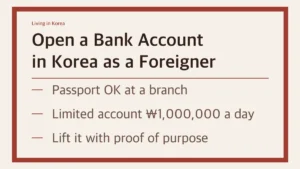 Open Bank Account in Korea Foreigner Guide: Passport Works at a Branch, ₩1,000,000 Daily LimitCan a foreigner open a bank account in Korea without a Residence Card? Yes, at a branch with a passport and proof of…