
The law sets no price for an agent. You agree on the fee with the agent, and the agent may not take anything beyond that fee.
Last updated: October 29, 2026
Who counts as an immigration agent in Korea
People say "visa agent," but Korean law is specific. The Immigration Control Act (출입국관리법), Article 79-2, lets foreigners, their employers, a company that hosts industrial trainees, and the head of a school where a foreign student is enrolled hand certain filings to an agency (대행기관). The article was added in 2020, and an agency must meet three conditions:
| Requirement | What it means |
|---|---|
| Qualification | A licensed lawyer (변호사) or a haengjeongsa (행정사) |
| Training | At least 4 hours of the Ministry of Justice's agency course |
| Company staffing | If the agency is a company, it needs staff who meet both rules above |
The agency then registers with the immigration office that covers its own address and receives a registration certificate (등록증) and an entry pass (출입증) for staff who go into immigration offices.
A haengjeongsa is not a lawyer. It is a licensed administrative scrivener under the Administrative Scriveners Act (행정사법): someone who writes documents for government offices and files them on your behalf. A haengjeongsa must also report the business to the city or district office, which issues a business notification certificate (신고확인증). That is a separate step from the immigration registration above.
One detail matters when you pick an office. The law has three types of haengjeongsa. A general haengjeongsa (일반행정사) can write and file documents for you. A foreign-language translation haengjeongsa (외국어번역행정사) is limited to translating documents and submitting those translations. Ask which type you are dealing with.
What an immigration agent in Korea can legally file
Article 79-2 lists nine filings, and the Enforcement Rule (출입국관리법 시행규칙) Article 68-3 adds five more. Together that makes 14:
| # | Filing | In plain English |
|---|---|---|
| 1 | Application for a visa issuance certificate (사증발급인정서) | The paper a sponsor in Korea files so you can get a visa abroad |
| 2 | Report under Article 19, paragraph 1 | Reports about a foreigner that the Act requires (also covers the cases it applies to by reference) |
| 3 | Report under Article 19-4, paragraph 2 | A second reporting duty in the Act |
| 4 | Permission to work outside your status (활동허가) | For activities your status does not normally allow |
| 5 | Permission to change or add a workplace | The permit version |
| 6 | Report of a change or addition of workplace | The report version |
| 7 | Application for a status of stay (체류자격 부여) | For people who need a status granted rather than changed |
| 8 | Change of status of stay (체류자격 변경) | For example, student to worker |
| 9 | Extension of stay (체류기간 연장) | The most common filing |
| 10 | Re-entry permit (재입국허가) | Rule Article 68-3 |
| 11 | Picking up a Residence Card (외국인등록증) | New or reissued card |
| 12 | Picking up a Permanent Resident Card (영주증) | New or reissued card |
| 13 | Report of changes to your registration details | Such as a new passport or name |
| 14 | Report of a change of address (체류지 변경신고) | Telling immigration where you now live |
Anything outside this list is not an immigration agency job. An agent can still help as an ordinary haengjeongsa (writing a document, explaining a procedure), but the immigration-specific rules in this article apply to the 14.
Agent or do it yourself?
The law says you may hand these filings to an agency. It never says you must. Here is how the two routes compare:
| Do it yourself | Registered agent | |
|---|---|---|
| Who files | You, on HiKorea or at the immigration office | The agent files for you |
| Filings covered | All of them | The 14 above |
| Cost | The government fee only | Government fee plus the agent's own fee |
| Responsibility | You prepare the documents | The agent prepares them under a legal duty of care (see below) |
| Good fit | Routine cases: extension, address change, a card pickup | Employers filing for staff, complex files, cases where you cannot read the forms |
A single standard form, such as an extension or an address report, is something most residents can file on HiKorea themselves. An agent earns their fee when the file is complicated or when you are filing many cases at once.
The Ministry of Justice also runs counters reserved for agencies at some immigration offices, and HiKorea posts which offices have them. That can make an agent faster for a company filing many cases.
What an immigration agent costs in Korea
The law sets no price. Article 19 of the Administrative Scriveners Act says the haengjeongsa receives payment from the person who gave the job, and that neither the haengjeongsa nor their staff may accept any other money or benefit in connection with the work. Breaking that rule carries a fine of up to ₩1 million.
That gives you three separate costs:
| Cost | Who sets it |
|---|---|
| Government fee for the filing | The Enforcement Rule (fixed by filing type) |
| The agent's fee | Agreed between you and the agent |
| Anything extra on top of the agent's fee | Not allowed under Article 19 |
Treat any "standard price" you see on an agent's website as that office's own price list, not an official rate. A fair check before you sign: get the filings the fee covers, and the total you will pay, in writing. If a second charge appears later for the same job, that is exactly what Article 19 prohibits.
How to check an agent is registered
Do not rely on a website saying "licensed." Run through these five checks:
- Look at the office name. A haengjeongsa office must use the words "haengjeongsa office" (행정사사무소) or "joint haengjeongsa office" (행정사합동사무소) in its name (Administrative Scriveners Act, Article 15). People who are not haengjeongsa may not use those names.
- Ask for the registration certificate (등록증). A registered agency receives one from the immigration office. Lawyers register the same way, so a law office also has one.
- Check the name against HiKorea's list. HiKorea's notice board has a post titled "Rules on immigration agency work and the status of registered agencies" (출입국민원 대행업무 관련 규정 및 등록 대행기관 현황). It carries the list of registered agencies (the current file is dated September 30, 2026) and the Ministry of Justice's agency management guideline (법무부고시 2021-447). Open it in HiKorea under News and Notices, then Notices.
- Ask for the business notification certificate (신고확인증). The city or district office issues it to the haengjeongsa. It cannot be lent to anyone else.
- Ask which type of haengjeongsa you are dealing with. For immigration filings you want a general haengjeongsa or a lawyer, not a translation-only haengjeongsa.
Show this: 대행기관 등록증과 출입증을 보여 주실 수 있어요?
Red flags and illegal brokers
Immigration paperwork attracts middlemen who are not registered. Korean law is blunt about them. This is what the Administrative Scriveners Act says:
| What happens | Penalty |
|---|---|
| A person who is not a haengjeongsa does a haengjeongsa's work as a business | Up to 3 years in prison or ₩30 million |
| A haengjeongsa lends the business notification certificate, or someone borrows it or arranges the loan | Up to 3 years in prison or ₩30 million |
| Working without reporting the haengjeongsa business | Up to 1 year in prison or ₩10 million |
| Advertising personal ties to officials as a way to influence a case | Up to 1 year in prison or ₩10 million |
| An ad that is false or exaggerated enough to mislead customers | Up to 1 year in prison or ₩10 million |
| Using a broker to find clients | Fine up to ₩1 million |
Treat these as warning signs when you meet an agent:
- "I know someone at immigration." The Act bans agents from advertising personal connections that suggest influence.
- "Approval guaranteed." A false or exaggerated claim to a foreigner is a listed ground for cancelling a registered agency.
- No registration certificate, or a name missing from HiKorea's list.
- A second fee after you agreed on the price.
If a registered agency does go wrong, the Ministry of Justice can cancel the registration, suspend its filing work for up to 6 months, or order it to fix the problem. Cancellation is compulsory if the agency registered with false information or filed during a suspension. Other grounds include submitting forged documents, losing documents you gave them, and neglecting to prepare or submit what a filing needs.
FAQ
Is a haengjeongsa the same as an immigration lawyer? No. A lawyer holds a bar license. A haengjeongsa holds a separate administrative scrivener license. Both can register as an immigration agency. The Administrative Scriveners Act bars haengjeongsa from stepping into lawsuits and other disputes outside their scope, so a contested case may need a lawyer.
How do I find a Korean visa agency near me? Start from HiKorea's list of registered agencies instead of a web search, and check the registration certificate before you pay.
Sources
- Immigration Control Act, Articles 79-2 and 79-3 (Korea Ministry of Government Legislation)
- Enforcement Rule of the Immigration Control Act, Articles 68-2 to 68-5
- Administrative Scriveners Act (행정사법)
- Enforcement Decree of the Administrative Scriveners Act, Article 3
- HiKorea notice: rules on immigration agency work and registered agencies
This guide is general information, not legal advice. Rules change, so confirm with HiKorea or the 1345 Immigration Contact Center before you apply.
Related guides
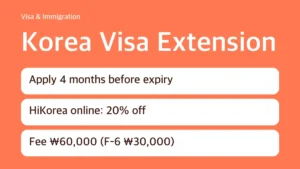 Korea Visa Extension: HiKorea Up to 4 Months Early, Fee ₩60,000When and how to extend your period of stay in Korea: the 4-month window, HiKorea e-Application versus a visit…
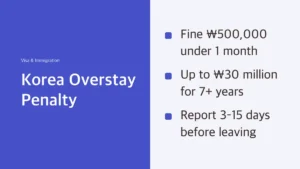 Korea Overstay Penalty: ₩500,000 Under a Month, Up to ₩30 MillionWhat happens if you overstay in Korea: the fine table by overstay length, the difference between a departure order…
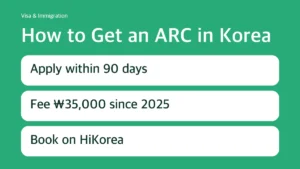 How to Get ARC in Korea (Residence Card): Book Within 90 Days, Pay ₩35,000Staying in Korea longer than 90 days? You need a Residence Card, still called an ARC. Here are the documents, the…