
Last updated: November 15, 2026
What a K-ETA denial means
K-ETA (Korea Electronic Travel Authorization, 전자여행허가) is the online pre-approval that visa-free travelers need before they board a flight or ship to Korea. A denial means you cannot board on that passport without some other permission. It is a decision on that one application, and it does not stop you from applying for a visa.
| Item | What happens after a denial |
|---|---|
| Fee | ₩10,000 (about US$7-8), not refunded whatever the result |
| Reason | Usually not stated on the result |
| Boarding | Airlines need a K-ETA approval or a visa for you to board |
| Next step | A new K-ETA application, or a C-3 visa from a Korean embassy or consulate |
| Questions | Only through the Ask Us form on k-eta.go.kr |
Common reasons for K-ETA denial
Korea does not publish a list of refusal codes. The official K-ETA guide does name the situations that lead to refusal, and these are the ones to check first.
| Official ground | What it means for you |
|---|---|
| False or inaccurate information | Approval is refused or canceled. You can also face penalties or entry restrictions, and the same restriction applies to everyone who applied with you in the same group. |
| Applying after boarding or while already in Korea | Can lead to refusal or entry restrictions. Apply before you travel. |
| Passport details that do not match | The passport number on your boarding pass and at entry must match the one on your K-ETA. A new passport needs a new K-ETA. |
| Criminal record and infectious disease answers | These are part of the review. If either changes after approval, you must apply again. |
| A purpose K-ETA does not cover | K-ETA is for short stays for travel, visiting relatives, events, conferences or business meetings. Paid or commercial activity needs a visa. |
Other refusals come from screening you cannot see. Korea JoongAng Daily reported in 2023 that K-ETA screening is stricter for some Southeast Asian nationalities because the system is designed to prevent illegal stays.
Will they tell you the reason?
In most cases, no. Korea JoongAng Daily reported that a denied application comes with no explanation. The K-ETA Center does not give phone or face-to-face consultations as a rule, so your only official channel is the Ask Us form at the bottom of k-eta.go.kr. Ask there if you believe a typing mistake caused the denial.
Can you reapply after a K-ETA denial?
Yes. A new application is reviewed as a new case and costs ₩10,000 again, plus an online payment fee of about 3%. Reapplying makes sense only when something in the first application was wrong or has changed.
- Compare every field with your passport. Use the name exactly as printed, the correct passport number and the right expiry date. If you hold two passports, apply with the one you will show at check-in and at entry.
- Replace a weak photo. Your full face, from forehead to chin, must be visible. A hijab or other religious head covering is allowed.
- Answer the purpose and address questions plainly. Give a real place to stay in Korea and a purpose K-ETA covers.
- Apply only at k-eta.go.kr or the official K-ETA app. Agency sites charge far more and add another place for typing errors.
- Leave time. Review usually takes 72 hours or less, but it can take longer and there is no express service. The K-ETA Center advises applying 1-2 months before your trip.
If your first answers were all correct, sending the same answers again is unlikely to change the outcome. Korea JoongAng Daily also reported in 2023 that the system expects travelers to apply for a visa after three failed K-ETA attempts. Go to the visa route sooner rather than paying for repeated tries.
Apply for a C-3 visa after a denied K-ETA
If you are from a K-ETA country, Korean embassies normally tell you to use K-ETA instead of a visa. A denial changes that. The Korean Embassy in Malaysia says a visa application can be submitted only if your K-ETA is denied, and the Embassy in Singapore lists proof of K-ETA denial as a required document for these applicants. With a visa, you no longer need a K-ETA, because visa holders are exempt from it.
For a holiday or family visit, the visa is the C-3-9 short-term tourist visa, which allows up to 90 days per stay.
Where to apply
Apply at the Korean embassy or consulate (or its visa center) that covers the place where you legally live, usually your home country.
- Consulates in the US accept applications only from residents of their own district. A non-American must also hold a US green card or a long-term US visa.
- The Embassy in Singapore does not accept this visa from short-term visitors in Singapore.
- Fill in the visa application form online as an e-Form on the Korea Visa Portal, print it and sign it by hand.
Documents
Exact lists differ by embassy. This is what the Singapore, US and Canada pages ask for.
| Document | Notes |
|---|---|
| Visa application form | Printed e-Form from the Korea Visa Portal, signed |
| Passport | At least 6 months of validity left, plus a copy of the photo page |
| Photo | Color passport photo, white background |
| Proof of K-ETA denial | A copy of your K-ETA result |
| Proof of residence | Residence card, work pass or green card from the country where you apply |
| Proof of job or study | Employer letter, business registration or school letter |
| Bank statements | Usually the last 1-3 months |
| Travel plans | Round-trip flight itinerary and hotel booking, or your host's address and ID copy |
Fees and processing time
| Item | Example |
|---|---|
| Standard fee, single entry up to 90 days | US$40 (Korean Embassy in the USA) |
| Range for single entry up to 90 days | US$30-130, depending on your nationality |
| US citizens, any visa type | US$45 |
| Singapore | 8 working days |
| Canada | About 7-10 business days |
| San Francisco | 2-3 weeks at the moment |
The Singapore embassy and the San Francisco consulate offer no express service. Singapore also asks you not to book flights or hotels until the visa is approved, and the Houston consulate notes that a flight ticket does not guarantee the visa arrives before your departure date.
The 22 K-ETA exempt countries: what changes in 2027
Nationals of 22 countries and regions do not need a K-ETA until December 31, 2026 (KST): Hong Kong, Japan, Macao, Singapore, Taiwan, Canada, the US (including Guam), Austria, Belgium, Denmark, Finland, France, Germany, Italy, the Netherlands, Norway, Poland, Spain, Sweden, the UK, Australia and New Zealand.
- As of November 15, 2026, the latest exemption notice on the K-ETA site is the one dated December 23, 2025, which runs the exemption to December 31, 2026. No notice for 2027 has been posted yet.
- If no new extension is announced, travelers from these countries who arrive on or after January 1, 2027 will fall under the normal K-ETA rule.
- Until then, a K-ETA is optional for them. Some apply anyway to skip the arrival card, and an approval stays valid until its own expiry date.
Sources
- K-ETA: application guide (refusal, fee, review time)
- K-ETA: application fee guide
- K-ETA: eligible countries and exemptions
- K-ETA: FAQ (Korean)
- K-ETA: notices
- Korean Embassy in Malaysia: C-3-9 checklist
- Korean Embassy in Singapore: C-3-9 short-term tourism visa
- Korean Embassy in the USA: visa fees by visa type
- Korean Consulate General in Houston: short-term visa
- Korean Consulate General in San Francisco: C-3-9 tourist visa
- Korean Embassy in Canada: C-3-9 short-term visitor visa
- Consulate of Korea in Hagatna: K-ETA exemption extended to December 31, 2026
- Korea Visa Portal
- Korea JoongAng Daily: Red tape difficulties putting tourists off visiting Korea (2023)
This guide is general information, not legal advice. Rules change, so confirm with HiKorea or the 1345 Immigration Contact Center before you apply.
Related guides
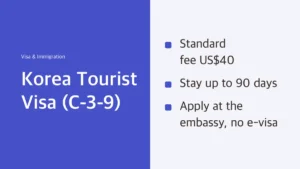 Korea Tourist Visa Requirements: Bank Proof, $40 Fee, 90 DaysWho needs a Korean tourist visa (C-3-9) instead of a K-ETA, the documents and bank proof embassies ask for, fees by…
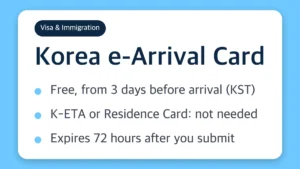 Korea e-Arrival Card: Free, File 3 Days Before Landing, K-ETA Holders Skip ItWho must submit the Korea e-Arrival Card, who is exempt, when the 3-day window opens, what the form asks, how to…
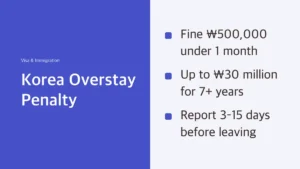 Korea Overstay Penalty: ₩500,000 Under a Month, Up to ₩30 MillionWhat happens if you overstay in Korea: the fine table by overstay length, the difference between a departure order…