
Last updated: November 17, 2026
What the e-Form is
The Korea Visa Portal calls it e-Form (Visa) (전자서식). In the portal's own words, it is a system where you write and submit the visa application form through the portal before you visit a Korean diplomatic mission. You then print the form with the barcode, gather your attachments, and visit the embassy or consulate that covers the place where you live to complete the application.
So the e-Form is the same visa application, typed online instead of on paper. The portal's page on applying through a diplomatic mission lists the application form as either official Form 17 on paper or the e-Form written from the portal's Application menu. The paper version was last revised on February 7, 2022.
The barcode is the point. It ties the printout to the answers you submitted to the portal, and some missions now insist on it. The Korean Embassy in the Netherlands titles its notice "a must do before the appointment", and the Consulate General in Houston asks applicants to complete and print the e-form with a barcode and sign it.
e-Form, e-Visa and K-ETA are three different things
People mix these up because all three live online. Only one of them is the visa application form.
| e-Form (Visa) | e-Visa (Individual) | K-ETA | |
|---|---|---|---|
| What it is | The visa application form, typed online | A full online visa application | A travel authorization for visa-free visitors |
| Who uses it | Anyone applying at an embassy or consulate | Limited groups only | Nationals who can enter without a visa |
| Pay online | No, you pay at the mission | Yes, by international credit card | Yes |
| Embassy visit | Yes, with the printed form | No | No |
| What you get | A visa issued by the mission | An electronic visa confirmation you print | An approval linked to your passport |
The e-Visa is narrow. The portal lists professors (E-1), researchers (E-3), technical instructors (E-4), professionals (E-5) and their families (F-3), E-7 workers holding an employment recommendation known as the Gold Card, group tourists handled by designated travel agencies (C-3-2), medical tourists invited by designated hospitals, and business visitors (C-3-4) invited by a Korean company who have entered Korea on a C-3 visa 3 or more times since January 1, 2012 with no violations. If that is not you, you are filling in the e-Form or the paper form.
A travel authorization (K-ETA) is not a visa at all. If you were refused a K-ETA and now need a visa, this form is your next step.
One more form exists. If your school or employer in Korea already got you a visa issuance number, you use a shorter application form made for holders of that confirmation. Your inviter downloads it from the portal's status page and emails it to you, or sends you the number and its expiry date. Houston's instructions say the same thing: with a visa issuance confirmation, use the separate form.
Which visas the portal lists for the e-Form
The portal's e-Form page lists the visas that Korean missions can issue on their own authority:
- Diplomatic (A-1), official (A-2) and agreement (A-3) visas, single or multiple entry
- Single-entry visas of 90 days or less for short-term news coverage (C-1), short-term visits (C-3) and short-term employment (C-4)
- Multiple-entry C-1 and C-3 visas of 90 days or less for nationals of countries with a multiple-entry visa agreement with Korea
- Other visas delegated to the head of the mission, such as a single-entry D-1 visa for artists invited by the Korea Foundation or Arts Council Korea
For most readers that means a short-term C-3 visa, including the tourist visa (C-3-9). Long-term applicants, such as someone going for a D-2 student visa, follow the instructions of their own embassy, which usually point to the same form or to the version for visa issuance number holders.
What to prepare before you start typing
The portal names two files to have ready before you open the e-Form:
- A scan or photo file of your passport information page
- A photo file in natural color, sized 3.5 cm x 4.5 cm
Keep these next to you as well, because the form asks for them:
- Your full home address, phone number and email
- An emergency contact: name, country, phone, relationship
- Your employer's or school's name, address and phone number
- Your hotel or host address in Korea and a phone number there
- Dates of trips to Korea and to other countries in the last 5 years
- Your inviter's details, if someone in Korea is inviting you
- Your estimated trip cost in US dollars
How to fill in and print the e-Form
The Korean Embassy in Canada gives the path in one line. Here it is, step by step.
- Go to the Korea Visa Portal at visa.go.kr and switch the language to English.
- Click Application, then e-Form (Visa).
- Read the short guide and start the electronic application form.
- Upload your passport file and photo file.
- Complete all 12 sections. Type your name exactly as it appears in your passport.
- Submit the form to the portal.
- Print the form. Make sure the barcode shows on the printout.
- Write the date and your name in the declaration, and sign by hand.
Print in color if you can. Houston waives the separate photo when the e-form is completed on the portal and printed in color, because your uploaded photo is already on the page.
The 12 sections at a glance
This is what official Form 17 asks, and what the e-Form walks you through.
| No. | Section | What it asks |
|---|---|---|
| 1 | Personal details | Name as in passport, sex, date of birth, nationality, country of birth, national ID number, other names, other citizenships |
| 2 | Details of visa application | Long-term (over 90 days) or short-term (90 days or less), and status of stay |
| 3 | Passport information | Type, number, country, place and date of issue, expiry date, any other valid passport |
| 4 | Contact information | Home address, current address if different, phone, email, emergency contact |
| 5 | Marital status and family | Married, divorced or single, spouse details, number of children |
| 6 | Education | Highest level completed, school name and location |
| 7 | Employment | Your current situation, plus company or school name, position, address, phone |
| 8 | Details of visit | Purpose, period of stay, date of entry, address and phone in Korea, past trips, family in Korea, family traveling with you |
| 9 | Details of invitation | Inviter's name, date of birth or business registration number, relationship, address, phone |
| 10 | Funding details | Estimated travel costs in US dollars and who pays |
| 11 | Assistance with this form | Whether someone helped you fill it in, and who |
| 12 | Declaration | Date, your name and your signature |
Boxes people get stuck on
1.1 Full name. The box says "as shown in passport". Put your family name in Family Name and everything else, middle names included, in Given Names, in the same order as your passport.
1.2 Name in Chinese characters. This is for applicants whose names are written in Chinese characters. If yours is not, it does not apply to you.
1.7 National Identity No. This means the ID number your own country gives you, not a Korean number. If your country does not issue one, mark the box N/A.
1.8 Other names. The question is whether you ever entered or left Korea under a different name, for example before marriage or a legal name change. Tick Yes only then, and give that name.
2.2 Status of stay. This is the visa code, not a description of your trip. A tourist writes C-3-9. A degree student writes D-2. Your embassy's document checklist is organized by these codes, so use the one on the checklist you are following.
4.2 Current residential address. Fill this in only if you live somewhere other than your home country address in 4.1.
8.4 and 8.5 Address and contact number in Korea. The form says the address can be a hotel. Give the phone number that goes with that address: the hotel's front desk, or your host's mobile number.
8.8 and 8.9 Family. "Family" here means your spouse, children, parents and siblings only. Cousins and friends do not count.
10.1 Estimated travel costs. One figure in US dollars for the whole trip. Keep it in line with the bank papers you attach.
10.2 Type of support. Name who pays, your relationship to them, and what they cover. If you pay for everything, put your own name, with "self" as the relationship and the support as all travel expenses. If a company or relative pays part, say which part, such as airfare or lodging.
11 Assistance. If a travel agent or relative typed the form for you, say Yes and list them. The declaration you sign says every statement is true.
Boxes that do not apply. The form's own instruction is to fill it out "completely and correctly". For a Yes or No question, tick No. For a box with nothing to enter, N/A shows the desk you did not skip it. If you run out of room, the form's notice lets you continue on a separate sheet.
Print, sign and submit
The portal lists what to bring to the mission: the visa application form with the barcode, your passport, a photo (natural color, 3.5 cm x 4.5 cm), the fee, and the supporting documents for your visa type. The form itself asks for a photo taken within the last 6 months, full face, no hat, on a white or off-white background.
Three rules come straight from the form and the missions:
- Sign by hand. The form warns that a missing name or signature may get the application denied. The Korean Embassy in Singapore adds that you sign directly on the form with a pen and that e-signatures are not allowed.
- Under 17. A parent or legal guardian signs for an applicant younger than 17.
- Follow your mission's checklist. The portal says each head of mission may add or waive documents to fit local conditions, and that the mission's list wins when it differs from the portal's.
Photo practice shows how much missions differ. Houston skips the separate photo for a color-printed e-form. Singapore asks for the form plus one physical passport photo.
Fees
You do not pay anything while filling in the e-Form. You pay when you submit at the mission, in US dollars in principle, or in local currency where the mission allows it. The portal's base fees are:
| Visa | Base fee |
|---|---|
| Single entry, stay of 90 days or less | US$40 |
| Single entry, stay of 91 days or more | US$60 |
| Double entry | US$70 |
| Multiple entry | US$90 |
Fees can be waived or set differently by agreement or reciprocity, so your nationality may change the amount. The fee pays for the review, so it is not refunded if the visa is refused.
Where and how to hand it in
You apply at the Korean embassy or consulate that covers the place where you live. In some countries the mission takes applications through a Korea Visa Application Center (KVAC) or designated travel agencies instead of its own counter. Houston, as one example, takes in-person submissions by online appointment only, also accepts applications by mail, and says processing normally takes 2 weeks.
After you submit: checking the result
The form's notice says you must check the result online on the Korea Visa Portal. The path is:
- On visa.go.kr, open Check Application Status, then Check Application Status & Print.
- Choose Diplomatic Office as the application type.
- Enter your passport number, your English name as in your passport, and your date of birth.
If the visa is refused and you want the refusal notice on paper, you have to visit the mission and ask for it in person.
Two more notices on the form are worth reading before you sign. A visa does not guarantee entry if you are found inadmissible at the airport. And category C visa holders cannot change their status of stay after entering Korea, so apply for the visa that matches what you will really do.
FAQ
Can the Korean visa application form be handwritten? Yes, on the paper form. Its instructions say to write in block letters in English or Korean. Typing the e-Form avoids handwriting problems and gives you the barcode, and some missions accept only the e-Form, so read your mission's notice first.
Where can I download the form as a PDF? The paper form is official Form 17 of the Enforcement Rule of the Immigration Act, linked in the sources below. Korean missions also post it on their visa pages. If your mission asks for the e-Form, the PDF is not a substitute.
Do I need a different form for each visa type? No. The same form covers every status of stay. What changes is the code in box 2.2 and the supporting documents. The only separate version is the one for people who already hold a visa issuance number.
What if I renew my passport after the visa is approved? The form's notice says you must tell the visa office about your new passport details.
Sources
- Korea Visa Portal: e-Form (Visa)
- Korea Visa Portal: application procedures
- Korea Visa Portal: visa fees
- Korea Visa Portal: check application status and print
- Visa Application Form, official Form 17, revised February 7, 2022 (PDF)
- Embassy of the Republic of Korea to the Netherlands: e-Form (Visa) application
- Korean Consulate General in Houston: short-term visa
- Embassy of the Republic of Korea to Canada: C-3-9 short-term visitor visa
- Embassy of the Republic of Korea in Singapore: C-3-9 short-term tourism visa
This guide is general information, not legal advice. Rules change, so confirm with HiKorea or the 1345 Immigration Contact Center before you apply.
Related guides
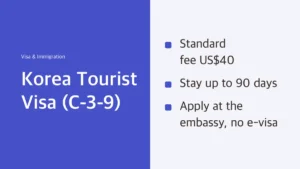 Korea Tourist Visa Requirements: Bank Proof, $40 Fee, 90 DaysWho needs a Korean tourist visa (C-3-9) instead of a K-ETA, the documents and bank proof embassies ask for, fees by…
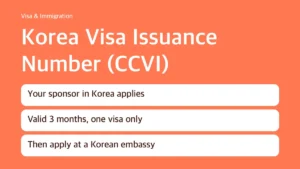 Korea Visa Issuance Number (CCVI): Sponsor Files, Valid 3 MonthsWhat a CCVI (visa issuance number) is, who applies for it in Korea, which visas use it, how long it stays valid, how…
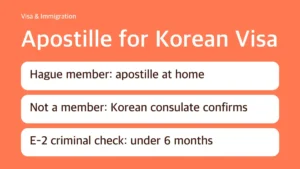 Apostille for Korean Visa: Needed If Your Country Joined the HagueWhich countries use an apostille for Korean visa documents, which ones need a Korean consulate instead, who issues…