
Last updated: November 2, 2026
The Korean government's English legal guide calls jeonse a "lump-sum deposit lease." You still pay maintenance fees, but the rent line on your budget disappears. The price is that your largest asset now sits with a stranger for two years, so most of this guide is about getting it back.
Jeonse vs wolse: how each lease works
These are the main ways to rent a home in Korea, as listed by the government's Easy to Find Practical Law service.
| Type | What you pay at the start | What you pay each month | What you get back |
|---|---|---|---|
| Jeonse (전세) | One large deposit | Maintenance fees only | The full deposit |
| Wolse (월세) | A smaller deposit | Rent plus maintenance fees | The full deposit |
| Ban-jeonse (반전세) | A large deposit, with some rent on top | Reduced rent plus maintenance fees | The full deposit |
| Sagyese (사글세) | Rent for the whole term, paid in advance | No rent | Nothing, because it was rent |
Here is what the trade looks like on one home, using an example figure. Say the jeonse deposit is ₩200,000,000 and the landlord moves ₩150,000,000 of it into rent at 5.0% a year, the legal ceiling explained below. You would hold a ₩50,000,000 deposit and pay ₩625,000 a month, or ₩15,000,000 over 24 months. On jeonse you skip that rent, but ₩150,000,000 more of your money is tied up.
That 5.0% comes from Article 7-2 of the Housing Lease Protection Act. It limits rent to the lower of 10% a year or the Bank of Korea base rate plus 2%. The base rate has been 3.00% since August 27, 2026. The cap covers converting an existing deposit into rent. New market listings can price the trade differently.
How much is a jeonse deposit?
Jeonse is usually far beyond what a newcomer has in savings. The KB October 2026 survey, reported by Kyunghyang Shinmun, put the average apartment jeonse price at ₩602.81 million in Seoul's 14 districts north of the Han River and ₩841.78 million in the 11 districts south of it.
Korea JoongAng Daily reported in 2022 that deposits typically ran 60 to 80 percent of a home's sale price. There is no legal percentage. That ratio matters because a high deposit leaves less room if the home's price falls, which is the core of the risk section below.
Jeonse is also shrinking. Wolse made up 70.0% of Korea's lease deals in August 2026, according to the KB Housing Market Review. In the first quarter, the wolse share rose from 48.0% in 2022 to 68.6% in 2026, per Ministry of Land data reported by Herald Business. That count includes ban-jeonse style deals.
Why does Korea have jeonse?
The deal works because each side gets something. You live without paying rent. The landlord gets a large sum that costs no interest, which Korea JoongAng Daily describes landlords often treating as an interest-free loan for investment or business.
A 1993 paper in the KDI journal explains why it lasted: Korea had no public rental housing at the time and formal housing finance was weak, so jeonse held on. Its origin is less clear. A researcher at the Korea Housing Finance Corporation traces it to a late Joseon custom called semae (세매), in which a homeowner took money and returned it to recover the house. Another account, cited by Korea JoongAng Daily, ties its growth to the port openings after the 1876 treaty with Japan.
The same research shows the old weakness. In a diary entry from 1796, a military official found his landlord had spent the deposit and could repay him only with money from the next tenant. That pattern, one tenant's deposit paying off the last, still drives jeonse trouble today.
Can foreigners rent on jeonse?
Yes. Easy to Find Practical Law lists both jeonse and wolse as options for foreign students, and its English lease guide for foreigners covers jeonse contracts directly. The real barrier is money, since few people arrive in Korea with this much cash.
Commercial banks run their own jeonse loans with their own terms, so get a bank's answer before you sign. Government-funded loans are aimed at low-income households without a home. Before you take any loan, note that one pledged against your deposit can block a guarantee, as covered below.
Your legal position takes one extra step. The Housing Lease Protection Act protects Korean nationals in principle, and foreign nationals come under it as an exception. The next section covers that exception, and it is simple to meet.
Three filings that protect your deposit
The law gives a tenant two powers, and you earn each by filing.
- Opposing power (대항력): if the home is sold, you can hold the new owner to your lease and stay until you are repaid.
- Preferential repayment right (우선변제권): if the home goes to auction, you are paid ahead of junior creditors.
| Step | Deadline | Where | What it gets you |
|---|---|---|---|
| Move in and file a change-of-residence report (체류지 변경신고) | Within 15 days of moving in; do it on day one | Community center, immigration office or HiKorea | Opposing power from 00:00 the next day |
| Get a fixed date (확정일자) on the contract | Same day as the report | Community center, district court, registry office or the Internet Registry Office | Preferential repayment right, once combined with the step above |
| Report the lease to the local government, jointly with the landlord | Within 30 days of signing, if the deposit is over ₩60 million or rent over ₩300,000 | Local office or rtms.molit.go.kr | Legal duty; submitting the contract also counts as a fixed-date request |
The Supreme Court settled the key question for foreigners. Alien registration or a change-of-residence report has the same legal effect as a Korean citizen's resident registration under Article 3(1) of the Act (Decision 2015Da254507, April 11, 2019). The same goes for a domestic residence report by an overseas Korean, such as an F-4 holder, whose change of address must be reported within 14 days.
The fixed date costs ₩600 for a contract of up to 4 pages. The fixed-date register records your alien registration number. Late lease reports can bring a fine of up to ₩1,000,000.
Show this: 체류지 변경신고하고 임대차계약서에 확정일자도 받으러 왔어요.
Four traps cost tenants their protection:
- Wrong unit number. The report must match the register. In one court case, a tenant used the number on the door (302) while the register said 202, and lost protection. Copy the unit exactly as the real estate register shows it.
- The one-day gap. Your protection starts at midnight after you file, and rights rank in order. A mortgage registered before that moment ranks ahead of you, so check the register again on the day you pay the balance.
- Moving out early. Leaving before you are repaid ends both powers. Moving your registration away with your family, even briefly, ends them too, and they restart only from the new filing.
- A raised deposit. If you agree to a higher deposit, sign a contract for the increase and get a new fixed date for that part.
Small deposits get one more shield. A tenant with opposing power before an auction filing can take a set amount ahead of other secured creditors: up to ₩55 million on deposits of ₩165 million or less in Seoul, and up to ₩25 million on deposits of ₩75 million or less in areas outside the listed cities. Most jeonse deposits in Seoul apartments are too large for this.
The 2-year term, renewal and leaving early
| Situation | Rule |
|---|---|
| Lease shorter than 2 years | Treated as 2 years, though you, the tenant, may hold to the shorter term |
| Asking to renew | Request between 6 and 2 months before the end; you can do this once, for 2 more years |
| Deposit increase on renewal | Up to 5% (1/20), and a city or province may set a lower cap by ordinance |
| Nobody says anything by 2 months before the end | The lease renews on the same terms for 2 years |
| Leaving after a renewal | You can give notice at any time; it takes effect 3 months after the landlord receives it |
| Deposit not repaid at the end | The lease is treated as continuing until you are repaid |
So one lease can give you 4 years in total if you use your renewal right. The landlord can refuse in listed cases, including you missing rent worth two payment periods, the landlord or a direct family member moving in, or planned demolition. If a landlord refuses in order to move in and then rents to someone else instead, you can claim compensation.
Leaving during the first term is the problem for foreigners on a fixed assignment. You have no general right to walk away, and Easy to Find Practical Law warns that recovering a deposit after ending a lease early is not easy.
The fix is a special clause in the contract. The guide's example says the lease ends one month after notice if the tenant must relocate for a job transfer or school. If your visa or job could end early, ask the broker to put your own version in writing. Verbal promises should also go in the special terms section.
How jeonse goes wrong
HUG notes that "jeonse fraud" is used loosely for any case where a tenant is likely to lose the deposit, not only for crimes. These are the patterns to look for.
| Risk | What happens | How to catch it |
|---|---|---|
| Under-secured jeonse (깡통전세) | Debts plus your deposit come close to the home's value, so an auction cannot repay you | Add mortgages and your deposit, and compare with recent sale prices |
| Wrong person signs | Someone who is not the owner takes the deposit | Match the owner's ID with the register; an agent must show a power of attorney with the owner's seal and a seal certificate |
| Unlicensed or dishonest broker | A broker tells the owner it is a low-deposit wolse and keeps your money | Check the posted registration, match the ID, and pay the deposit into the owner's own account |
| Landlord's unpaid taxes | Overdue national or local taxes are a warning sign | Ask for national and local tax payment certificates, which landlords must present under Article 3-7 |
| Other tenants ahead of you | In a multi-household house, earlier deposits come first | Ask the landlord to consent to fixed-date information, which shows existing deposits and dates |
A listing priced far below its neighbors deserves extra care. HUG's Safe Jeonse app, built with the Ministry of Land, shows market prices, local jeonse ratios and landlord information such as tax arrears and past guarantee accidents.
How to read the real estate register
The register (등기부) is public, and anyone can view it. Use the Supreme Court's Internet Registry Office at iros.go.kr. Viewing costs ₩700 and an issued copy ₩1,000 as of November 2, 2026. A rule proposed by the court administration would raise these to ₩1,100 and ₩1,400, with public comment open until November 9.
| Section | What it shows | What to check |
|---|---|---|
| Title section (표제부) | Address, building, unit | The lot number and unit match your contract |
| Section A (갑구) | Ownership, seizures, auction entries | The signer is the owner; avoid seizure, provisional seizure or injunction entries |
| Section B (을구) | Mortgages and other rights | Mortgage amounts and dates; a mortgage set before you ranks ahead of you |
Do this twice: when you sign, and again before you pay the balance. Easy to Find Practical Law tells tenants to read it themselves even when using a broker. The register does not show everything, such as a contractor's lien, so visit the home in person and read the building register for illegal construction.
Deposit return guarantee: the safety net
A jeonse deposit return guarantee (전세보증금반환보증) pays you if the landlord cannot return the deposit at the end of the lease. HUG states that foreigners can apply. Seoul Guarantee Insurance and the Korea Housing Finance Corporation offer similar products with their own rules.
| HUG requirement | Detail |
|---|---|
| Deadline | Before half of the lease term has passed, counted from the later of balance payment or move-in report |
| Maximum deposit | ₩700 million in the capital area, ₩500 million elsewhere |
| Value test | Deposit plus senior debts must fit within 90% of the home price |
| Senior debts | No more than 60% of HUG's home value (price × 90%) |
| Lease | At least 1 year, signed through a licensed broker |
| Status | You live there, with a move-in report and a fixed date |
| Register | No seizure or auction entries; land and building both owned by the landlord |
| Building | Not listed as an illegal structure (apartments excepted) |
| Loans | No jeonse loan with a pledge or assigned claim, apart from those tied to Seoul Guarantee Insurance |
For a foreign tenant, the change-of-residence report stands in for the move-in report. HUG gives this example of the value test: on a ₩100 million home, a ₩90 million deposit passes and a ₩95 million deposit fails. That same test is a useful warning sign even if you never apply.
The premium is the guaranteed amount × the annual rate × days ÷ 365, with rates from 0.097% to 0.211% a year. On a ₩200 million apartment deposit for 2 years at the lowest debt band (0.102%), you pay about ₩408,000. Villas and higher debt ratios cost more. HUG also lists discounts, including 60% for households earning ₩50 million or less a year.
Wolse with a large deposit can qualify too, using HUG's 6.5% conversion rate.
You can apply at HUG branches or partner banks such as Shinhan, KB Kookmin, Woori and Hana, which accept all housing types. Naver Pay, Kakao Pay and Toss also take applications for some types. HUG's call center is 1566-9009.
If the landlord does not return your deposit
Do not hand back the keys and leave. Your rights depend on staying, and the lease continues until you are repaid. These are the usual steps in the government's guide.
- Send content-certified mail (내용증명) stating the lease and the amount owed.
- If you hold a guarantee, claim from the guarantor.
- If you must move, apply to the local court for an order for leasehold registration (임차권등기명령). Once it is registered, you keep both powers after moving out.
- Apply for a payment order, or file a lawsuit for return of the deposit.
- With a court title in hand, you can request an auction of the home.
You can also claim default interest at 5% a year on the delayed amount. Fraud victims can get legal, financial and housing help through the Lease Fraud Victim Support Center, which is listed on HUG's Safe Jeonse Portal.
Should you choose jeonse?
For most foreign residents, wolse is the practical choice. It needs far less cash, and a short stay rarely justifies the risk. Jeonse makes sense if you plan to stay at least 2 years, already hold the money, and can pass HUG's guarantee test. If a home fails that test, take it as your answer and keep looking. Seoul also designates Global Real Estate Agencies that explain lease steps in foreign languages, listed at land.seoul.go.kr. A broker's fee is capped by local ordinance, within 0.3% to 0.7% of the deal depending on its size.
Sources
- Easy to Find Practical Law: Lease (Lump-sum Deposit Lease) Agreements
- Easy to Find Practical Law: Housing Lease Deposit Refunds
- Easy to Find Practical Law: Application of the Housing Lease Protection Act
- Easy to Find Practical Law (Korean): Finding a home for foreign students
- Easy to Find Practical Law (Korean): Opposing power and preferential repayment
- Easy to Find Practical Law (Korean): Checking the register
- Easy to Find Practical Law (Korean): Lease renewal
- Easy to Find Practical Law (Korean): Ending a housing lease
- Housing Lease Protection Act, Korean and English text (KLRI)
- Enforcement Decree of the Housing Lease Protection Act (KLRI)
- HUG: Jeonse deposit return guarantee overview
- HUG: Mobile application guide
- HUG Safe Jeonse Portal
- HUG: What jeonse fraud means
- Supreme Court of Korea: Proposed register fee rule
- Bank of Korea: Base rate history
- KB Housing Market Review, October 2026
- Herald Business: Ministry of Land housing statistics, March 2026
- Kyunghyang Shinmun: KB October 2026 jeonse prices
- KDI Journal of Economic Policy: Korea's Chonsei Rental System (1993)
- Segye Ilbo: The origins of jeonse in the Joseon era
- Korea JoongAng Daily: Why jeonse exists
This guide is general information, not legal advice. Rules change, so confirm with HUG (1566-9009), a licensed broker or the 1345 Immigration Contact Center before you sign.
Related guides
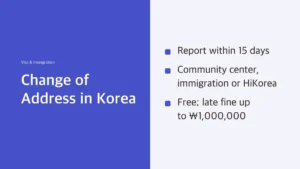 Change of Address Korea (Foreigners): Report Within 15 Days, Free, Online on HiKoreaYou moved to a new place in Korea. Here is where to report your change of address, what to bring, how the HiKorea…
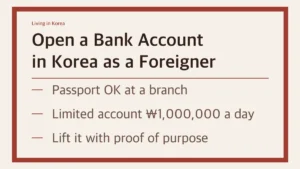 Open Bank Account in Korea Foreigner Guide: Passport Works at a Branch, ₩1,000,000 Daily LimitCan a foreigner open a bank account in Korea without a Residence Card? Yes, at a branch with a passport and proof of…
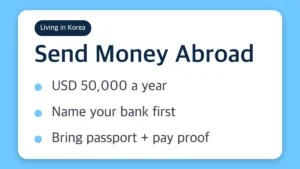 Send Money Abroad From Korea as a Foreigner: $50,000 a YearYou work in Korea and want to send won home. Here is the yearly limit, what a foreign exchange bank is, what to…