
Last updated: October 15, 2026
What KIIP is
KIIP stands for the Korea Immigration and Integration Program. Its Korean name means "social integration program" (사회통합프로그램). The Ministry of Justice has run it since 2009.
It teaches three things:
- Korean language
- Korean culture
- Understanding Korean society, including its constitutional values
Immigration uses KIIP as proof of your Korean level. Completing a level can earn points or meet a requirement when you apply for a visa, change your status, apply for permanent residence or apply for citizenship.
Who can join
KIIP is open to:
- Any foreigner who has done alien registration and is staying in Korea legally
- People who became Korean citizens within the last 3 years
You need a Residence Card (외국인등록증) first. If you are in Korea on a short-term stay without alien registration, you cannot join yet.
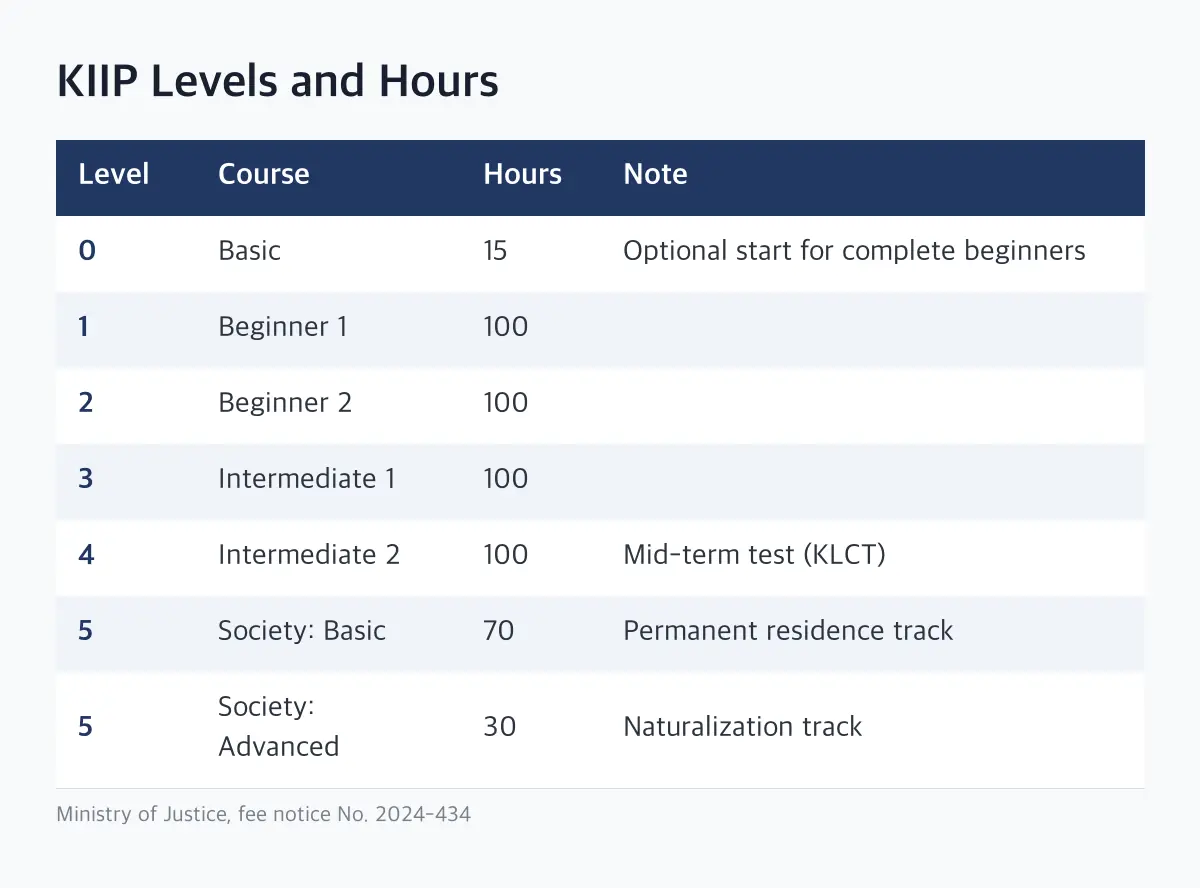
The 6 levels and how long they take
There are two parts. Levels 0 to 4 are Korean language and culture (415 hours). Level 5 is Understanding Korean Society (100 hours).
| Level | Course | Hours | Note |
|---|---|---|---|
| 0 | Basic | 15 | Optional start for complete beginners |
| 1 | Beginner 1 | 100 | |
| 2 | Beginner 2 | 100 | |
| 3 | Intermediate 1 | 100 | |
| 4 | Intermediate 2 | 100 | Mid-term test (KLCT) |
| 5 | Society: Basic | 70 | Permanent residence track |
| 5 | Society: Advanced | 30 | Naturalization track |
You do not have to start at Level 0. The pre-assessment (사전평가) places you at the level that fits your Korean.
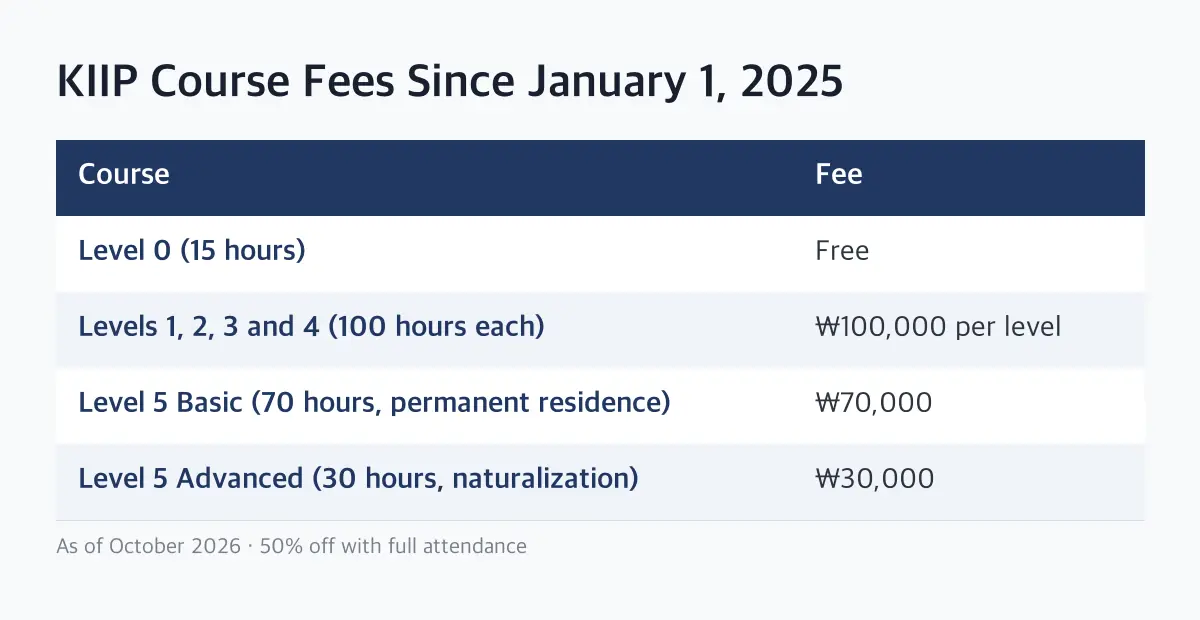
What KIIP costs (since January 1, 2025)
KIIP used to be free. From January 1, 2025, the Ministry of Justice charges a course fee. It says the fee covers about 20% of the real cost, or ₩1,000 per hour.
| Course | Fee |
|---|---|
| Level 0 (15 hours) | Free |
| Levels 1, 2, 3 and 4 (100 hours each) | ₩100,000 per level |
| Level 5 Basic (70 hours, permanent residence) | ₩70,000 |
| Level 5 Advanced (30 hours, naturalization) | ₩30,000 |
Half price (50% off): if you attend 100% of the classes in that level, or your teacher recommends you for an excellent learning attitude.
Free for some people, including:
- Basic livelihood security recipients (국민기초생활 수급자) and their family
- People with severe disabilities
- Independence patriots and national merit recipients, and their families
- Minor children who joined a parent in Korea (F-1-52) and minor foreign children of Korean citizens (F-2-2)
- Some G-1 humanitarian stays, such as an industrial accident, illness or accident, pregnancy and childbirth, or long-term treatment
When you pay: after each level ends and before you apply for that level's test. You pay online on Socinet. If you do not pay before the test application closes, you cannot take the test.
Example: Start at Level 0 and go all the way to Level 5 Advanced. You pay 4 × ₩100,000 + ₩70,000 + ₩30,000 = ₩500,000. With full attendance at every level, that drops to ₩250,000.
The tests themselves are booked separately on the test website (kiiptest.org). Check the fee shown there when you register.
The pre-assessment: where you start
The pre-assessment (사전평가) is the placement test. Your score decides your starting level.
- If you are a total beginner, you can skip it and start at Level 0.
- The test is booked online on kiiptest.org, first come, first served. Seats are set per test site and fill up.
- Results appear on Socinet and kiiptest.org.
- A pre-assessment score is valid for 2 years from the result date. Completed levels and passed mid-term or comprehensive tests do not expire.
Your score also counts on its own for some visa points. The September 2026 HiKorea stay manual puts these scores in the same boxes as completed levels:
| Pre-assessment score | Counts like |
|---|---|
| 41 or more | Level 2 completed |
| 61 or more | Level 3 completed |
| 81 or more | Level 4 completed |
In 2026, the Korea Immigration Foundation (한국이민재단) also runs computer-based tests at three centers in Seoul, Gwangmyeong and Daejeon. They hold the pre-assessment and the naturalization comprehensive test there, and they added the mid-term test in July 2025.
How to sign up, step by step
- Join Socinet. Go to socinet.go.kr (사회통합정보망) and make an account.
- Apply for KIIP and choose a starting point. On Socinet, use the level assignment menu (단계배정). Choose the pre-assessment, or choose to start at Level 0 without a test.
- Book the pre-assessment. If you chose the test, register for it on kiiptest.org during the application window.
- Check your level. Your assigned level shows on Socinet after the results come out.
- Apply for a class. Pick a class at an operating institution (운영기관) on Socinet. These are universities, local governments, family centers and other groups the Ministry designates. Evening classes, weekend classes and live online classes exist for people who cannot attend in the daytime.
- Finish the level, pay, and take the test. Pay the level fee on Socinet, then apply for that level's test.
If kiiptest.org will not let you go to the next step, update your address or visa status on Socinet first (My Page), then try again. If it cannot find your stay details, apply through the level assignment menu on Socinet.
Show this: 사회통합프로그램 수업을 신청하고 싶어요. 어떻게 하면 되나요?
2026 class terms
KIIP runs on three terms a year. For 2026, the test foundation lists:
| Term | Dates |
|---|---|
| Term 1 | January 2 to May 10 |
| Term 2 | May 11 to August 16 |
| Term 3 | August 17 to December 13 |
Computer-based mid-term tests run for the last 4 weeks of each term, every Monday and Friday.
What each level gets you
This is the part most people join for. The numbers below come from the HiKorea stay manual dated September 2026.
| Visa or goal | What KIIP does | Level you need |
|---|---|---|
| D-10 job seeker | Korean ability points (up to 20) | Level 2 = 5, Level 3 = 10, Level 4 = 15, Level 5 = 20 points |
| D-10-1 part-time work (recent Korean-university graduates) | Lets you take part-time factory work | Level 4 or higher (TOPIK does not count for factory jobs) |
| D-10-1 part-time hours (same group) | Weekday limit goes from 25 to 30 hours | Level 5 or higher |
| F-2-7 points-based residence | Basic knowledge points (up to 20) | Level 1 = 3, Level 2 = 5, Level 3 = 10, Level 4 = 15, Level 5 = 20 points |
| F-2-99 long-term residence | Meets the Korean language and culture requirement | Level 4, or a pre-assessment score of 81 or more (a Korean school or university diploma also works) |
| F-5 permanent residence (F-5-1, F-5-10, F-5-16 and spouses) | Meets the basic knowledge requirement | Level 5, or 60 or more out of 100 on a comprehensive test |
| Naturalization | Exemption from the naturalization written test and interview, per the Korea Immigration Service | Complete the program (Level 5 Advanced is the naturalization track) |
A few details that trip people up:
- TOPIK is the main alternative. For D-10 and F-2-7, TOPIK levels fill the same point boxes as KIIP levels. For general F-5, a TOPIK certificate only counted for applications filed by March 31, 2019. Today you need KIIP Level 5 or a comprehensive test score of 60 or more.
- Two different comprehensive tests. The permanent residence test is KIPRAT (한국이민영주적격시험), on the Level 5 Basic track. The naturalization test is KINAT (한국이민귀화적격시험), on the Level 5 Advanced track. Either one with 60 or more counts for F-5.
- Some F-5 types skip the requirement. Examples in the manual include high-value investors (F-5-5), PhDs in advanced technology fields (F-5-9) and pension recipients (F-5-13). Applicants under 15 are also exempt.
- Keep your certificates. Immigration asks for the completion certificate or test pass certificate as proof, not just your Socinet record.
KIIP may change: the 2026 reform plan
On July 9, 2026, the Ministry of Justice held a workshop with about 200 people from the 380 operating institutions. It shared a reform plan for KIIP. The main ideas:
- Separate courses for different groups: workers, students, professionals, overseas Koreans, spouses, and children and teens with a migrant background
- Training before you arrive in Korea (pre-departure)
- Making KIIP completion mandatory
These are plans under discussion, not new rules. As of October 15, 2026, we found no Ministry notice that changes the levels, hours or fees above. If you plan to start KIIP soon, check Socinet notices for any change before you register.
Sources
- Ministry of Justice press release: KIIP fees from January 1, 2025, with fee notice No. 2024-434 (PDF)
- Ministry of Justice press release: KIIP reform plan workshop (July 2026)
- Korea Immigration Service: Korea Immigration & Integration Program (English)
- Korea Immigration Service: social integration program overview (Korean)
- HiKorea: stay manual by status, September 2026 (HWP attachment)
- Korea Immigration Foundation: 2026 computer-based mid-term test schedule (PDF)
- Korea Immigration Foundation: pre-assessment registration notice (PDF)
- Socinet (사회통합정보망)
This guide is general information, not legal advice. Rules change, so confirm with HiKorea or the 1345 Immigration Contact Center before you apply.
Related guides
 D-10 Visa Korea: Score 60 of 190 Points, Stay Up to 3 YearsWho qualifies for the D-10 job seeker visa, how the 190-point test works, how long each score lets you stay, the…
 E-7 Visa Korea: 94 Jobs, a ₩31.12M Salary Floor, an Eligible EmployerWho qualifies for Korea's E-7 work visa in 2026: the 94 approved job codes, the degree and experience rules, the…
 Korea Visa Extension: HiKorea Up to 4 Months Early, Fee ₩60,000When and how to extend your period of stay in Korea: the 4-month window, HiKorea e-Application versus a visit…