
Last updated: October 16, 2026
What F-2-7 is
F-2-7 (점수제 우수인재, points-based talent) is a sub-type of the F-2 residence status (거주). Immigration scores you on age, education, Korean ability and income, and if you pass the line you move from a job-specific visa to a residence status. It is also the usual stepping stone to permanent residence, because 3 years on F-2-7 opens the points-based F-5-16 route.
Everything below comes from the HiKorea stay manual dated September 18, 2026 and the visa manual dated September 2026, the latest versions the Korea Immigration Service has posted. Some third-party tables online still show an old 100-point scale or extra "work experience" points. The current table has neither.
Who can apply: the 5 eligible groups
A high score alone is not enough. You must also belong to one of these groups.
| Group | Who it covers | Key condition |
|---|---|---|
| Listed company employee (상장법인 종사자) | Working for, or hired by, a KOSPI or KOSDAQ listed company | Job must be a manager, professional or related role in the Korean Standard Classification of Occupations |
| Promising industry worker (유망산업분야 종사자) | IT, nano, bio, digital electronics, new materials, energy and other high-tech fields | Last year's income at least 1.5 times GNI per capita (for new hires, the contract salary counts) |
| Professional (전문직 종사자) | Registered foreigners on E-1 to E-7-1 or D-5 to D-9 | 3 years in a row of legal stay on those statuses (E-6-2 and E-7-2 to E-7-4 do not count) |
| Korean graduate (유학인재) | Master's or higher from a regular program at a Korean university | Hired or working in an E-1 to E-7-1 or D-5 to D-9 job within 5 years of the degree |
| Potential talent (잠재적 우수인재, F-2-7S) | Science and engineering master's or PhD graduates of designated universities and research institutes | University president's recommendation, no job or score needed (see below) |
For the professional group, the 3-year rule is waived if your annual income on the income certificate (소득금액증명) is ₩40 million or more, or if you were invited through a science and engineering talent program and recommended by a central government ministry.
Korean War allied-nation talent with a Korean bachelor's degree and a ministry recommendation also qualify as Korean graduates, with special bonus points.
The F-2-7 points table
The total has two parts. Common items cap at 130 points and bonus items cap at 40 points, so the maximum is 170. Deductions come off the total. The pass line is 80.
Age (up to 25 points)
Your age is counted on the application date, from the birth date in your passport.
| Age | Points |
|---|---|
| 18 to 24 | 23 |
| 25 to 29 | 25 |
| 30 to 34 | 23 |
| 35 to 39 | 20 |
| 40 to 44 | 12 |
| 45 to 50 | 8 |
| 51 and over | 3 |
Education (up to 25 points)
| Degree | STEM, or two or more degrees at that level | Other fields |
|---|---|---|
| PhD (박사) | 25 | 20 |
| Master's (석사) | 20 | 17 |
| Bachelor's (학사) | 17 | 15 |
| Associate (전문학사) | 15 (STEM) | 10 |
Only a finished degree counts. Course completion without a degree (수료) does not, and the issuing school must be able to confirm the degree. "Two or more" means two degrees at the same level in any field.
Korean ability (up to 20 points)
You can score this with TOPIK (한국어능력시험) or with the stage you completed in the Korea Immigration and Integration Program, KIIP (사회통합프로그램).
| Level | TOPIK | KIIP stage | Points |
|---|---|---|---|
| Advanced | Level 5 or higher | Stage 5 | 20 |
| Intermediate | Level 4 | Stage 4 | 15 |
| Intermediate | Level 3 | Stage 3 | 10 |
| Beginner | Level 2 | Stage 2 | 5 |
| Beginner | Level 1 | Stage 1 | 3 |
KIIP has one extra advantage: finishing the Stage 5 basic course also earns a separate 10-point bonus (see bonus items), which TOPIK cannot earn.
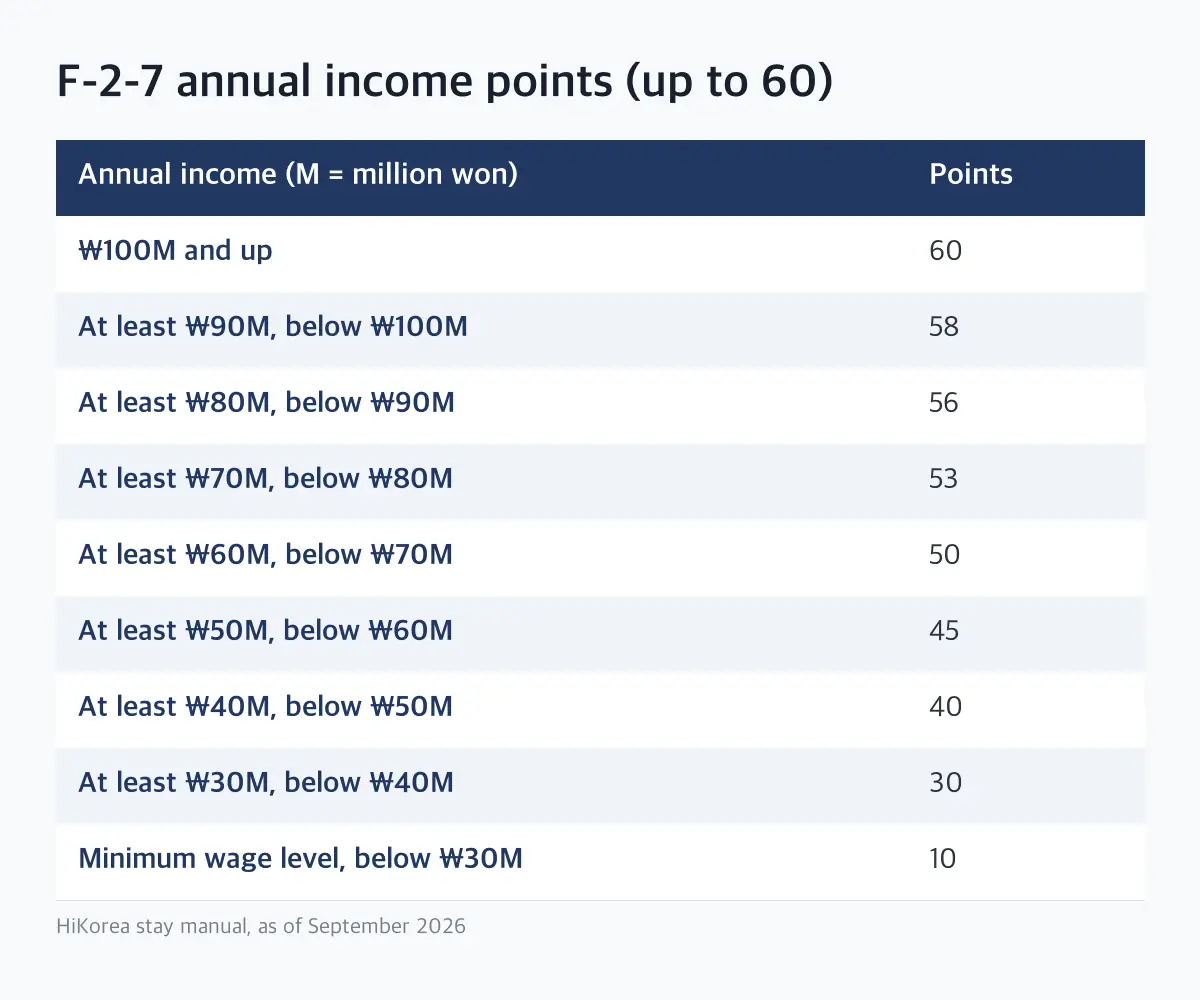
Annual income (up to 60 points)
Income is the biggest single item. Immigration uses the taxable income for the latest year on the newest income certificate (소득금액증명) you can get from the tax office.
| Annual income (M = million won) | Points |
|---|---|
| ₩100M and up | 60 |
| At least ₩90M, below ₩100M | 58 |
| At least ₩80M, below ₩90M | 56 |
| At least ₩70M, below ₩80M | 53 |
| At least ₩60M, below ₩70M | 50 |
| At least ₩50M, below ₩60M | 45 |
| At least ₩40M, below ₩50M | 40 |
| At least ₩30M, below ₩40M | 30 |
| Minimum wage level, below ₩30M | 10 |
If you do not submit income proof, are not working, or earn below the minimum wage, you get 0 points here.
Bonus items (up to 40 points)
| Bonus item | Points |
|---|---|
| Korean War allied-nation talent recommended by a ministry | 20 |
| Recommendation letter from a central government ministry | 20 |
| KIIP Stage 5 basic course or higher completed | 10 |
| PhD from a top university abroad / from a Korean university | 30 / 10 |
| Master's from a top university abroad / from a Korean university | 20 / 7 |
| Bachelor's from a top university abroad / from a Korean university | 15 / 5 |
| Volunteer work: 3 years or more (18 times and 150 hours) | 7 |
| Volunteer work: 2 to under 3 years (12 times and 100 hours) | 5 |
| Volunteer work: 1 to under 2 years (6 times and 50 hours) | 1 |
A "top university" is one ranked within the QS top 500 or the THE top 200 in any of the last 5 years. If you hold several Korean degrees, only the highest one earns a bonus. Even if your bonus rows add up to more, the cap is 40.
Deductions
| Record | Points |
|---|---|
| Immigration penalty (통고처분) of ₩3M or more, a departure order, or deportation | -30 |
| Immigration penalty of at least ₩1M, below ₩3M | -20 |
| Immigration penalty of at least ₩500,000, below ₩1M | -10 |
| Court fine of ₩3M or more, or any heavier sentence | -40 |
| Court fine of at least ₩2M, below ₩3M | -30 |
| Court fine below ₩2M | -20 |
Immigration fines count if you paid them within 3 years of applying, and departure orders or deportation within 5 years. A criminal fine of ₩3 million or more, or a heavier sentence (including a suspended sentence), confirmed within the last 3 years means refusal, not just a deduction. Criminal fines under ₩2 million are deducted no matter how old they are.
F-2-7 points calculator: three worked examples
Add your age, education, Korean and income points, then add bonuses (up to 40) and subtract deductions.
Example 1: E-7-1 engineer, 31, bachelor's, TOPIK 4
| Item | Your situation | Points |
|---|---|---|
| Age | 31 | 23 |
| Education | Bachelor's in a non-STEM field | 15 |
| Korean | TOPIK Level 4 | 15 |
| Income | ₩45 million | 40 |
| Bonus | None | 0 |
| Total | 93 |
She passes with 93. She also needs to be in an eligible group. With 3 straight years on E-7-1 she qualifies as a professional. If she has been on E-7-1 for only 2 years, her ₩45 million income (over ₩40 million) waives the 3-year rule.
Example 2: Korean master's graduate, 27, KIIP Stage 5
| Item | Your situation | Points |
|---|---|---|
| Age | 27 | 25 |
| Education | Master's in engineering | 20 |
| Korean | KIIP Stage 5 completed | 20 |
| Income | ₩32 million | 30 |
| Bonus | KIIP Stage 5 (10) + Korean master's (7) | 17 |
| Total | 112 |
He scores 112 even on a modest salary, because age, KIIP and his Korean degree carry him. He fits the Korean graduate group as long as he got the job within 5 years of the degree.
Example 3: Falling short at 42
| Item | Your situation | Points |
|---|---|---|
| Age | 42 | 12 |
| Education | Bachelor's in a non-STEM field | 15 |
| Korean | TOPIK Level 2 | 5 |
| Income | ₩38 million | 30 |
| Total | 62 |
He is 18 points short. Reaching KIIP Stage 4 or TOPIK 4 lifts Korean from 5 to 15, for a total of 72, still short. Finishing KIIP Stage 5 gives 20 Korean points plus the 10-point bonus, for a total of 87, which passes. A raise to ₩50 million would add another 15 income points.
How long you can stay
When you extend, immigration looks at either your total score or your income points, whichever gives you the longer stay.
| Total score | Or income points | Period granted |
|---|---|---|
| 130 or more | 50 or more | 5 years |
| 120 to 129 | 45 or more | 3 years |
| 110 to 119 | 40 or more | 2 years |
| 80 to 109 | 30 or less | 1 year |
Look at Example 1 again. Her total of 93 alone would give 1 year, but her income points of 40 give 2 years, so she gets 2 years.
Documents for the change of status
Basic documents:
- Application form (통합신청서), passport, Residence Card (외국인등록증) and one photo
- Fee
- Proof of where you live (lease, dormitory receipt or similar)
- Employment contract
- Criminal record certificate from abroad, if required (see below)
Points documents:
- A points sheet where you fill in your own score for each item (점수표)
- Proof for every item you claim: TOPIK score report or KIIP record, degree certificate, income certificate (소득금액증명), volunteer records and so on
- Extra papers if they apply: family relationship proof including birth certificates, a TB test result (결핵검진 확인서), certificate of employment (재직증명서), the company's business registration and corporate registry, and the university president's recommendation for F-2-7S
Documents issued abroad need an apostille or Korean consular confirmation plus a Korean or English translation, and they are valid for 3 months from the issue date.
You can skip the foreign criminal record certificate if you were born in Korea and never stayed abroad for 6 months in a row, if you already submitted one and have not been abroad 6 months in a row since, or if you submitted one for a visa at an embassy and apply within 3 months of that visa.
Fee and how to apply
| Application | Fee |
|---|---|
| Change of status to F-2-7 | ₩100,000 |
| Extension of stay | ₩60,000 |
The fee is a review fee, so it is not refunded once your application is accepted.
- Score yourself with the tables above and collect the proof for each item.
- Book a visit at the immigration office for your address through HiKorea (www.hikorea.go.kr).
- Submit the forms, proof and fee while you are still in Korea. Leaving the country after you apply can lead to refusal.
- If approved, you get F-2-7 on your Residence Card.
Show this: 점수제 우수인재(F-2-7)로 체류자격 변경하러 왔어요.
If you are abroad and were hired by a listed company or a promising-industry company, a visa issuance certificate (사증발급인정서) can be requested at the immigration office that covers the workplace or online through the Korea Visa Portal. That gives a single-entry F-2-7 visa valid for 90 days.
Who gets refused even with 80 points
You also have to pass the conduct and health checks. You are refused if, for example:
- You were sentenced to imprisonment or heavier (including a suspended sentence) within the last 5 years
- You were fined ₩3 million or more under Korean law within the last 3 years
- You broke the Immigration Act 3 or more times in 3 years with fines totaling ₩5 million or more
- You submitted false documents in the last 3 years
- You worked in a restricted field in the last 3 years
- You have tuberculosis or another condition covered by the health rules
If you have a record of breaking Korean law, you may also be told to take a 3-hour law-abiding citizen class (준법시민교육) as part of the change or extension.
Extending F-2-7 and what happens if your income drops
- You need 80 points again at each extension.
- If you score under 80 but you are working and earn at least the minimum wage, you get a 1-year grace extension.
- If you are unemployed or earn below the minimum wage, you sign a pledge and get 6 months, up to two times. If you still miss the income line the third time, the extension is refused and you can switch to D-10 job seeking for up to 1 year.
- Pregnancy, childbirth or parental leave that cuts your income gives a 1-year grace period, and your family keeps the same status.
Show this: 점수제 우수인재(F-2-7) 체류기간 연장하러 왔어요.
Your spouse and children
Your legal spouse and your minor children can join you. They get the family residence status F-2-71 when your annual income is at least last year's GNI per capita published by the Bank of Korea. Only with F-2-71 can they also work. If your income is below that line, they can still stay with you on a visiting-family status instead.
Shortcuts: E-7-S holders and F-2-7S
E-7-S (negative-list visa) holders. If you have been on E-7-S in Korea for at least 1 year and are working normally, the points test for F-2-7 is waived when you meet the E-7-S2 points requirement (60 points or more, income only for E-7-S1) and you have completed, or are placed in, KIIP Stage 3 or higher. The conduct and restricted-job checks still apply.
F-2-7S (potential talent). Master's and PhD graduates in science and engineering from designated schools, such as KAIST and the government research institutes, can get F-2-7S with a university president's recommendation even without a job or the 80 points. The recommendation is for those about to graduate or within 1 year of graduating. The first grant is 2 years, extendable up to 5 years in total, and after that the normal points rules apply. The K-STAR visa track for selected universities also issues F-2-7S.
After F-2-7: permanent residence
After 3 years in a row on F-2-7, you can apply for F-5 permanent residence through the points-based F-5-16 route. You need income of at least 2 times GNI per capita, or net assets of at least 1.5 times the national average, and no history of working in adult entertainment businesses during those 3 years.
FAQ
Is there an official F-2-7 points calculator?
HiKorea does not run an online calculator. The official tool is the points sheet (점수표) you fill in and submit with proof. The tables and examples above follow that sheet's items.
Do TOPIK and KIIP give the same points?
Yes, in the Korean ability item. TOPIK 5 and KIIP Stage 5 both give 20. KIIP Stage 5 also adds a 10-point bonus.
Sources
- HiKorea notice: latest integrated stay and visa manuals (stay manual September 18, 2026, visa manual September 2026)
- Korea Immigration Service: Immigration Contact Center 1345
Need help in English? Call 1345 inside Korea or +82-1345 from abroad, 09:00 to 22:00 on weekdays.
This guide is general information, not legal advice. Rules change, so confirm with HiKorea or the 1345 Immigration Contact Center before you apply.
Related guides
 KIIP Program Korea: ₩100,000 per Level, and Level 5 Counts for F-5What Korea's Immigration and Integration Program (KIIP) is, how the six levels and the pre-assessment work, what…
 E-7 Visa Korea: 94 Jobs, a ₩31.12M Salary Floor, an Eligible EmployerWho qualifies for Korea's E-7 work visa in 2026: the 94 approved job codes, the degree and experience rules, the…
 Korea Visa Extension: HiKorea Up to 4 Months Early, Fee ₩60,000When and how to extend your period of stay in Korea: the 4-month window, HiKorea e-Application versus a visit…