
Last updated: October 28, 2026
Who can apply
The E-7-4 visa is for factory, construction, farming, livestock, shipbuilding, fishing and coastal-shipping workers who have built up skills in Korea. The Ministry of Justice describes it as a way to move non-professional workers to a long-term work visa after a points check. To apply, you must meet all four of these:
- You have stayed 4 years or more in the last 10 years on E-9, E-10 or H-2, you are a registered foreigner now, and you are working normally at your current workplace.
- Your current employer offers an E-7-4 contract of 2 years or more at ₩26 million a year or more (₩25 million for farming, livestock, fishing and coastal shipping).
- An employer where you have worked 1 year or more recommends you.
- You score 200 or more of 300 points (bonus points count), with at least 50 points in both average income and Korean ability.
If you have lived 3 years or more outside the Seoul metropolitan area, a metropolitan government recommendation can replace the 4-year stay in requirement 1.
Your recommendation and the E-7-4 contract must come from the same company you work for now. The ministry says the table can change during operation, so use the 2026 version published with the June 1 press release.
The 300-point table
Five groups of points are added up. Income, Korean and age make up the base score.
Average income (average of the last two years), up to 120 points:
| Yearly income | Points |
|---|---|
| ₩25–30 million | 50 |
| ₩30–35 million | 65 |
| ₩35–40 million | 80 |
| ₩40–45 million | 95 |
| ₩45–50 million | 110 |
| ₩50 million or more | 120 |
Korean ability, up to 120 points. Any one of the three proofs works:
| Level | TOPIK | KIIP completed | KIIP placement test | Points |
|---|---|---|---|---|
| Basic | Level 2 | Stage 2 | 41–60 | 50 |
| Middle | Level 3 | Stage 3 | 61–80 | 80 |
| High | Level 4 or higher | Stage 4 or higher | 81 or more | 120 |
Age, up to 60 points:
| Age | Points |
|---|---|
| 19–26 | 40 |
| 27–33 | 60 |
| 34–40 | 30 |
| 41 or older | 10 |
Bonus points. You can stack these, but a central-ministry and a metropolitan-government recommendation count only once.
| Bonus | Points |
|---|---|
| Recommendation from your employer | 50 |
| Recommendation from a central ministry or a metropolitan government | 30 |
| 3 years or more at your current workplace | 20 |
| 3 years or more working in a population-decline area or a rural township (읍·면) | 20 |
| Professional certificate or a Korean degree | 20 |
| Korean driver's license | 10 |
Deductions. Points are taken off for a record: a fine under ₩1 million (5 points once, 10 twice, 20 three times or more), a stay restriction for unpaid tax (5, 10, 15) and up to three Immigration Act violations with an administrative penalty (5, 10, 15).
Korean language: the minimum and the deferral
You need at least 50 Korean points, which means TOPIK Level 2, KIIP Stage 2 completed, or a KIIP placement score of 41 or more. The ministry's survey in June 2026 found that Korean-score requirements were the top difficulty for workers: 53.5% of surveyed E-9 workers named getting the Korean score as their main obstacle.
There is a temporary deferral. If you meet every other requirement and score 150 points or more, you can defer proving your Korean until your first extension (2 years). The deferral runs through December 31, 2026. It is a delay, not a waiver, so you must show the Korean score when you extend.
For exam dates and costs, see the TOPIK guide. The KIIP guide explains the stages and fees.
Who is excluded
You cannot apply if any of these applies to you:
- A criminal fine of ₩1 million or more
- Unpaid taxes (you can apply once you pay in full)
- 4 or more Immigration Act violations
- 3 months or more of unlawful stay in your history
- The ministry judges you a risk to public safety or social order
The 2026 quota
The Ministry of Justice sets the number each year after asking other ministries and local governments. The 2026 quota is 33,000. The quota was expanded from 2,000 to 35,000 in September 2023, and by September 2026 52,648 people held E-7-4 status.
What changed in 2026
June 2026 (in effect). Two rules changed:
- A company in farming, livestock or fishing can now employ E-7-4 workers up to 50% of its Korean headcount instead of 30%, the same special rule that already covered population-decline areas and root industries. A farm or fishery with 4 or fewer Korean employees can hire 2 E-7-4 workers instead of 1.
- If you had to leave a job through no fault of your own (a closed workplace, assault, unpaid wages), your time at the old workplace now counts toward the 1-year recommendation rule and the 3-year bonus. The ministry's example: 9 months at a closed company plus 4 months at the new one counts as 1 year 1 month.
October 22, 2026 (announced). The ministry said it will:
- Cut the documents needed for a stay extension from 12 or more to 7 or fewer.
- Open a trial online tool on HiKorea, the Employment Visa Guide (취업비자 안내 길잡이), with a job finder, a self-check, a points calculator and a printable document checklist.
- Give extra points for long service at the same company and shorten the stay needed for the later move to F-2.
- Publish an official ladder: E-9 or E-10 → E-7-4 → F-2 → F-5.
The October announcement gives no start date for these steps, so treat them as planned, not in force.
How to apply
You apply for a change of status (체류자격 변경허가) at your immigration office, or in principle online on HiKorea. The change of status guide lists the steps and the ₩100,000 fee for a status change. Your employer prepares the recommendation and the contract, and you bring proof of your Korean score. Documents depend on your current visa and your industry, so use the HiKorea checklist once it opens.
After approval, your stay is up to 2 years at a time and can be extended. Your family can come on an accompanying visa, as explained in the F-3 visa guide.
Show this: 숙련기능인력(E-7-4)으로 체류자격 변경을 신청하고 싶어요.
What about E-7-4R
The E-7-4R (regional skilled worker) visa is the regional version of the same scheme. The June 2026 changes above apply to it too. Its own requirements differ from E-7-4, so confirm them with the 1345 Immigration Contact Center.
Sources
- Ministry of Justice press release, October 22, 2026: E-7-4 system improvement
- Ministry of Justice press release, June 1, 2026: E-7-4 employment limit and tenure rule, with the score table
- Ministry of Justice press release, February 10, 2026: 2026 annual visa quota
This guide is general information, not legal advice. Rules change, so confirm with HiKorea or the 1345 Immigration Contact Center before you apply.
Related guides
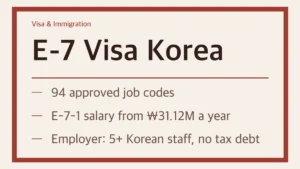 E-7 Visa Korea: 94 Jobs, a ₩31.12M Salary Floor, an Eligible EmployerWho qualifies for Korea's E-7 work visa in 2026: the 94 approved job codes, the degree and experience rules, the…
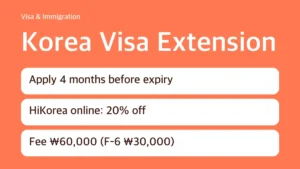 Korea Visa Extension: HiKorea Up to 4 Months Early, Fee ₩60,000When and how to extend your period of stay in Korea: the 4-month window, HiKorea e-Application versus a visit…
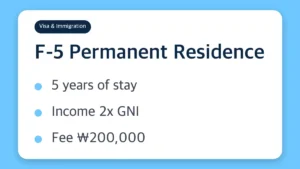 F-5 Permanent Residence Korea Requirements: 5 Years, 2x GNIWhat the general F-5-1 permanent residence visa asks for in 2026: which visas count toward 5 years, the 2x GNI…