
Last updated: October 18, 2026
Do D-2 students need a permit to work part time?
Yes. The law bans paid work outside your study purpose unless the Minister of Justice approves it first. The approval is called a Permission for Activities Outside Status (체류자격 외 활동허가). You get it from your local immigration office, and you must have it before your first shift. Starting while the application is still pending counts as illegal work.
Your university's international office has to confirm you first. The Ministry of Justice manual says a D-2 or D-4 student must have some Korean ability, focus on study, and be confirmed by the school's international student staff.
Show this at your school office: 시간제 취업 확인서 받으러 왔어요.
Who can apply?
- D-2 students with the sub-types D-2-1 to D-2-4, D-2-6, and D-2-7.
- D-4 language students (D-4-1, D-4-7) and visiting students (D-2-8) can apply only after 6 months from the date their status changed, or 6 months from entry if they came on a visa.
- Students whose study period has ended without graduating (for example, short on credits) are generally not eligible. Master's and PhD students writing a thesis after finishing coursework may be allowed, unless the delay is clearly their fault.
- Many schools also ask for a previous-semester GPA of at least 2.0 (C).
How many hours can a D-2 student work?
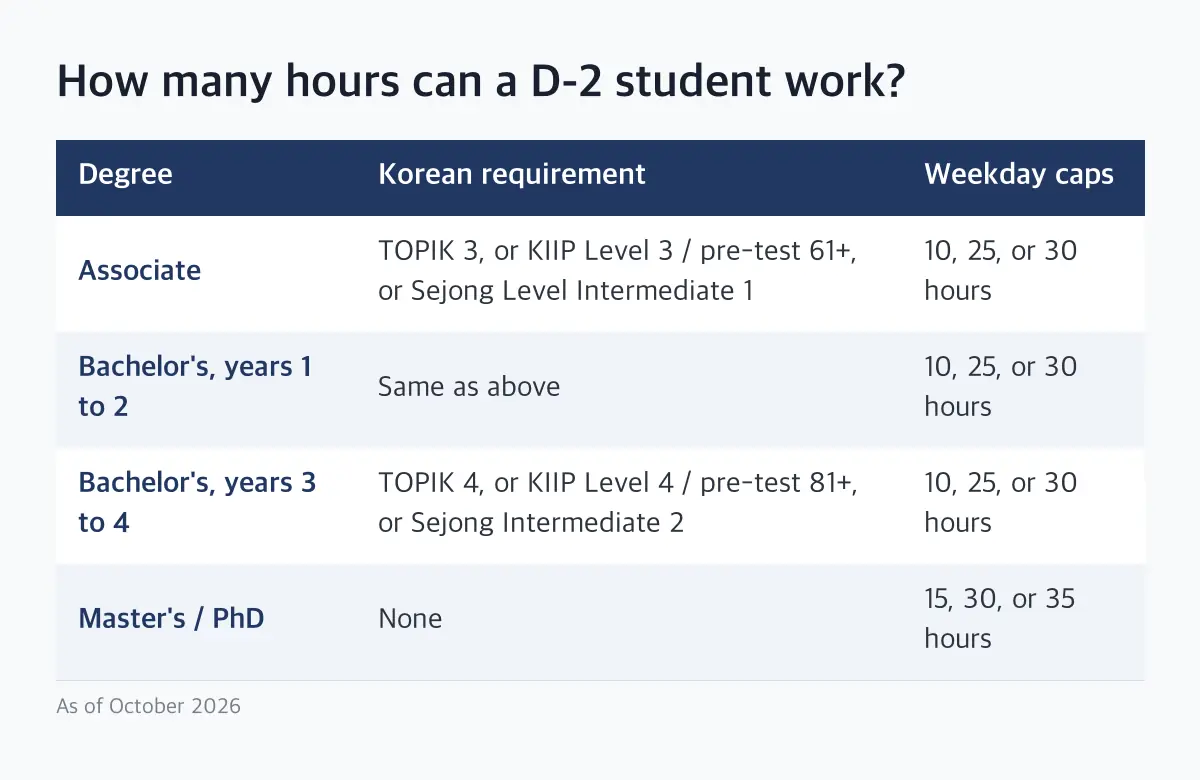
Hour limits depend on your degree level, your Korean level, and whether your school is certified. The Ministry of Justice manual (version dated September 1, 2026, as summarized by the government's Easy Law site) lists these weekday figures:
| Degree | Korean requirement | Weekday caps |
|---|---|---|
| Associate | TOPIK 3, or KIIP Level 3 / pre-test 61+, or Sejong Level Intermediate 1 | 10, 25, or 30 hours |
| Bachelor's, years 1 to 2 | Same as above | 10, 25, or 30 hours |
| Bachelor's, years 3 to 4 | TOPIK 4, or KIIP Level 4 / pre-test 81+, or Sejong Intermediate 2 | 10, 25, or 30 hours |
| Master's / PhD | None | 15, 30, or 35 hours |
Weekends and school vacations have no hour limit under this table. The higher tiers are tied to your school's certification, your grades, and your Korean level, and the manual does not spell out which one you get in plain words. Your international office will tell you your number. Some universities use stricter numbers: one Seoul university lists 20 weekday hours for undergraduates.
If you study in an English-taught program, a language score can replace TOPIK, for example TOEFL iBT 71, IELTS 5.5, or CEFR B2.
Students who have finished all courses and are only writing a thesis, or who were allowed to stay on exceptional terms, are capped at 30 hours a week, and the no-limit rule for weekends and vacations does not apply.
What jobs are allowed and what jobs are banned?
The work must fit what a student normally does, and it should relate to your major or be easy to do alongside classes. Common allowed jobs are restaurant helper, office helper, interpreter or translator, and sales help at a duty-free shop.
Banned or restricted work:
- Jobs that go against public morals, such as entertainment venues
- Professional jobs under E-1 to E-7 visas, for example teaching conversation to minors at a language center (E-2 work)
- Factory work (E-9 jobs) and ship work (E-10), except that students with TOPIK 4 or higher may work in manufacturing
- Delivery and other contract-based work: parcel couriers, delivery riders, designated drivers, insurance planners, door-to-door sales
- Dispatch, subcontract, or broker arrangements
- Jobs far from home or school, which many schools define as about 1 hour of travel
- Employers who were punished before for illegal hiring
Exceptions exist: seasonal work, helper roles at English kids' cafes and camps, and assistant roles or summer internships in E-1 to E-7 fields. Some jobs also require a license. You can check whether a job is open to you on HiKorea under the foreign worker employment lookup.
How do you apply for the permit?
- Find a job and sign a standard labor contract. It must show your wage, duties, and hours.
- Get the Part-Time Work Confirmation Form (시간제 취업 확인서) signed by your employer and then by your school's international office. The combined application form and the confirmation form can be downloaded from HiKorea.
- Gather your documents: passport, Residence Card (ARC), transcript, enrollment certificate, Korean test proof, a copy of the employer's business registration, and the contract. Schools also ask for the employer's ID.
- Apply through HiKorea online or visit your immigration office by appointment.
- Wait for approval. You get a permit sticker in your passport or a printed permit.
The permit lasts up to 1 year within your stay period, and you can hold at most 2 workplaces at the same time. If your workplace changes, you must get approval again. If your ARC is not issued yet, get your Residence Card first.
Show this at the immigration desk: 시간제 취업 허가를 신청하러 왔어요.
What happens if you work without a permit?
Working without the permit can lead to up to 3 years in prison or a fine of up to 30 million won, a recommendation to leave Korea voluntarily, or forced removal. Working outside the approved job, place, or hours counts the same way. Delivery work is a common reason students are caught, and the Ministry of Justice has been running crackdowns. Penalties on the employer are also serious.
Is the rule changing in 2026?
The Ministry of Justice announced a student visa reform plan on October 7, 2026. According to news reports, it would simplify the part-time permit around Korean ability and grades, raise the Korean requirement to KIIP Level 3, and let the school's confirmation form replace extra documents. These are plans, and the Ministry has not published start dates. Keep following the rules above until your school or HiKorea says otherwise.
What should you do after graduation?
If you want to keep working legally after your degree, the usual next step is a job-seeking visa. See the D-10 visa rules, and read how a change of status works if you plan to move to a work visa such as the E-7 visa.
Sources
- Easy Law: Part-time work for international students (Korea Ministry of Government Legislation)
- HiKorea: Permission for activities outside status
- Sungshin Women's University: Notice on part-time employment (updated June 2026)
- Newspim: Ministry of Justice student visa reform (October 7, 2026, Korean)
This guide is general information, not legal advice. Rules change, so confirm with HiKorea or the 1345 Immigration Contact Center before you apply.
Related guides
 D-10 Visa Korea: Score 60 of 190 Points, Stay Up to 3 YearsWho qualifies for the D-10 job seeker visa, how the 190-point test works, how long each score lets you stay, the…
 Change Visa Status in Korea: Get Permission First (HiKorea, ₩100,000 Fee)Who can switch status of stay inside Korea and who must leave first, the common switches (D-2 to D-10 or E-7,…
 KIIP Program Korea: ₩100,000 per Level, and Level 5 Counts for F-5What Korea's Immigration and Integration Program (KIIP) is, how the six levels and the pre-assessment work, what…