
After you land, a designated hospital does the E-2 medical check, and you hand it in when you register for your Residence Card within 90 days.
Your employer files most of the paperwork. Your part is getting the degree and the background check authenticated at home, which is usually the slowest step.
Last updated: October 23, 2026
What the E-2 visa covers
E-2 is the conversation instructor status (회화지도). It lets you teach people how to communicate in a foreign language at:
- Foreign language academies (hagwons, 외국어학원), including online academies
- Elementary schools and above, and their language institutes
- Language training centers run by broadcasters and companies
- Some lifelong education facilities, government-run education facilities, and job training institutes
- Companies and public institutions with a classroom and language equipment for their own staff
The rule is about conversation. Teaching literature, a specific language subject, or translation techniques in a foreign language is not conversation teaching under the HiKorea manual, so it does not fit E-2.
E-2 is not only for English. Chinese, Japanese and other languages also qualify, with slightly different rules.
Who qualifies: nationality and degree
The September 2026 HiKorea manuals list several groups. Find the row that matches your job.
| Your situation | Nationality rule | Education rule |
|---|---|---|
| Hagwon, university, or company instructor | Citizen of a country where the language you teach is the native language | Bachelor's degree or higher from a college in that country |
| EPIK public school English teacher | Citizen of 1 of 7 English-native countries | Bachelor's degree or higher from a college in your home country |
| English assistant teacher under the Korea-India CEPA | Indian citizen | Bachelor's degree plus a teacher's certificate with an English major |
| TaLK scholar (after-school English) | Citizen of an English-native country | At least 2 years of college (1 year for UK universities), or a junior college degree |
| CPIK Chinese assistant teacher | Chinese citizen | Bachelor's degree plus a teaching certificate for Chinese as a foreign language |
| Spouse of an E-1 to E-7 worker or a STEM master's or PhD student | Any country | Bachelor's degree plus a TESOL certificate |
The manual names the 7 English-native countries as the United States, United Kingdom, Canada, South Africa, New Zealand, Australia and Ireland. If your passport is from another country, you cannot get E-2 to teach English, unless you fall under the India CEPA or spouse rows above.
Three details that trip people up:
- The degree must come from the native-language country. A US citizen with a degree from a German university does not meet the basic rule. There is one exception: if you finished high school or junior college in the native-language country and then earned a bachelor's degree at a Korean university, that counts.
- Other languages have an extra route. For languages other than English, Chinese and Japanese, a citizen of a country that uses the language as an official language can qualify with a recognized teaching license or a related bachelor's degree. The salary must be at least 80% of the previous year's per-capita GNI, or the minimum wage at a non-profit such as an embassy cultural center.
- The spouse route (since July 3, 2017) excludes spouses of E-6-2 hotel and entertainment workers.
The 2026 E-2 chapters do not set an age limit. Employers may have their own hiring preferences, but those are not immigration rules.
The documents your employer files in Korea
Most hagwon and university teachers get E-2-1 through a Certificate for Confirmation of Visa Issuance (사증발급인정서, often called the CCVI). Your employer applies for it at a Korean immigration office. You then take it to a Korean embassy or consulate.
| Document | Rule from the 2026 visa manual |
|---|---|
| Application form (Form 21), passport, 1 standard photo | Basic set |
| Degree proof, authenticated | One of: degree copy, degree certificate, or graduation certificate showing the degree |
| Criminal record check from your government, authenticated | Must cover your whole country and be issued within 6 months of filing |
| Third-country criminal record check | Only if your degree is from a country other than your own (since January 1, 2020) |
| Self health declaration | The form revised on May 15, 2018 |
| Employment contract | Pay must be at least the current minimum wage |
| School or academy registration papers | Provided by your employer |
| Other review papers | For example, an instructor plan and student and staff numbers |
"Authenticated" means an apostille if your country is in the Apostille Convention, or consular confirmation at a Korean mission if it is not. A degree from a Korean university needs no authentication. If immigration already has your authenticated degree from an earlier E-2, you do not submit it again.
There is also a rule for returning teachers. If you leave Korea and reapply within 3 months, you can skip a new criminal record check. If you stay abroad longer than 3 months before you come back, you submit a new one when you register for your Residence Card.
If an agent or recruiter files for you, the employer adds a power of attorney, the agent's employment certificate and ID.
Which criminal record check each country uses
The manual gives these as examples:
| Country | Accepted check (examples) |
|---|---|
| United States | FBI Identity History Summary, including through an FBI-approved channeler; a state check only if it covers the whole US |
| Canada | RCMP National Repository of Criminal Records check |
| United Kingdom | Basic Disclosure, Disclosure Scotland, Access Northern Ireland, ACRO certificate |
| Australia | AFP National Police Certificate |
| South Africa | SAPS Police Clearance Certificate |
| Ireland | Police certificate from the national police (Garda) |
| New Zealand | Criminal record from the Ministry of Justice |
A criminal record is, in principle, grounds for refusal. The manual explains that E-2 teachers mostly teach young people, which is why the check is strict.
Public school teachers: EPIK, TaLK and CPIK
If a provincial office of education hires you through EPIK, TaLK or CPIK, you get E-2-2 directly from a Korean embassy or consulate, with no CCVI. You bring:
- Visa application form (Form 17), passport, 1 photo and the fee
- Your EPIK or CPIK acceptance letter, or your TaLK invitation
- Your employment contract with the office of education
You usually do not submit the degree and criminal record papers to immigration, because the National Institute for International Education or the office of education has already checked them. You can apply at any Korean mission abroad, except that Chinese assistant teachers apply only at missions in China. The manual adds that US citizens get a multiple-entry visa on this route.
One catch: a teacher an office of education hires on its own, outside EPIK, CPIK and TaLK, goes through the CCVI route for E-2-1 instead.
How long you can stay
One grant of E-2 stay is capped at 2 years. Immigration sets it as your contract period plus 1 month, up to that cap. A 12-month contract gives you about 13 months.
For special programs, the manual sets the working period at 1 year for India CEPA teachers and up to 2 years for TaLK and CPIK.
Step by step: from contract to Residence Card
- Sign your contract and get your authenticated degree and criminal record check ready.
- Your employer applies for the CCVI in Korea with your documents.
- You apply for the visa at a Korean embassy or consulate. The visa fee is paid in US dollars and the amount depends on your nationality, so check with your consulate.
- Fly to Korea and start work at the employer named on your visa.
- Get the E-2 medical check at a designated hospital (see below).
- Register for your Residence Card within 90 days of entry. Book a visit on HiKorea first.
For the Residence Card (외국인등록증), the E-2 list is: application form, passport, 1 photo, the fee, your employer's business registration certificate, the sealed medical check and proof of where you live. The card fee is ₩35,000.
Show this: 회화지도(E-2) 외국인등록 하러 왔어요. 채용신체검사서는 봉투째 가져왔어요.
The E-2 medical check after you arrive
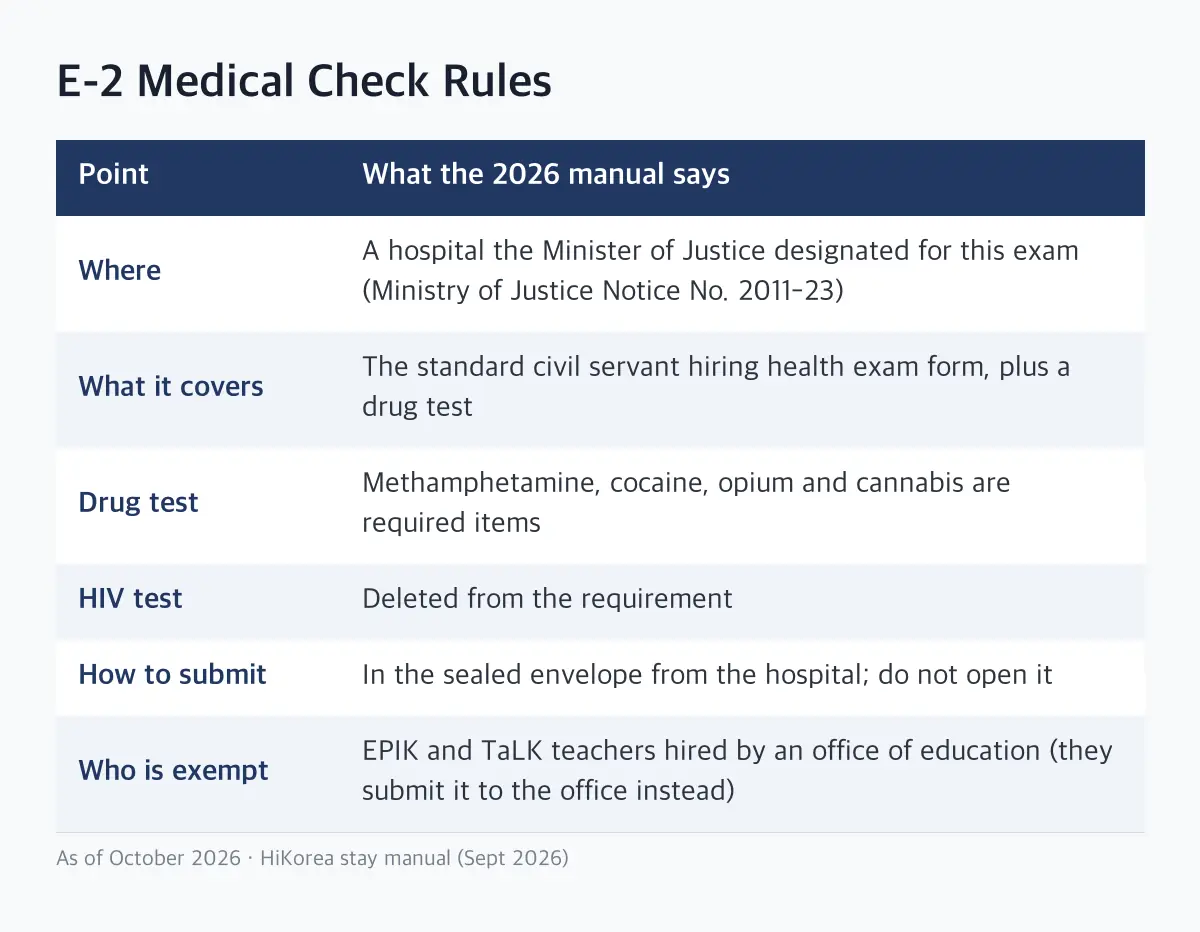
The E-2 medical check is the employment health exam (채용신체검사서). It is different from the TB certificate some nationalities need. The manual sets these rules:
| Point | What the 2026 manual says |
|---|---|
| Where | A hospital the Minister of Justice designated for this exam (Ministry of Justice Notice No. 2011-23) |
| What it covers | The standard civil servant hiring health exam form, plus a drug test |
| Drug test | Methamphetamine, cocaine, opium and cannabis are required items |
| HIV test | Deleted from the requirement |
| How to submit | In the sealed envelope from the hospital; do not open it |
| Who is exempt | EPIK and TaLK teachers hired by an office of education (they submit it to the office instead) |
A clinic that is not on the designated list cannot issue a valid certificate, so ask your employer or the 1345 Immigration Contact Center which hospital to use near you. The manual does not publish a set price for the exam.
You also need the medical check when you change into E-2 status inside Korea. People who already submitted the degree, criminal record and medical papers on an earlier E-2 and stayed on, for example on D-10, can skip them.
If your passport is from a country on Korea's TB high-risk list, such as South Africa, India or China, you may also need a TB certificate.
Switching to E-2 inside Korea
You do not always have to leave Korea to start teaching. The 2026 stay manual allows a change of status to E-2 for:
- Registered foreigners who meet the E-2 rules (including A-1 to A-3)
- Anyone hired by an office of education as an elementary, middle or high school English teacher, whatever their current status
- D-2 students about to graduate and D-10 job seekers, if they meet the E-2 rules and sign a contract
The documents mirror the CCVI list: contract, business registration, authenticated degree, criminal record checks issued within 6 months, and the sealed medical check. A contract below the minimum wage is, in principle, refused. The change of status fee is ₩100,000.
Extension: what to bring
To stay with the same employer past your current period, apply for an extension before your stay expires. The manual lists:
- Application form, passport, Residence Card and the fee
- Employment contract, original and copy
- Business registration certificate
- Academy registration certificate, if your employer is a hagwon
- For lifelong education facilities and companies: student lists, timetables and payroll tax records
- Any missing degree or criminal record papers, if immigration asks
- Certificate of income amount (소득금액증명)
- Proof of where you live, such as a lease or dormitory receipt
- Your class timetable
EPIK and other education office teachers do not need to resubmit the criminal record, degree check or medical check. The extension fee is ₩60,000. If your pay was reported as business income instead of wage income, the manual tells the employer and you to file a correction.
Changing or adding an employer
For E-2 teachers, a workplace change or an added workplace is a report, not a permission. You file it within 15 days of the change at your local immigration office, and the manual asks for an in-person visit because immigration puts a sticker or stamp in your passport.
You can use the report if:
- You finished your contract, or your employer closed or suspended business
- You were fired or quit for your own fault, but your original employer agrees to the move
- Your current employer agrees to a second contract with another employer
- Your employer sends you to teach elsewhere for extra pay, within 1/3 of your monthly teaching hours
Bring the application form, passport, Residence Card, new contract, business registration, the original employer's consent and the new school's registration papers. The consent letter is not needed if you worked until the contract end date. If the old employer closed or did not pay wages, proof or a written explanation can replace it.
If your remaining stay is shorter than the new contract plus 1 month, you apply for an extension at the same time. Teaching anywhere outside your reported workplaces, such as private lessons, is not covered by E-2.
E-2 fees in Korea
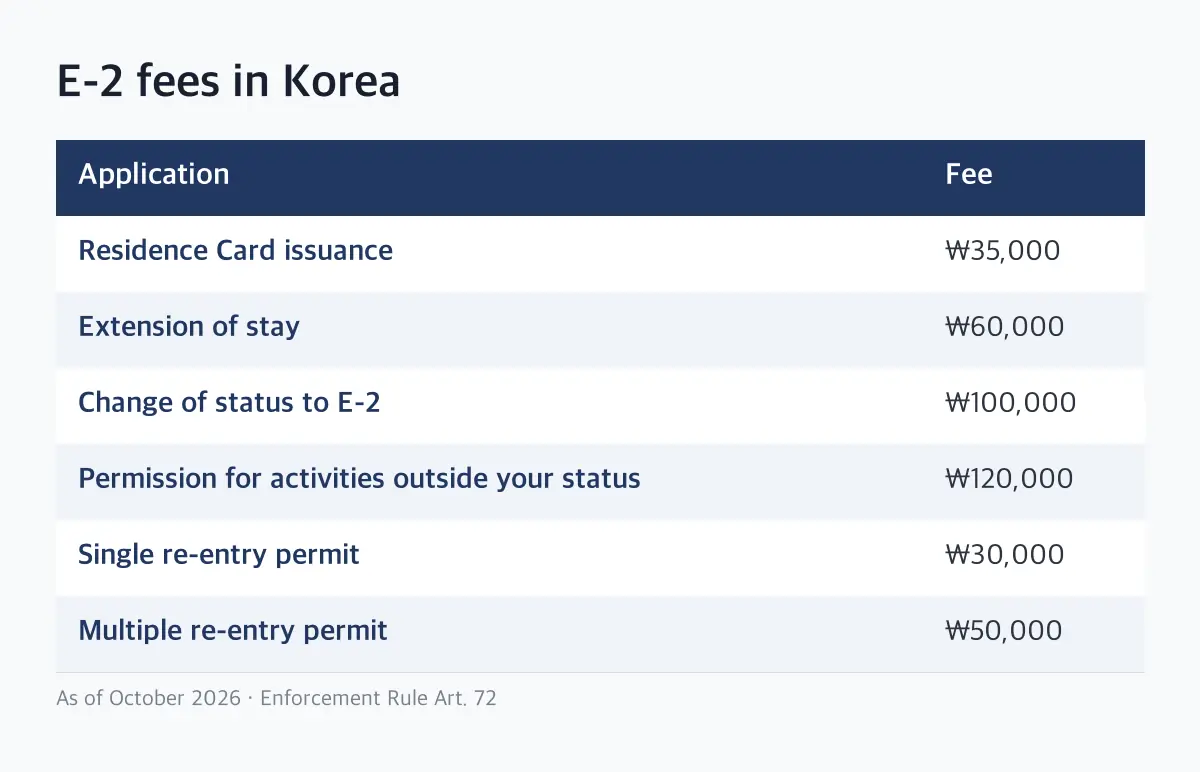
These fees come from Article 72 of the Enforcement Rule of the Immigration Control Act (effective September 15, 2026).
| Application | Fee |
|---|---|
| Residence Card issuance | ₩35,000 |
| Extension of stay | ₩60,000 |
| Change of status to E-2 | ₩100,000 |
| Permission for activities outside your status | ₩120,000 |
| Single re-entry permit | ₩30,000 |
| Multiple re-entry permit | ₩50,000 |
You do not need a re-entry permit if you are registered and come back within 1 year of leaving, or before your stay expires if less than a year is left.
FAQ
Can I get an E-2 visa without a degree?
Not for hagwon, university or EPIK jobs. They need a bachelor's degree. The only lower bar is TaLK, which accepts at least 2 years of college (1 year for UK universities) or a junior college degree.
Is there an E-2 visa age limit in Korea?
The 2026 E-2 chapters of the HiKorea manuals do not set one. Age limits you see in job ads are employer choices.
Can I teach private lessons on an E-2 visa?
No. E-2 covers the workplaces you have reported to immigration. Extra teaching elsewhere needs a reported added workplace with your employer's agreement.
Sources
- HiKorea: integrated guide manuals by status of stay, September 2026 (Korean)
- Enforcement Rule of the Immigration Control Act, Article 72: fees (Korean)
- Ministry of Justice: Residence Card guide (Korean)
- Gov.kr: foreigner registration (Korean)
This guide is general information, not legal advice. Rules change, so confirm with HiKorea or the 1345 Immigration Contact Center before you apply.
Related guides
 How to Get ARC in Korea (Residence Card): Book Within 90 Days, Pay ₩35,000Staying in Korea longer than 90 days? You need a Residence Card, still called an ARC. Here are the documents, the…
 TB Test for Korea Visa: 35 Countries, ₩2,000 at a Health CenterIf you hold a passport from one of 35 high-TB-risk countries, Korean immigration may ask for a TB certificate. Here…
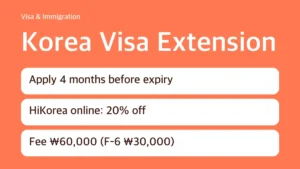 Korea Visa Extension: HiKorea Up to 4 Months Early, Fee ₩60,000When and how to extend your period of stay in Korea: the 4-month window, HiKorea e-Application versus a visit…