
Last updated: October 21, 2026
This guide follows the HiKorea stay and visa manuals published in September 2026 and the fee pages of three Seoul-area public health centers. It covers the TB certificate for Korean immigration, not the TB test for a UK visa (more on that at the end).
Who Needs a TB Certificate for Korean Immigration
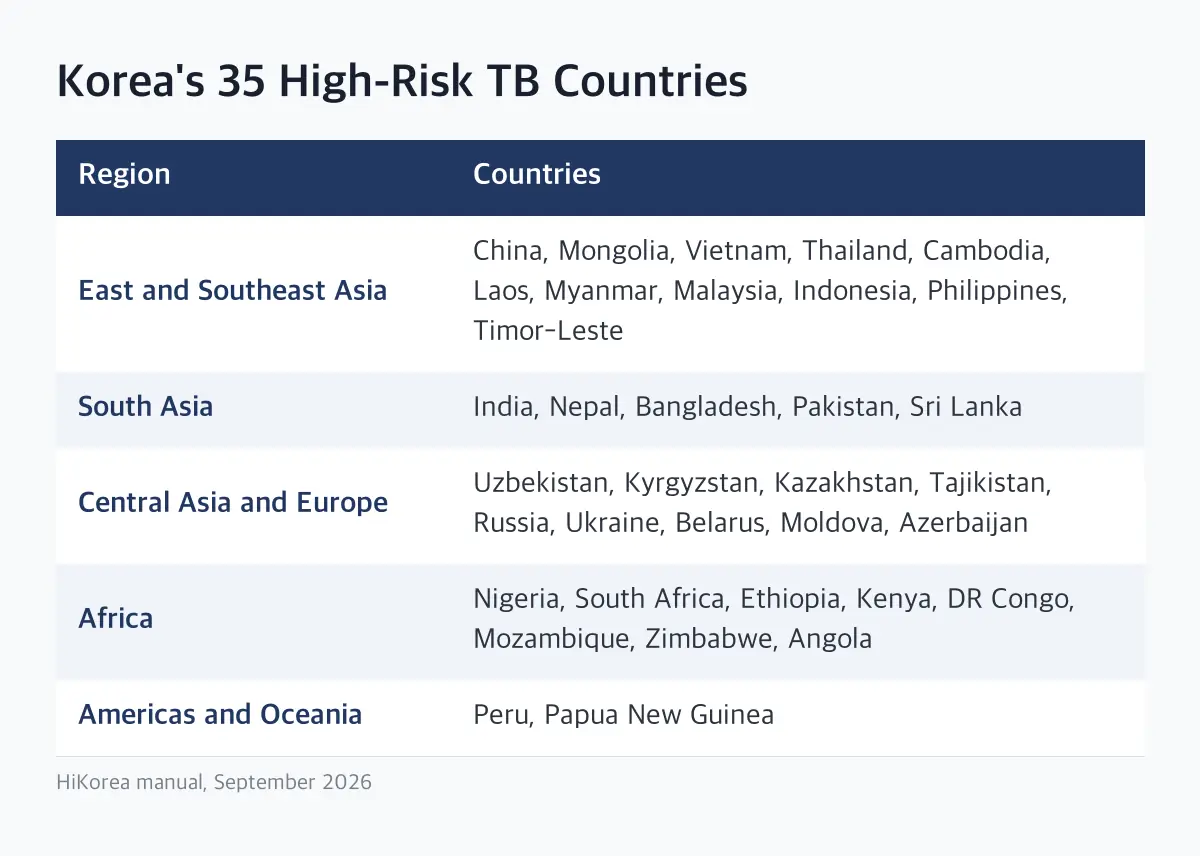
The rule only applies to nationals of the 35 countries listed below. Within that group, the HiKorea manual names three moments when you must hand in a TB certificate (결핵진단서).
| When | You need the TB certificate if |
|---|---|
| Visa application abroad | You apply for a visa to stay more than 90 days (any long-term status, even if the planned stay is shorter) |
| Visa application abroad | You apply as a seasonal worker (C-4-1 to C-4-4) or as a caregiver invited by a TB patient in Korea |
| Visa application abroad | You submitted one before, left Korea for good, and now want a new long-term visa |
| Residence Card registration | You entered on an e-visa that would have required the certificate |
| Residence Card registration | You hold a long-term multiple-entry visa and entered more than 6 months after it was issued |
| Stay permit in Korea | You came on a short-term status and now apply to change to a long-term status |
| Stay permit in Korea | You are on a long-term status and have never submitted one since March 2, 2016 |
| Stay permit in Korea | You apply for an extension or change of status and spent 6 months or more in a row in a high-risk country during the past year |
The last row matters most for people already living here. A routine extension does not automatically need a new certificate. You need one again only if you spent a long stretch back in a high-risk country. The manual adds that if your trip was to a country that is not on the list, you do not need to submit one.
The 35 High-Risk Countries
This is the list in the September 2026 HiKorea manual. The same manual labels it as the list in force since April 1, 2020.
| Region | Countries |
|---|---|
| East and Southeast Asia | China, Mongolia, Vietnam, Thailand, Cambodia, Laos, Myanmar, Malaysia, Indonesia, Philippines, Timor-Leste |
| South Asia | India, Nepal, Bangladesh, Pakistan, Sri Lanka |
| Central Asia and Europe | Uzbekistan, Kyrgyzstan, Kazakhstan, Tajikistan, Russia, Ukraine, Belarus, Moldova, Azerbaijan |
| Africa | Nigeria, South Africa, Ethiopia, Kenya, DR Congo, Mozambique, Zimbabwe, Angola |
| Americas and Oceania | Peru, Papua New Guinea |
If your country is not here, the TB certificate rule does not apply to you. Your visa may still need other health papers, such as the medical check for E-2 teachers or for marriage visas.
Who Is Exempt
The HiKorea manual exempts these people even if they are from a listed country:
- Diplomatic (A-1), official (A-2) and agreement (A-3) status holders
- Children under 6 (they submit one at the first stay permit application after turning 6)
- Pregnant women
- People who cannot move because of old age or illness
Where to Get the TB Test in Korea
Most foreigners in Korea get the certificate at the public health center (보건소) of their district. Every gu in Seoul and every city or county elsewhere runs one. The test is a single chest X-ray. Ask for the certificate for immigration, which health centers call the foreigner TB check certificate (외국인 결핵검진확인서).
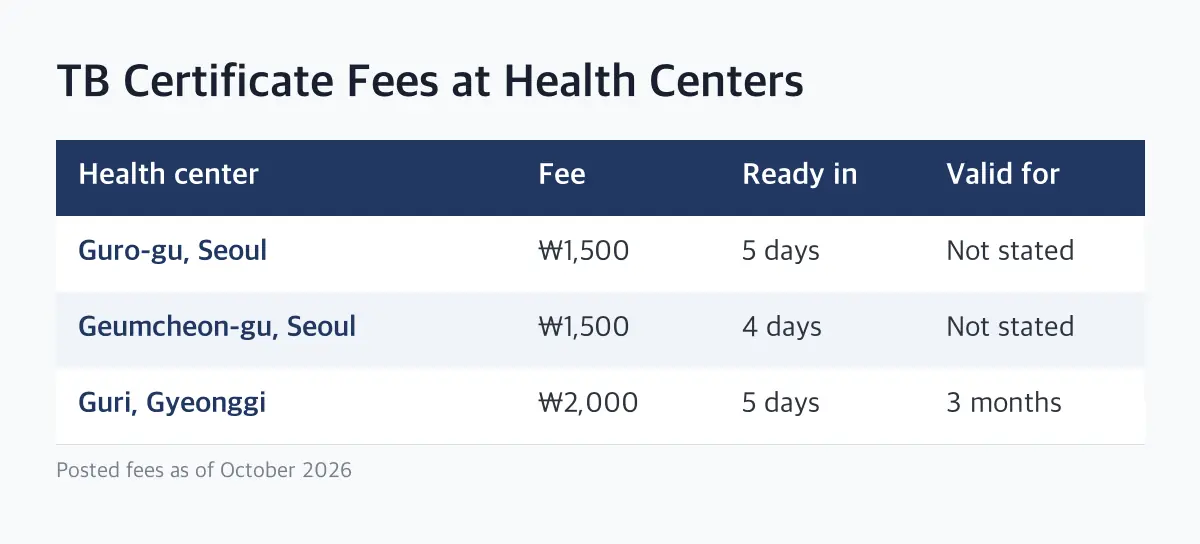
Fees and waiting times are set by each health center, so they differ slightly. These are the posted numbers at three centers:
| Health center | Fee | Ready in | Valid for |
|---|---|---|---|
| Guro-gu, Seoul | ₩1,500 | 5 days | Not stated |
| Geumcheon-gu, Seoul | ₩1,500 | 4 days | Not stated |
| Guri, Gyeonggi | ₩2,000 | 5 days | 3 months |
Guro counts the test day and skips weekends and holidays, Geumcheon skips holidays, and Guri counts the 3 months from the day you apply.
Guri charges ₩500 for a reissue and Geumcheon charges ₩300. Guro warns that if the X-ray looks suspicious, the center runs a sputum test, which can take at least 1 week and up to 2 months.
What about private hospitals? The September 2026 manual does not say which clinics may issue the certificate for a stay permit. Health centers are the standard route because their certificate is made for immigration. If you want to use a hospital, call your immigration office or 1345 first so you do not pay hospital prices for a paper they will not take.
If you apply for a visa from abroad, the test is done in your home country, not in Korea. Ask the Korean embassy or consulate that handles your visa which hospitals it accepts.
What to Bring and How Long It Stays Valid
Bring your passport. If you already have a Residence Card (외국인등록증), bring that too. Geumcheon lists the Residence Card or passport as accepted ID, and Guri asks for a passport. No photo is needed.
TB in Korean is gyeolhaek (결핵), and a chest X-ray is a hyungbu X-ray (흉부 엑스레이). At the counter, you can show this line.
Show this: 출입국 제출용 외국인 결핵검진확인서 받으러 왔어요.
On validity, the HiKorea stay manual says documents issued in Korea are valid for 3 months from the issue date unless a different period is set. Guri health center also lists 3 months for its immigration certificate. Plan your test so your immigration appointment falls inside that window, and do not take it more than a few weeks early.
The manual also says health certificates should go to immigration in the envelope sealed by the issuing medical institution. If the health center hands you a sealed envelope, do not open it.
How It Fits Into Each Application
| Application | When the TB certificate is needed |
|---|---|
| Residence Card (first registration) | Only if you came on an e-visa, or entered 6+ months after a long-term multiple-entry visa was issued |
| Visa extension | Only if you spent 6+ months in a row in a high-risk country in the past year, or never submitted one since 2016 |
| Change of status | Always when moving from short-term to long-term status; otherwise the same two cases as an extension |
The health center fee is separate from the immigration fee for each application. Book your HiKorea appointment first, then go to the health center about a week before, so the certificate is ready and still fresh.
If the Result Is Not Clear
A suspicious X-ray does not end your stay. The center will run more tests, and that is where the 2-month delay can come from. If you are diagnosed with TB, Korea treats it, and the stay manual says immigration asks the health center whether you are following treatment before deciding on an extension. People who deliberately avoid treatment can be refused an extension and ordered to leave. If your appointment date is close, tell immigration early that your test is still in progress.
Not the Same as the UK Visa TB Test
Many people living in Korea search for a TB test because they are applying for a UK visa. That is a different system. The UK only accepts certificates from clinics it has approved. In Korea those are Gangnam Severance Hospital (₩110,450 for ages 11 and up) and Severance Hospital in Sinchon (₩113,000). A Korean health center certificate will not work for the UK.
Sources
- HiKorea: Stay and visa manuals (September 2026), TB certificate section and common rules
- Guro-gu Public Health Center: TB test and certificates
- Geumcheon-gu Public Health Center: Certificate fees
- Geumcheon-gu Public Health Center: Certificate applications
- Guri Public Health Center: Certificates
- GOV.UK: Tuberculosis testing in South Korea (UK visa)
This guide is general information, not legal advice. Rules change, so confirm with HiKorea or the 1345 Immigration Contact Center before you apply.
Related guides
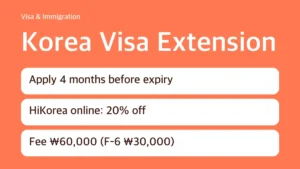 Korea Visa Extension: HiKorea Up to 4 Months Early, Fee ₩60,000When and how to extend your period of stay in Korea: the 4-month window, HiKorea e-Application versus a visit…
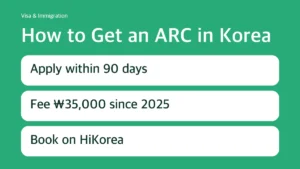 How to Get ARC in Korea (Residence Card): Book Within 90 Days, Pay ₩35,000Staying in Korea longer than 90 days? You need a Residence Card, still called an ARC. Here are the documents, the…
 F-3 Visa Korea: Spouse and Kids Under 19, Apply From AbroadWho can get Korea's F-3 dependent visa, which sponsor visas qualify, the documents a consulate asks for, why…