
Last updated: November 2, 2026
What the D-4 visa covers
D-4 is the general training status. It covers study and training that do not fit the D-2 degree visa. Immigration can grant up to 2 years at a time, but a first language visa is shorter.
| Code | Who it is for |
|---|---|
| D-4-1 | Korean language study at a university institute |
| D-4-2 | General training at agencies, companies and similar groups |
| D-4-3 | Primary, middle and high school students |
| D-4-5 | Korean cooking training |
| D-4-6 | Vocational training at approved private institutions |
| D-4-7 | Foreign language study at a university institute |
Most people searching for this visa mean D-4-1, so the rest of this guide covers that code. Self-funded D-4-3 school students follow separate rules, including a guardian in Korea.
Three groups do not need a D-4-1:
- Courses of 90 days or less: these use the short-term C-3-1 visa.
- Legal residents on another status: any legal resident can take a language course during their stay without a separate permit.
- Working holiday holders: H-1 allows language study, within the limits of each country's agreement.
Who qualifies for D-4-1
You need a high school diploma or higher. The manual sets no Korean level, GPA floor or age limit for a first D-4-1. Students with no Korean start in level 1 at Seoul National University.
The school rules are stricter than the student rules:
- Allowed: a language institute attached to a junior college or university. It must sit under the president's authority and normally be on campus.
- Not allowed: private academies, and lifelong education facilities even when a university runs them. Cyber and distance universities are also out.
- Class schedule: at least 4 days a week and 15 hours a week, held in person between 9:00 and 18:00, with at least 300 hours per half year.
That schedule is why evening programs do not work. Seoul National University, for one, offers D-4 only for its regular program.
Most schools also set a minimum enrollment. Hallym and Ewha require 2 semesters. Seoul National University has D-4 applicants pay for 2 sessions. Dong-A asks for 6 months or longer. Hallym says some nationalities must register for 4 semesters.
How much money you need to show
The manual's rule is in words: 6 months of tuition and living costs. The won figures come from the Justice Ministry's June 23, 2023 release, in force since July 3, 2023.
| Your school | Benchmark | Source |
|---|---|---|
| University in the Seoul area | ₩10 million | Justice Ministry, 2023 |
| University outside the Seoul area | ₩8 million | Justice Ministry, 2023 |
The Ministry's October 7, 2026 paper still lists the matching degree-student pair, ₩20 million and ₩16 million, as current. Many guides still quote USD 10,000, but the rule moved from dollars to won in 2023.
Your school screens funds before it issues your admission papers, so its number comes first. Current school pages differ:
| School | Amount asked |
|---|---|
| Seoul National University | Above ₩10 million |
| Ewha Womans University | At least ₩10 million for 2 semesters |
| Dongseo University, Busan | Over ₩8 million |
| Hallym University, Chuncheon | About USD 9,000 to 10,000 |
| Incheon National University | USD 10,000 |
| Sangmyung University, Cheonan | USD 10,000 or more |
| Dong-A University, Busan | Over USD 18,000 |
Korean embassies can add their own funds test on top of this. When the numbers disagree, prepare for the highest one that applies to you: your school's, your embassy's or the Ministry's.
Rules for the bank certificate
The student section of the visa manual, updated October 19, 2026, sets these conditions. That section covers D-2 and language students alike.
- Issuer: a bank in Korea or abroad
- Whose account: yours or a parent's. A sibling's counts only if your parents have died
- Age: issued within 30 days before you apply
- After the visa: keep the balance for your whole permitted stay
- Last-minute deposits: immigration can check your balance again later
Ewha adds that a transaction history cannot replace a balance certificate, and that the original needs a handwritten signature or bank stamp.
Some nationalities face extra rules:
| Nationality | Extra rule | Source |
|---|---|---|
| Vietnam | Separate study-expenses certificate with a withdrawal hold | Visa manual |
| Vietnam | 3-month balance, or a study deposit confirmation | Seoul National University |
| China | Deposit blocked for more than 6 months | Seoul National University |
| Uzbekistan | Issued by a Korean bank's branch in Uzbekistan, balance held 3 months | Seoul National University, Ewha |
| Thailand | Consistent balance for the past 3 months | Ewha |
Documents for your application
Embassies can add or remove items, so your embassy's checklist is the final word.
| Document | Notes |
|---|---|
| Application form, passport, photo, fee | Photo taken within 6 months |
| School's business registration copy | From your institute |
| Certificate of Admission (표준입학허가서) | Signed by the university president or dean |
| Proof of last education | Apostille or consular confirmation is required, as for D-2 |
| Proof of funds | Bank certificate, passbook, scholarship certificate or transaction records |
| Family relationship document | Only with a parent's bank certificate |
| Training plan (연수계획서) | Class timetable, instructor list and facilities |
| TB certificate | Only for nationals of the 35 high-risk countries |
Applicants educated in China use a CHSI or CDGDC verification report instead of an apostille.
Schools often ask for more at the admission stage. Sangmyung, Dong-A and Incheon National want a parent's or sponsor's employment and income papers. Seoul National University wants a statement of purpose and a resume.
How to apply: embassy visa or CCVI
The steps run in this order:
- Apply to the institute and get accepted.
- Pay tuition. The school then issues your Certificate of Admission and registers it in FIMS, the Justice Ministry's foreign student system.
- Get your bank certificate last, so it stays within 30 days.
- Apply at the Korean embassy or consulate for your country of residence or last school.
- Enter Korea on the single-entry visa.
Some applicants need one more step first. A CCVI (사증발급인정서) is a confirmation number issued in Korea, filed at the immigration office near the school. You take that number to the embassy.
Your route depends on your school type and passport. This follows the manual's chart:
| School type | Your passport | Embassy visa | CCVI |
|---|---|---|---|
| Top accredited | Any | Yes | Yes |
| Accredited | Any | Yes | No |
| General or stricter screening | Most countries | Yes | No |
| General or stricter screening | China, Vietnam, Mongolia, Uzbekistan | No | Yes |
| Visa precision review | Any | No route listed | No route listed |
Passport holders from Cuba, Syria, Macedonia and Kosovo must use a CCVI at every school. E-visas are not available for D-4-1. In February 2026 the government named 16 universities for precision review, so confirm your school's status before you pay.
Seoul National University and Sangmyung both say a D-4 visa takes about one month. Incheon National allows 4 to 5 weeks just for the visa code.
D-4 visa cost
| Item | Cost |
|---|---|
| Single-entry visa over 90 days | About USD 60 |
| Residence Card | ₩35,000 |
| Extension of stay | ₩60,000 |
| Change of status to D-4 | ₩100,000 |
| Part-time work permit | Free |
| Institute application fee | ₩100,000 at Seoul National University and Ewha |
| Tuition per term | ₩1,800,000 at Ewha, ₩1,270,000 at Sangmyung Cheonan |
Embassy fees change by passport, and our D-2 guide lists the main rates. Korean fees are review fees, so you do not get them back after a refusal. Ewha's tuition rises to ₩1,850,000 from winter 2026, and books cost extra.
Two terms at Ewha come to ₩3,600,000, a little over a third of the ₩10 million benchmark. The rest covers living costs, which the rule also asks you to show.
After you land
You must get a Residence Card (외국인등록증) within 90 days of arrival. Skipping it can mean a fine or removal. Sungshin's institute files for new students as a group each term. Otherwise, bring these to the immigration office:
- Application, passport, one photo and ₩35,000
- Enrollment certificate
- Proof of where you live, such as a lease or dormitory confirmation
Seoul National University says D-4 students join National Health Insurance automatically after 6 months in Korea. Until then, its students are covered by the school's group insurance. Once registered, you do not need a re-entry permit for trips under 1 year, within your stay.
How long you can stay on a D-4 visa
A first visa gives up to 6 months. You then extend inside Korea, and each grant can run up to 2 years under the manual. Sungshin tells language students they can stay on D-4 for up to 2 years.
The manual lists these extension documents:
- Application, passport, Residence Card and fee
- Enrollment certificate, plus grades or attendance records
- Course schedule or training plan
- Proof of where you live
- Proof of funds
The funds line catches people out: only money in your own Korean bank account counts. A parent's foreign account works for the first visa, but not here. Some school checklists leave this item off, so follow the October 30, 2026 manual. It names no separate amount, so base yours on tuition and living costs for the period you are requesting.
Show this: 체류기간 연장용 잔고증명서 발급해 주세요.
The manual sets no attendance percentage for D-4-1 extensions. Sungshin and Sangmyung both use 80%, so treat that as your floor.
Two more limits apply:
- Taking a break: a leave of absence for personal reasons blocks an extension, apart from illness or accident.
- Changing institutes: the rule is to leave Korea and get a new visa. The exceptions are a closed institute, or TOPIK 3 or KIIP stage 3 with a valid reason, and only to a general university or above.
Family cannot normally join you. F-3 dependent visas are limited for language students, except on humanitarian grounds.
Can you work on a D-4 visa?
Yes, but not at first, and not without a permit. These are the conditions:
| Condition | Rule | Source |
|---|---|---|
| Waiting period | 6 months from entry or status change | Stay manual |
| Attendance | 90% average across completed terms | Stay manual |
| Korean level | TOPIK 2 or higher | Sungshin, Hallym |
| Weekly hours | 20 hours | Stay manual form, Sungshin |
| Below the Korean level | 10 hours | Sungshin |
| Workplaces | 1 place at a time | Stay manual |
| Permit length | Up to 6 months within your stay | Stay manual |
Sungshin counts the 20 hours across weekends, holidays and vacations, and it adds 5 weekday hours at a certified university. That is tighter than the D-2 table, which has no limit on weekends or vacations. Schools read this differently: Hallym lists 10 weekday hours and 20 on weekends and holidays. Your school's confirmation form sets your number.
You need that form from the school's international student office before you apply. The other steps and banned jobs, such as delivery riding, follow the same part-time rules for students as D-2. A new employer needs a new permit first.
A minor first offense for working without a permit ends in a fine notice, and you can stay. A second means removal from Korea. Illegal construction work means an order to leave on the first catch. Breaking your permit's conditions draws a warning, then a ban on part-time work, then loss of your status.
Switching to D-4 inside Korea
Registered long-term residents can usually change to D-4 at an immigration office. Short-stay visitors on B or C status are refused as a rule. D-3, E-9, E-10 and most G-1 holders cannot change either.
You file the same papers as the embassy route, plus your Residence Card and the ₩100,000 fee. Nationals of countries listed by the Justice Minister can be asked to explain why they need language study, based on age and similar factors.
Moving from D-4 to a degree
Most students use D-4 as a bridge to a D-2 degree. You change status in Korea with a Certificate of Admission, your language school grades and attendance, and a new bank certificate issued within 30 days.
The bar rises at this step. The benchmark is ₩20 million, or ₩16 million outside the Seoul area, and your school and embassy set the figure at accredited universities. Funds should come from abroad as a rule, though money earned legally on a part-time permit counts.
At stricter screening universities, nationals of 21 listed countries and 5 focus-management countries also need a Korean score. That means TOPIK 2 for associate degrees and TOPIK 4 for bachelor's degrees or higher.
Changes coming to D-4 rules
The Justice Ministry published a reform plan on October 7, 2026. It has not reached the October 30 manual, so treat these as plans:
- Study expense deposit: this now covers some nationalities at non-accredited universities. It would widen to focus-country students without Korean ability, at any school. The Ministry's Q&A says the first half of 2027 in one answer and 2028 in its task list.
- Part-time work: a Korean score becomes required. After a 1-year grace period, you could not work from 2028 without one, such as KIIP stage 3.
- Funds waiver: TOPIK 4 or KIIP stage 4 would waive funds proof at any school.
- Language bar for degrees: the Korean score rule could spread beyond stricter screening schools after a grace period.
Sources
- Visa Manual by Status, October 19, 2026 and Stay Manual, October 30, 2026 (HiKorea notice)
- Ministry of Justice: student visa changes, June 23, 2023 (PDF)
- Ministry of Justice: student visa reform plan and Q&A, October 7, 2026
- Ministry of Justice: accredited university results, February 12, 2026
- Study in Korea: student visas
- Easy to Find Practical Law: foreign student visas
- Easy to Find Practical Law: foreigner registration for students
- Easy to Find Practical Law: part-time work for students
- HiKorea: activities outside your status
- Seoul National University: regular program application
- Seoul National University: D-4 visa
- Ewha Language Center: registration guide
- Dongseo University: how to apply
- Hallym University: D-4 visa
- Hallym University: part-time work guide
- Sungshin Women's University: D-4 visa
- Sungshin Women's University: part-time work
- Dong-A University: D-4 visa
- Incheon National University: D-4 documents
- Sangmyung University Cheonan: admission and visa guide
This guide is general information, not legal advice. Rules change, so confirm with HiKorea or the 1345 Immigration Contact Center before you apply.
Related guides
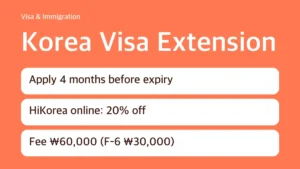 Korea Visa Extension: HiKorea Up to 4 Months Early, Fee ₩60,000When and how to extend your period of stay in Korea: the 4-month window, HiKorea e-Application versus a visit…
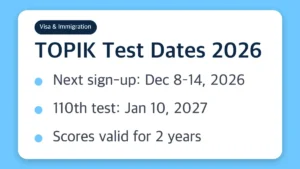 TOPIK Test Dates 2026: Next Sign-Up Dec 8–14 for the Jan 10 TestAll 2026 TOPIK dates in Korea, why every 2026 sign-up has already closed, the next registration window (Dec 8–14 for…
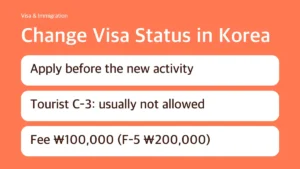 Change Visa Status in Korea: Get Permission First (HiKorea, ₩100,000 Fee)Who can switch status of stay inside Korea and who must leave first, the common switches (D-2 to D-10 or E-7,…