
Last updated: November 4, 2026
Which visas ask for one
The criminal record certificate (범죄경력증명서) shows up in HiKorea's visa manual (October 19, 2026) and stay manual (November 2, 2026) for these statuses:
| Visa | Who submits | How recent |
|---|---|---|
| E-2 conversation teacher | The teacher, through the employer's filing | Issued within 6 months of filing |
| E-7 foreign teachers at schools | Teachers at schools for mostly young students, on E-2 rules | Same as E-2 |
| C-4 English camp teacher | Teachers working 90 days or less at a camp | Apostille or consular confirmation required |
| E-9 and E-10 workers | Every visa applicant | Issued within 3 months of the visa application |
| F-1-D digital nomad | Every applicant | Issued within 6 months |
| F-2-3 spouse of an F-5 holder | Both spouses | —; the F-5 holder skips it if already submitted for F-5 |
| F-2-7 points visa | Applicants changing status in Korea | Overseas documents are valid 3 months from issue |
| F-2-99 long-term residence | Applicants changing status in Korea | Issued within 6 months of filing |
| F-4 overseas Korean | Applicants at a consulate or changing status in Korea | Issued within 6 months |
| F-5 permanent residence | Applicants in Korea, with exemptions below | Issued within 6 months |
| F-6 marriage migrant | The foreign spouse | Issued within 3 months |
| H-1 working holiday | Depends on each country's agreement | Set by reciprocity |
| C-3-8 overseas Korean visit | Applicants aged 14 or older | Issued within 3 months |
The visa manual lists no criminal record certificate for D-2, D-4, D-8 or D-10 applications. A record still counts on other visas: for E-7-4 skilled workers, a drunk-driving, assault or theft record from your time in Korea is grounds to hold back the visa confirmation.
What the certificate must look like
The details vary by visa, but the manuals repeat these rules:
- Your whole country. The certificate must come from an authorized agency of your country and list all criminal history nationwide. Where a country has no working national system, a certificate from the authority for your home area can stand in.
- An apostille or consular confirmation. E-2, C-4, F-1-D, F-2, F-4 and F-5 spell this out. If your country joined the Hague Apostille Convention, you get an apostille (아포스티유) in that country. If it did not, the Korean embassy or consulate there gives a consular confirmation (영사확인). For the full process, see our apostille guide.
- Not from your embassy in Korea. For F-4 and F-5, a record issued by your country's embassy in Seoul is not accepted. The manuals make an exception for Russia and Turkmenistan, whose embassies have legal authority to issue records, and the record still needs authentication.
- Original plus translation. F-4, F-5 and F-1-D applicants hand in the original and a notarized translation that lists the translator's name and contact details, with a copy of the translator's ID. For F-4, if you have no record, you can use a plain translation, a translator's statement and the translator's ID copy instead. The translator cannot be you.
A second check from a third country
Some visas also want a record from a country other than your own:
- E-2: if you earned your degree in another country, you also submit that country's check. This rule has applied since January 1, 2020.
- F-4, F-5 and F-1-D: you add a check from any country where you lived for 1 year or more without a break in the last 5 years.
- F-5 and F-2-7: if you stayed abroad for 6 months or more in a row, you need a record from the country where you stayed.
Who can skip it
The rules are narrow, and you may need to prove that you qualify.
| Exemption | Applies to |
|---|---|
| Under 14 | F-1-D, F-4, F-5 and F-2-99 |
| Born in Korea, or entered before 14, and never abroad for 6 months in a row after turning 14 | F-1-D, F-4, F-5 |
| Submitted a check for the visa and changing status within 3 months of the visa date | F-1-D, F-4, F-5 |
| Submitted a check before and never abroad for 6 months in a row since | F-4, F-5 |
| Your country will not issue one at your age, such as Canadians under 18 | F-1-D, F-4, F-5 |
| Aged 60 or older | F-4, C-3-8 |
| Legal stay of 10 years or more in Korea without a break | F-5 |
| Applying as F-5-5, F-5-9, F-5-11, F-5-12 or F-5-15 | F-5 |
| Left Korea and reapplied within 3 months after an earlier authenticated check | E-2 |
| The Korean spouse is exempt from the international marriage guidance program | F-6 (foreign spouse) |
Two teacher groups also skip it at immigration. EPIK, TaLK and CPIK teachers send their documents to the program instead: the National Institute for International Education or the office of education checks the degree and criminal record before it issues the acceptance.
For E-7 teachers, the school does its own check for teachers who hold a teaching license in their country, were hired at a job fair, or worked 3 years or more as an E-2 or E-7 teacher in Korea in the last 5 years.
Show this: 해외범죄경력증명서 제출 면제 대상인지 확인하고 싶어요.
What a record can mean for your application
For an E-2, a criminal record is, in principle, grounds for refusal. The manual explains that E-2 teachers mostly teach young people.
The F-4 overseas Korean visa and F-5 permanent residence have written thresholds for crimes committed abroad:
| Record abroad | F-4 overseas Korean | F-5 permanent residence |
|---|---|---|
| Specified violent crimes | Visa and status change refused | Fails the good-conduct test |
| Drugs, voice phishing, 3 or more drunk-driving convictions | Refused for 7 years from sentencing | Fails the good-conduct test |
| Threats, extortion or fraud | Counted as other crimes for F-4 | F-5 change refused |
| Other crimes with a sentence at the level of imprisonment | Refused for 5 years from sentencing | Restricted for 10 years from sentencing |
For the working holiday visa, a confirmed fine of ₩3,000,000 or more means refusal. Under reciprocity, nationals of countries that do not ask Koreans for a criminal check skip it and give an interview or statement instead. The manual named Australia, Hong Kong, the Czech Republic and Poland as of 2018. American applicants follow the Korea-US WEST program memorandum.
How to get it in each country
The E-2 manual lists the accepted certificate for each of the 7 English-native countries. The same certificates work for other visas.
| Country | Accepted certificate |
|---|---|
| United States | FBI Identity History Summary, directly or through an FBI-approved channeler |
| Canada | RCMP certified criminal record check (fingerprint-based) |
| United Kingdom | Basic Disclosure, or an ACRO police certificate |
| Australia | AFP National Police Certificate |
| New Zealand | Criminal record from the Ministry of Justice |
| Ireland | Police certificate from the national police (Garda) |
| South Africa | Police Clearance Certificate from the South African Police Service |
United States
Korea's manuals treat the FBI check as the standard. You can request it yourself or through an FBI-approved channeler. A state check is accepted only when it covers records from the whole United States. For questions about your FBI request, the FBI's Identity History Summary unit answers at identity@fbi.gov or 304-625-5590.
An FBI report is a federal document, so its apostille comes from the U.S. Department of State, not your state's Secretary of State.
Canada
Use the RCMP certified check, which needs your fingerprints. Korea does not accept the name-based check because it is weak at confirming who you are.
Canada now issues apostilles. Global Affairs Canada handles federal documents like an RCMP check. Its posted processing time is 25 business days, plus 5–10 business days of mail if you ship from Canada, and it offers no expedited service. You can submit directly, and a third-party service does not make it faster.
United Kingdom
Korea's manual accepts a Basic Disclosure or an ACRO police certificate. A basic DBS check from GOV.UK costs £20, usually takes up to 3 days to process, and arrives as a paper certificate. It is for jobs in England and Wales. Scotland and Northern Ireland have their own routes. You must be 16 or older, and the check shows only convictions that are not spent.
For the apostille, the FCDO Legalisation Office charges £45 per document for a paper apostille, plus courier costs. DBS certificates and ACRO police certificates cannot get an e-Apostille, so plan for postage.
Australia
Apply to the Australian Federal Police for a National Police Certificate. It costs $57, or $114 with fingerprints. Online applications usually arrive as a digital certificate within a few days. Fingerprint checks take 15–30 business days and must go by post.
The AFP releases information based on the purpose you state, and you can only use the certificate for that purpose. Pick the purpose that matches a visa for another country. Australia is a Hague member, so you then get an apostille from the Department of Foreign Affairs and Trade.
New Zealand
Request your own record from the Ministry of Justice online, with your ID and a signed Authority to Release Information form. It is free. The Ministry aims to reply within 20 working days, and about 90% of requests come back in less than a week.
Under the Clean Slate scheme, some old convictions are hidden unless you tick the full record box. Korea asks for all criminal history in your country, so ticking the full record box is the safer choice. Then send the record to the Department of Internal Affairs Apostille service.
Ireland and South Africa
Korea's manual names the Garda police certificate for Ireland and the South African Police Service clearance certificate for South Africa. Both countries are on the manual's list of Apostille Convention members (June 2024), so you get the apostille at home.
Timing your check
The clock usually starts on the issue date, so order the check last among your documents.
- Find your window. E-2, F-4, F-5 and F-1-D need an issue date within 6 months of filing. E-9, E-10, C-3-8 and F-6 need 3 months.
- Add the apostille time. In Canada, the apostille alone can add 25 business days plus mail. In the UK, the paper apostille must go by post.
- Check your names. Your certificate should match the name on your passport. If you have used other names, list them on the application, as the AFP asks you to.
- Keep the original safe. F-4, F-5 and F-1-D applicants hand in the original certificate, so order a spare if you need one for another application.
If you are already in Korea and changing into E-2, your own country's embassy in Korea can give the consular confirmation instead of a Korean mission abroad.
Sources
- HiKorea: Visa Manual by Status (October 19, 2026) and Stay Manual by Status (November 2, 2026)
- EPIK (English Program in Korea)
- FBI: Electronic Departmental Order (Identity History Summary)
- Global Affairs Canada: authentication of documents
- GOV.UK: request a basic DBS check
- GOV.UK: get your document legalised
- Australian Federal Police: National Police Certificate
- New Zealand Ministry of Justice: get your own criminal record
This guide is general information, not legal advice. Rules change, so confirm with HiKorea or the 1345 Immigration Contact Center before you apply.
Related guides
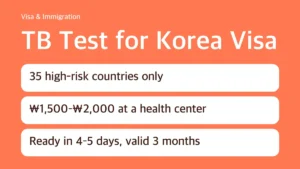 TB Test for Korea Visa: 35 Countries, ₩2,000 at a Health CenterIf you hold a passport from one of 35 high-TB-risk countries, Korean immigration may ask for a TB certificate. Here…
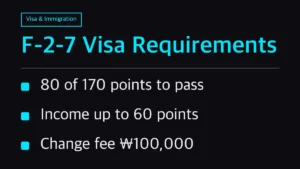 F-2-7 Visa Requirements: Score 80 of 170 Points to QualifyWho can apply for Korea's F-2-7 points-based residence visa, the full points table, three worked score examples, how…
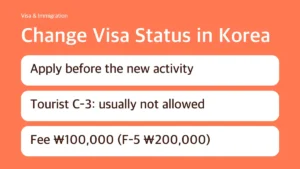 How to Change Visa Status in Korea: Get Permission First, Fee ₩100,000Who can switch status of stay inside Korea and who must leave first, the common switches (D-2 to D-10 or E-7,…